


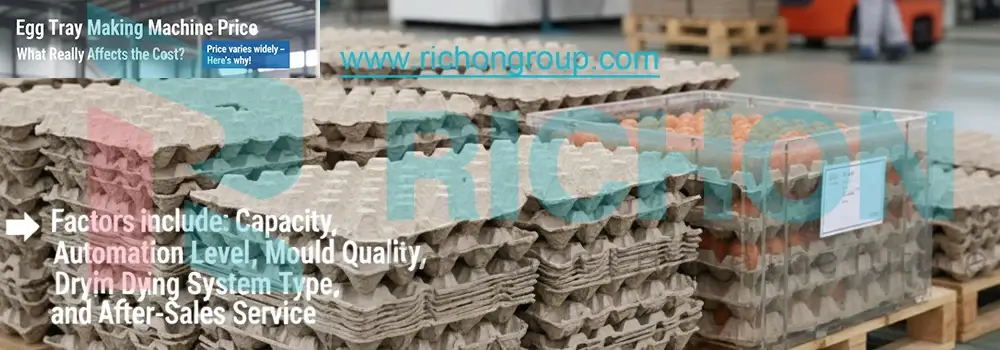
Egg Tray Making Machine Price: A Real Cost Breakdown for New Factories
When searching for an egg tray making machine, many buyers quickly discover that prices vary dramatically — from a few thousand dollars to over six figures.
So what actually determines the real price of an egg tray machine?
This article breaks down all cost factors involved, helping new investors, factory owners, and packaging entrepreneurs understand what they are really paying for — and why.
1.Price Range: How Much Does an Egg Tray Making Machine Cost?
Depending on configuration and capacity, the price of an egg tray making machine typically falls into these ranges:
- Small semi-automatic machines: USD 8,000 – 15,000
- Automatic egg tray production lines: USD 35,000 – 120,000+
- High-output industrial systems: Custom pricing
However, machine price alone does not reflect total investment. To avoid costly mistakes, it’s important to understand what actually drives these numbers.
Looking Beyond Machine Price?
An egg tray making machine is only one part of the full production system. In real manufacturing, layout design, drying configuration, and raw material adaptability determine long-term performance.
To understand how a complete system is engineered for stable output and consistent quality:
Explore a Complete Egg Tray Production Line Design2.Machine Type: Manual vs Automatic Systems
One of the biggest price differences comes from the level of automation.
Manual / Semi-Automatic Machines
- Lower upfront cost
- Higher labor dependency
- Suitable for small-scale or startup factories
Fully Automatic Egg Tray Production Lines
- Higher initial investment
- Lower labor cost per unit
- Stable output & consistent quality
👉 In many regions, factories switching to automation recover the price difference within 12–18 months through labor savings alone.
3.Production Capacity: Output Changes Everything
Machine price increases proportionally with output capacity:
| Capacity (pcs/hour) | Typical Application |
|---|---|
| 1,000 – 2,000 | Small local market |
| 3,000 – 5,000 | Medium factory |
| 6,000 – 8,000+ | Export-oriented plants |
Higher capacity requires:
- Larger forming machines
- More drying layers
- Stronger vacuum & pulp systems
Which directly affects the final cost.
4.Drying System: The Hidden Cost Factor
Drying is often underestimated, but it can account for 30–45% of total line cost.
Common drying options include:
- Natural drying (lowest cost, weather-dependent)
- Metal drying lines (gas, diesel, biomass)
- Brick kiln drying rooms (custom-built, region-specific)
Each option impacts:
- Energy consumption
- Output stability
- Required factory space
5.Mold Quality & Material
Molds directly affect:
- Tray accuracy
- Product lifespan
- Maintenance cost
Typical mold materials:
- Plastic (low cost, short lifespan)
- Aluminum (balanced)
- Stainless steel (high durability)
Higher-quality molds increase upfront price but reduce long-term replacement costs.
6.Raw Materials & Local Conditions
Machine pricing also depends on:
- Waste paper type availability
- Electricity cost
- Labor cost in your region
- Environmental regulations
For example, a factory using mixed waste paper may require a more robust pulping system, increasing total equipment cost.
7.Total Investment vs Machine Price (Important!)
Many buyers focus only on machine price, but real investment includes:
- Machine system
- Drying solution
- Installation & training
- Factory layout planning
- After-sales technical support
👉 This is why two machines with similar output may differ greatly in price.
8.Choosing the Right Egg Tray Production Line
For factories aiming at long-term, stable production, a complete egg tray production line with automatic forming and energy-efficient drying offers better ROI than low-cost standalone machines.
You can view a detailed system configuration here:
👉 Egg Tray Production Line Solution
Final Thoughts: Don’t Buy by Price Alone
The cheapest egg tray making machine is rarely the most economical choice.
Understanding how capacity, automation, drying method, and mold quality affect pricing will help you:
- Avoid underperforming equipment
- Control long-term operating costs
- Build a scalable egg tray manufacturing business
If you’re planning a project, evaluating total production cost — not just machine price — is the smartest first step.
Last updated: February 2026
Need a Capacity Recommendation for Your Market?
Share your target output, local humidity/energy conditions, and tray type. Our engineers will suggest a suitable 3,000–8,000 pcs/h configuration and drying solution.
- Factory layout & utilities checklist
- Drying bottleneck evaluation
- Cost & ROI estimation reference
