


Egg Tray Profit Margin: How Much Can You Really Earn? (Full ROI Analysis)
Starting an egg tray manufacturing business can be highly profitable — but only if you clearly understand the real cost structure, selling price, and operating efficiency behind the project.
Many investors are attracted by the growing demand for sustainable packaging, but they still ask the same practical questions:
- How much profit can an egg tray factory make per day?
- What is the real profit per 1,000 trays?
- How long does it take to recover the equipment investment?
- Which part of the production line has the biggest impact on margin?
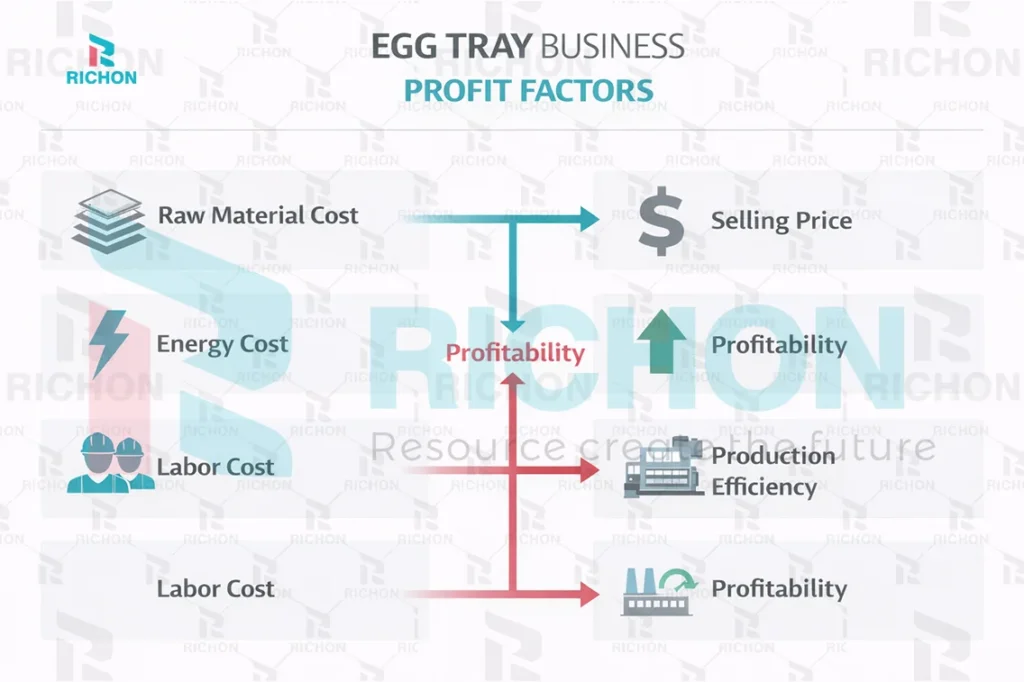
The truth is simple: egg tray profit margin is not determined by machine price alone. It depends on a combination of raw material cost, drying energy consumption, labor efficiency, plant layout, and production stability.
In this guide, we break down the real profit logic behind an egg tray production line, including:
- Profit per 1,000 trays
- Daily and monthly earnings
- Cost breakdown by major operating section
- ROI estimation by production scale
- Ways to improve margin in real factory conditions
For investors, trading companies, and factory planners, this is where business decisions become more realistic.
What Determines Egg Tray Profit Margin?
Profit margin in egg tray production is shaped by five major variables. If one of them is misjudged, the entire ROI calculation can become misleading.
1. Raw material cost
Waste paper is usually the largest or second-largest production cost after drying energy. The local supply of newspapers, cartons, office waste, or mixed recycled paper directly affects your cost per 1,000 trays.
If you want to understand how paper type, pulp ratio, and sourcing strategy affect production economics, read:
Сырье для производства лотков для яиц: виды макулатуры, соотношение целлюлозы и руководство по себестоимости.
2. Energy cost
In most projects, electricity is important, but thermal energy used for drying is often the real cost center. Many first-time buyers underestimate how strongly the drying system influences overall profitability.
For electricity details, see:
Сколько электроэнергии потребляет машина для изготовления лотков для яиц? Руководство по энергопотреблению.
For drying cost details, see:
Egg Tray Drying System Cost: Energy, Fuel & ROI Comparison
3. Labor cost
A line that depends heavily on manual transfer, manual stacking, or unstable drying control usually has lower profit margin than a line with smoother automation and lower labor intensity.
4. Production capacity and utilization
A larger line is not automatically more profitable. What matters is whether the line runs steadily and whether the capacity matches the local market. Oversized capacity with insufficient orders leads to poor utilization and weak returns.
For capacity planning, see:
Как выбрать подходящую линию по производству лотков для яиц с оптимальной производительностью (1000–8000 шт./час)
5. Selling price and market demand
Profit margin also depends on where and how the trays are sold. If the factory supplies poultry farms, fruit packaging users, or local distributors with stable recurring demand, earnings are usually more predictable.
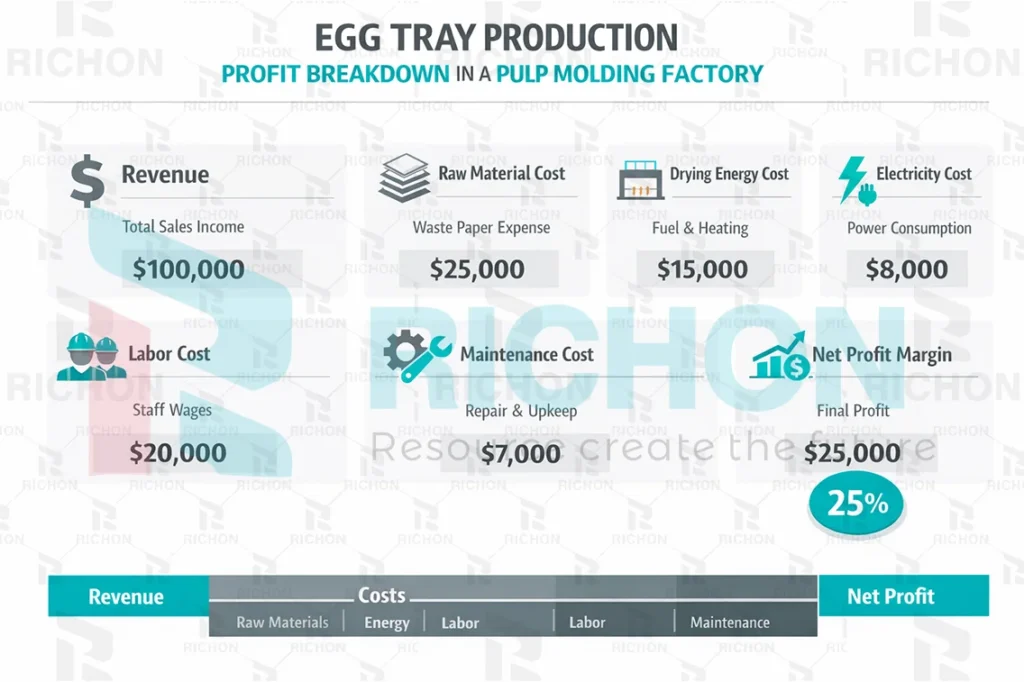
Profit Per 1,000 Egg Trays: A Practical Calculation
To understand real profitability, it is better to start with a simple unit-based calculation.
Below is a typical reference range for standard egg tray production.
Typical cost per 1,000 trays
| Cost Component | Typical Cost per 1,000 Trays |
|---|---|
| Raw material | $12–18 |
| Electricity + drying fuel | $8–15 |
| Труд | $5–10 |
| Maintenance + consumables + others | $3–5 |
Total cost per 1,000 trays
Estimated total: $28–48
Typical selling price per 1,000 trays
Estimated market price: $45–70
Typical gross profit per 1,000 trays
Estimated profit: $10–30
This range shows why some factories perform very well while others struggle. Even when two plants sell similar trays, their margin can be very different depending on paper sourcing, drying fuel choice, and labor control.
A factory using lower-cost local waste paper and a more efficient dryer can achieve much healthier margins than a factory using expensive paper and diesel-heavy drying.
Why Drying Cost Has a Huge Impact on Profit
Among all operating sections, drying usually has the biggest effect on margin. This is why profit analysis should never be separated from drying system selection.
In many real projects:
- Forming depends mainly on electricity
- Drying depends mainly on thermal energy
- Thermal energy often represents the largest operating expense
This is also why buyers comparing only equipment quotations often make the wrong investment decision. A cheaper machine with inefficient drying can reduce long-term profit. A slightly higher initial investment may produce better overall ROI if operating cost is lower.
To understand how fuel type changes long-term returns, read:
Кирпичная или металлическая сушилка: какая лучше подходит для производства яичных лотков?
And for the cost logic behind dryer selection, see:
Egg Tray Drying System Cost: Energy, Fuel & ROI Comparison
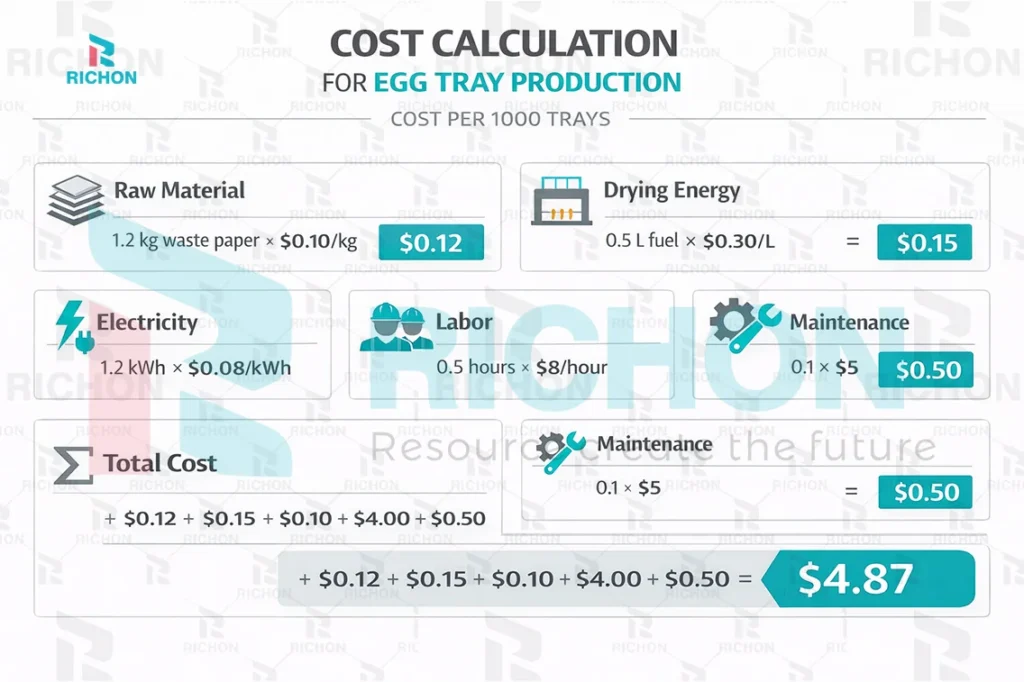
Daily and Monthly Profit Estimation
Unit profit becomes more meaningful when converted into daily and monthly earnings.
Let us use a mid-scale line as an example.
Example: 6,000 pcs/h production line
Предположения:
- Effective running time: 20 hours per day
- Daily output: 120,000 trays
- Profit per 1,000 trays: $15
Daily profit
120,000 trays ÷ 1,000 × $15 = $1,800/day
Monthly profit
Assuming 26 working days per month:
$1,800 × 26 = $46,800/month
If the selling price is stronger or operating cost is better controlled, monthly profit can go higher. If raw material becomes expensive or drying fuel cost rises sharply, profit can fall quickly.
This is why profit margin must always be calculated with local conditions, not copied from generic online estimates.
Different Capacity Levels Mean Different Profit Logic
The same profit formula does not apply equally to every capacity range.
Small capacity lines
Small systems usually require lower initial investment, but their unit production cost is often higher. They are suitable for startups, local supply projects, or customers testing the market.
Medium capacity lines
This is often the most balanced range for investors. Equipment investment, labor requirement, and output are easier to manage. For many markets, this range offers a good balance between risk and return.
Large capacity lines
Large lines can produce lower unit cost when they run steadily, but they also require stronger raw material supply, more stable market demand, and better utility planning.
If you want to compare production scale more clearly, read:
Производственная линия по выпуску лотков для яиц: 3 тыс., 5 тыс., 8 тыс. и 10 тыс. штук: в чем разница?
You can also review equipment investment structure here:
Стоимость автоматов для производства лотков для яиц в 2026 году: подробный анализ затрат и руководство по окупаемости инвестиций.
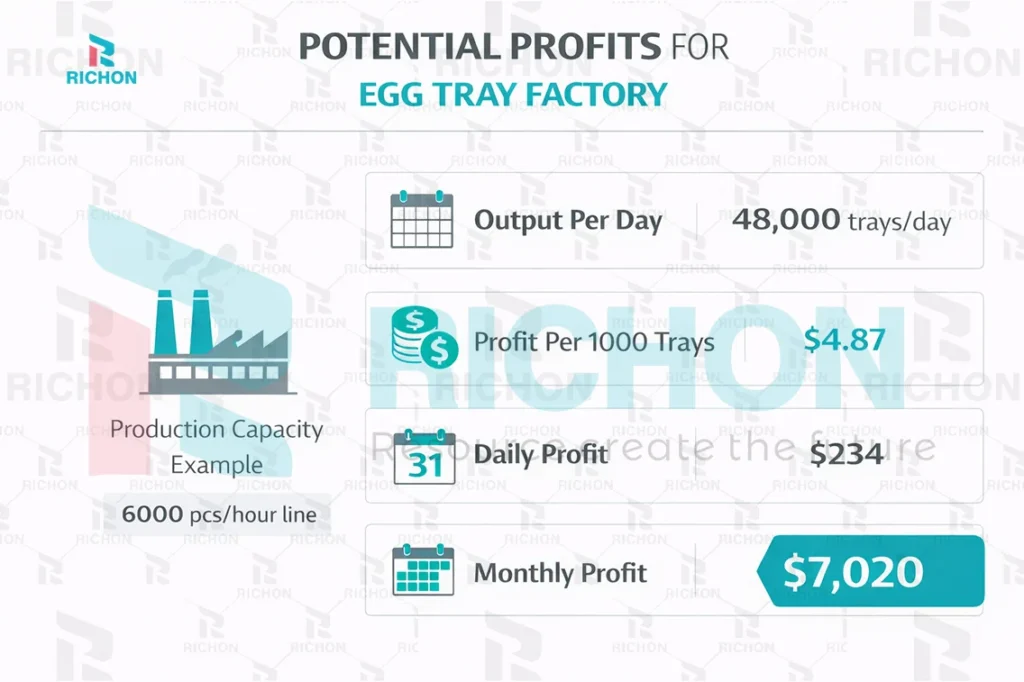
ROI Analysis: How Long Does It Take to Recover the Investment?
Profit margin tells you how much you can earn. ROI tells you how long it takes to recover the capital.
Typical investment ranges may look like this:
| Емкость | Typical Investment Range |
|---|---|
| Small (around 1,000 pcs/h) | $30,000–50,000 |
| Medium (around 3,000–4,000 pcs/h) | $60,000–120,000 |
| Large (6,000+ pcs/h) | $150,000–300,000 |
Typical payback period
| Емкость | Typical Payback Period |
|---|---|
| Small | 6–12 months |
| Середина | 4–8 months |
| Большой | 3–6 months |
These numbers are only reference ranges. In real projects, ROI depends on:
- Waste paper price
- Fuel and electricity price
- Tray selling price
- Capacity utilization
- Plant layout efficiency
- Maintenance downtime
A well-matched system with stable orders can recover investment much faster than a larger but poorly planned project.
For factory planning factors that influence production stability and cost, read:
Сколько места необходимо для фабрики по производству лотков для яиц? Схема размещения.
High-Profit Scenario vs Low-Profit Scenario
The difference between a healthy project and a weak project is often not dramatic on paper, but very obvious in operation.
High-profit scenario
A profitable egg tray project usually has:
- Stable waste paper sourcing
- Lower-cost or suitable drying fuel
- Smooth forming and drying coordination
- Reasonable labor arrangement
- Good tray quality and low rejection rate
- Market demand that can absorb the output
Low-profit scenario
A weak-margin project often has:
- High raw material cost
- Expensive fuel such as diesel in a poor price environment
- Oversized capacity for the local market
- Frequent downtime
- Poor drying efficiency
- Weak process stability and product inconsistency
This is why profitability should not be viewed as only a finance issue. It is also an engineering issue.
To better understand how production stability is built from the process side, read:
Процесс производства лотков для яиц: пошаговое руководство по изготовлению.
And for quality-related production factors, see:
Ключевые особенности технологического процесса производства лотков для яиц, влияющие на качество продукции.
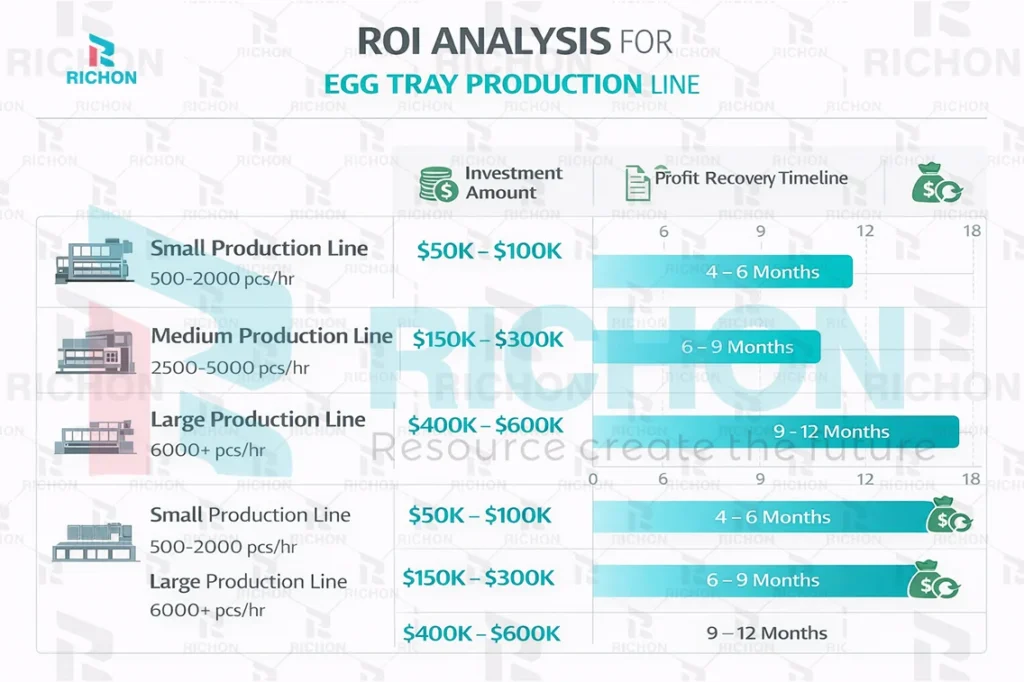
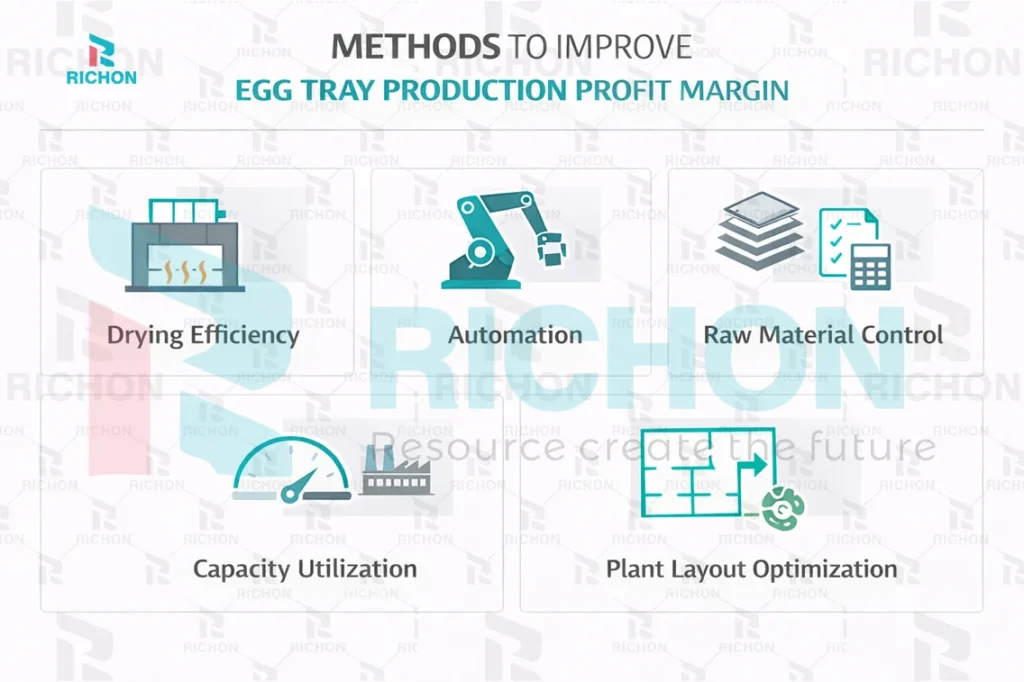
How to Increase Egg Tray Profit Margin
Improving margin is not only about selling at a higher price. In many cases, the more reliable method is to reduce avoidable cost and improve production efficiency.
Optimize drying efficiency
Drying often determines whether the factory operates with a healthy margin. Better insulation, better fuel matching, and better dryer selection can change the economics of the whole line.
Improve capacity utilization
A line running at stable output usually performs better than a higher-capacity line running intermittently. Matching equipment to real demand is more important than choosing the biggest model.
Control water and electricity use
Although drying is the biggest cost driver, water and electricity still affect operating efficiency and system balance.
For water planning, read:
How Much Water Is Needed for Egg Tray Production? Complete Consumption Guide
For power planning, read:
Сколько электроэнергии потребляет машина для изготовления лотков для яиц? Руководство по энергопотреблению.
Improve plant layout
Unnecessary material transfer, poor drying section arrangement, or weak utility planning can all reduce real profitability.
You can review the layout logic here:
Сколько места необходимо для фабрики по производству лотков для яиц? Схема размещения.
Select the right equipment foundation
Understanding the machine structure also helps investors judge long-term maintenance, spare parts, and production stability.
For the machine structure overview, read:
Основные компоненты машины для изготовления лотков для яиц
Is Egg Tray Manufacturing Still Profitable in 2026?
Yes — but not automatically.
The market opportunity is still strong because molded fiber packaging continues to benefit from demand for recyclable and lower-plastic packaging solutions. However, profitability depends on execution.
Factories with strong control over raw material sourcing, energy structure, and stable market channels can still achieve attractive returns. Factories that only focus on low purchase price but ignore operating cost often face weaker-than-expected results.
This is also why serious investors compare not just equipment quotations, but the whole production economics behind the line.
If you are still comparing whether to work directly with a factory or through a trading structure, this perspective may also help:
Фабрика или торговая компания?
FAQ: Egg Tray Profit Margin
Is egg tray business profitable in 2026?
Yes. In many markets, egg tray production remains profitable when raw material supply, drying energy, and product demand are managed well.
What is the average profit margin?
A practical range is often around 20% to 40%, but it varies by market, tray type, fuel cost, and production efficiency.
What affects egg tray profit the most?
Drying energy cost is usually the strongest factor, followed by raw material cost, labor efficiency, and actual production utilization.
Can a small egg tray factory make profit?
Yes. Small factories can still be profitable, but they usually have higher unit cost and a longer payback period than well-run medium-scale lines.
Is machine price the most important factor in ROI?
No. Machine price matters, but long-term operating cost and system efficiency often have a greater effect on total return.
Заключительные мысли
Egg tray manufacturing can offer attractive returns, but real profit does not come from a simple machine quotation or a rough market guess.
It comes from understanding the full logic of the project:
- raw material cost
- energy structure
- capacity matching
- labor efficiency
- layout planning
- process stability
- market selling price
If those elements are aligned, an egg tray line can become a solid industrial investment with a healthy payback cycle.
If they are not aligned, the same project can look profitable in theory but weak in practice.
That is why profit analysis should always be connected to real factory engineering.
If you are planning a new project, choosing capacity, or comparing ROI under your local energy and raw material conditions, Richon can help you evaluate a more realistic solution.
Нужны рекомендации по пропускной способности для вашего рынка?
Укажите желаемую производительность, местные условия влажности/энергопотребления и тип лотка. Наши инженеры предложат подходящий вариант. 3000–8000 шт./час конфигурация и решение для сушки.
- Контрольный список планировки и инженерных коммуникаций завода
- Оценка узких мест сушки
- Справочная информация по оценке затрат и рентабельности инвестиций.
Получите быструю инженерную проверку.
Ответ в течение 24 часов (рабочих дней).
Связаться с нашими инженерами →