


Как выбрать подходящую производительность линии по производству лотков для яиц
1,000–8,000 pcs/h Guide for Investment, Output & Factory Planning
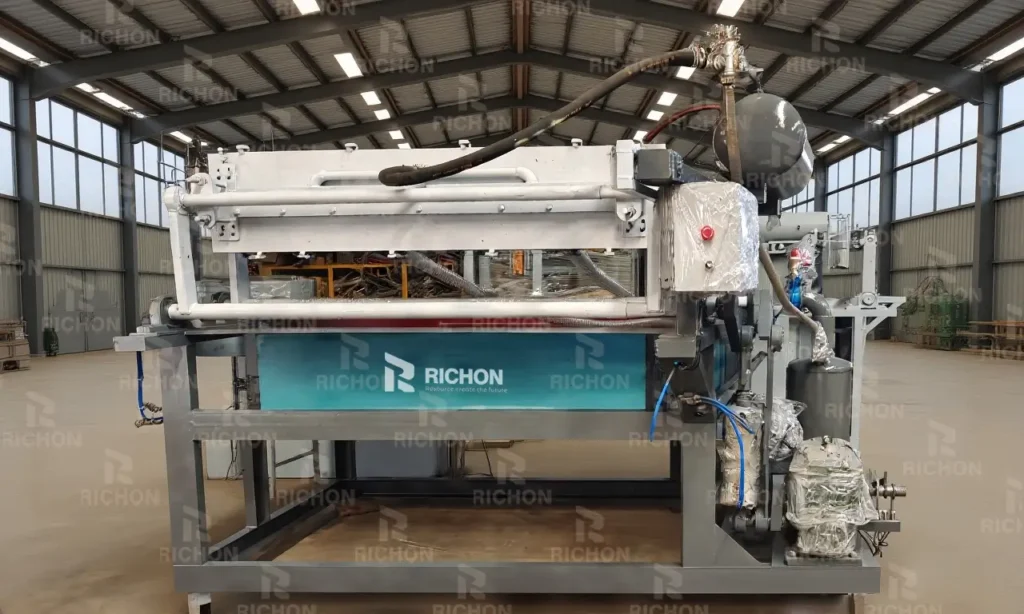
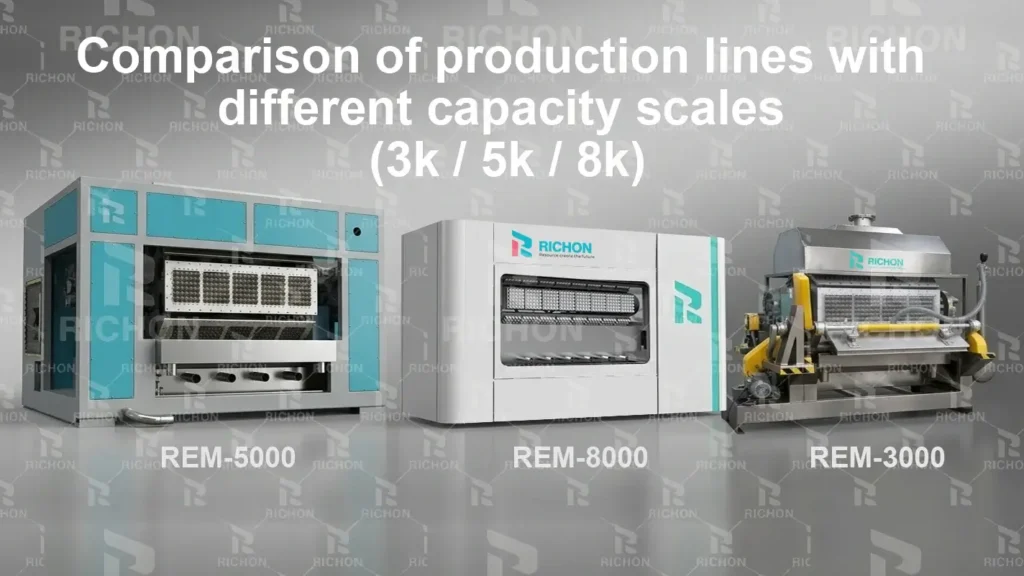
Choosing the right egg tray production line capacity is one of the most important decisions before starting a pulp molding project.
Many investors first ask:
“How many trays per hour should I produce?”
But experienced engineers do not choose capacity only by machine output. They evaluate market demand, drying system capacity, raw material supply, factory space, utility stability, labor structure, and long-term ROI.
A 5,000 pcs/h machine is not always more profitable than a 3,000 pcs/h line. The best capacity is the one that matches your real sales demand, factory conditions, drying ability, and investment plan.
This guide explains how to choose the right egg tray production line capacity from 1,000 to 8,000 pcs/h, including common capacity ranges, engineering considerations, regional market logic, and practical selection advice.
If you are still in the early planning stage, you can also read our guide on how to start an egg tray manufacturing business.
1. Why Production Capacity Matters
Production capacity affects almost every part of an egg tray project:
- Initial investment
- Производственные помещения
- Drying system size
- Labor requirement
- Electricity and fuel consumption
- Raw material demand
- Daily output
- Payback period
- Future expansion potential
A common mistake is choosing the biggest line within the budget. In reality, oversized capacity can create cash flow pressure if sales channels are not ready.
Another mistake is choosing a very small line only because the investment is lower. If local demand grows quickly, the factory may soon face output limitations and lose larger customers.
The right capacity should balance:
Market Demand + Investment Budget + Drying Ability + Factory Conditions + ROI Target
2. Common Egg Tray Production Line Capacity Ranges
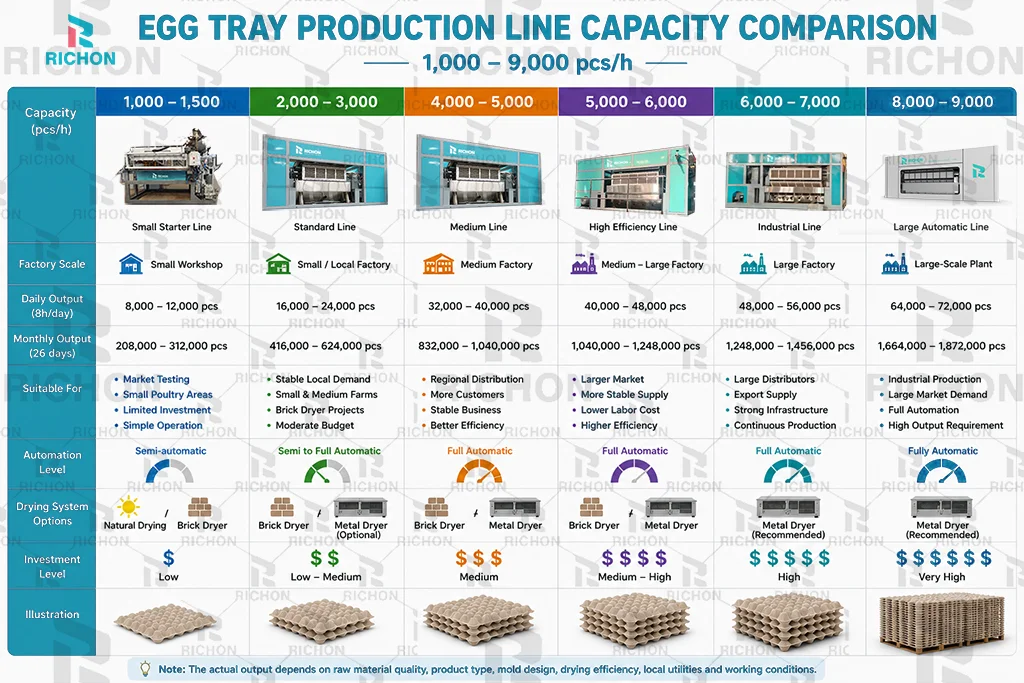
Different capacity ranges are suitable for different investment stages.
| Диапазон вместимости | Typical Project Type | Подходит для |
|---|---|---|
| 1000–2000 шт./час | Small starter line | Market testing, small local supply |
| 3000 шт./час | Practical commercial line | Stable local production |
| 4,000–5,000 pcs/h | Средняя фабрика | Региональное распространение |
| 6,000–8,000 pcs/h | Industrial production | Large market or export supply |
| 8000+ шт./час | Large automatic plant | Strong sales channels and infrastructure |
For most new investors, the safest range is usually 2,000–5,000 pcs/h, depending on local demand and drying conditions.
For a wider equipment overview, visit our Линия по производству лотков для яиц страница с решением.
3. Step 1: Analyze Real Market Demand Before Choosing Capacity
Before selecting a machine model, first evaluate your real market demand.
Key questions include:
- How many poultry farms are nearby?
- How many egg distributors need trays?
- Are egg trays currently imported or locally produced?
- What is the average selling price per tray?
- Is demand stable or seasonal?
- Are you targeting local buyers, regional distributors, or export customers?
In many emerging markets, 3000–5000 шт./час lines are common because they offer enough daily output without creating excessive investment pressure.
Например:
- Africa: 1,000–3,000 pcs/h is common for starter projects
- India: 3,000–5,000 pcs/h is common for regional supply
- Russia and Eastern Europe: 5,000–8,000 pcs/h may be suitable for larger markets
- Middle East: automated systems are often preferred due to labor and quality requirements
Choosing capacity without validating real demand may lead to:
- Низкий уровень использования оборудования
- High production cost per tray
- Давление на денежный поток
- Overstock of finished trays
- Longer ROI period
Production capacity must match real sales potential, not theoretical maximum output.
If you want to compare business feasibility before selecting capacity, read our руководство по бизнес-планированию лотков для яиц.
4. Step 2: Match Capacity with Investment Budget
Capacity selection directly affects total investment.
However, forming machine capacity alone does not define the final project budget. A complete egg tray factory investment also includes:
- Система пульпирования
- Формовочная машина
- Система сушки
- Molds
- Stacking or packing system
- Installation and commissioning
- Shipping
- Factory construction
- Electrical and water preparation
- Labor and training
A 3,000 pcs/h line with a brick dryer and a 3,000 pcs/h line with a metal dryer may have very different investment levels.
General investment logic
| Емкость | Investment Pressure | Typical Use |
|---|---|---|
| 1000–2000 шт./час | Низкий | Small workshop or market testing |
| 3000 шт./час | Середина | Practical local production |
| 5000 шт./час | Medium-high | Regional commercial supply |
| 8000 шт./час | Высокий | Large automatic factory |
The larger the capacity, the more important factory infrastructure becomes. Higher output requires stronger electricity supply, larger drying capacity, better raw material storage, and more organized production management.
For detailed machine price factors, see our прайс-лист на машины для изготовления лотков для яиц.
To understand long-term operating expenses, read Что определяет реальную себестоимость производства на линии по изготовлению лотков для яиц?.
5. Step 3: Drying System Determines Real Output
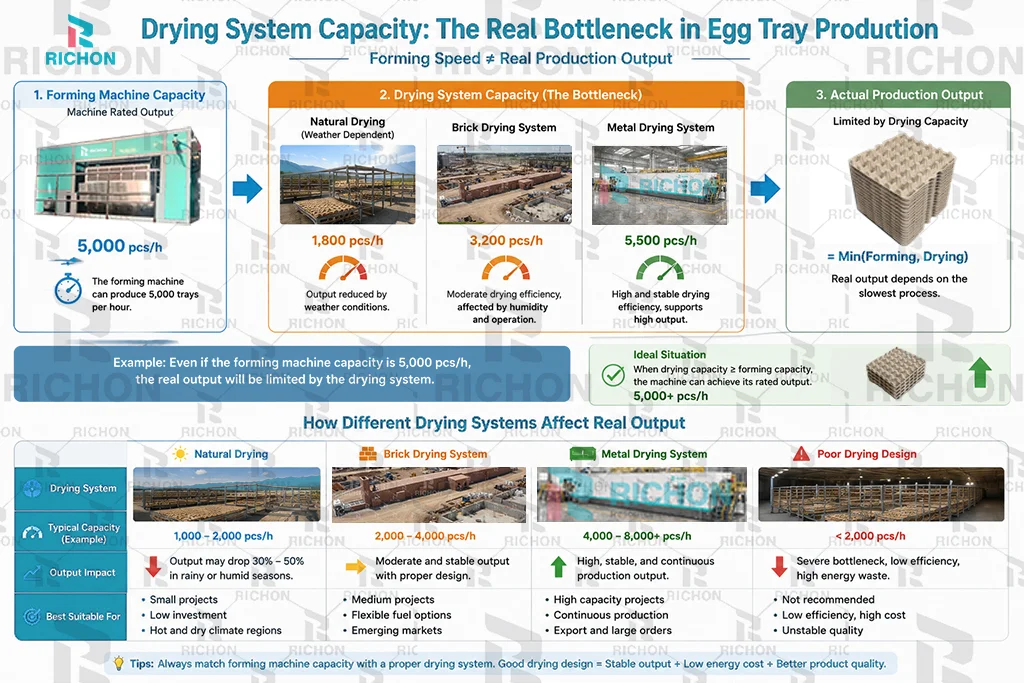
One of the most common misunderstandings in egg tray projects is:
Скорость формования не равна реальному объему производства.
The drying system is often the real bottleneck.
If a forming machine can produce 5,000 trays per hour but the drying system can only dry 3,500 trays per hour, the actual output will be limited by the dryer.
К распространенным способам сушки относятся:
Естественная сушка
Suitable for small projects and regions with stable sunlight.
Преимущества:
- Low energy cost
- Низкие инвестиции
- Простое управление
Ограничения:
- Зависит от погоды
- Requires large drying space
- Difficult during rainy seasons
- Not suitable for stable high output
Brick Drying System
Suitable for many 2,000–3,000 pcs/h and medium projects.
Преимущества:
- Lower investment than metal dryer
- Гибкие варианты топлива
- Упрощенное местное строительство
- Practical for many emerging markets
Ограничения:
- Requires good airflow design
- Usually needs more manual management
- Drying consistency depends on construction and operation
Система сушки металла
Suitable for higher-capacity automatic production lines.
Преимущества:
- Stable continuous drying
- Более высокий уровень автоматизации
- Better drying consistency
- More suitable for 5,000 pcs/h and above projects
Ограничения:
- Более высокие первоначальные инвестиции
- Higher requirements for fuel supply and maintenance
Before choosing a higher capacity, always confirm whether the drying system can support real output.
For a full comparison, read our brick dryer vs metal dryer guide.
For fuel and energy analysis, see our egg tray drying system cost guide.
6. Step 4: Mold Configuration Affects Cycle Time and Product Range
Capacity is also affected by mold design and forming efficiency.
Different mold configurations affect:
- Скорость впитывания целлюлозы
- Эффективность вакуума
- Толщина изделия
- Drainage performance
- Cycle time
- Product consistency
- Процент отказов
A well-designed mold system can improve forming stability and reduce quality problems.
If the mold drainage is poor, wet trays may contain too much moisture. This increases drying time and reduces real production efficiency.
If mold precision is low, trays may have uneven thickness, poor stacking performance, or deformation after drying.
This is why capacity selection should not only look at “pcs/h”. You also need to evaluate mold quality, drainage structure, vacuum efficiency, and product type.
For technical details, read our руководство по технологиям литья.
7. Step 5: Evaluate Utilities and Factory Infrastructure
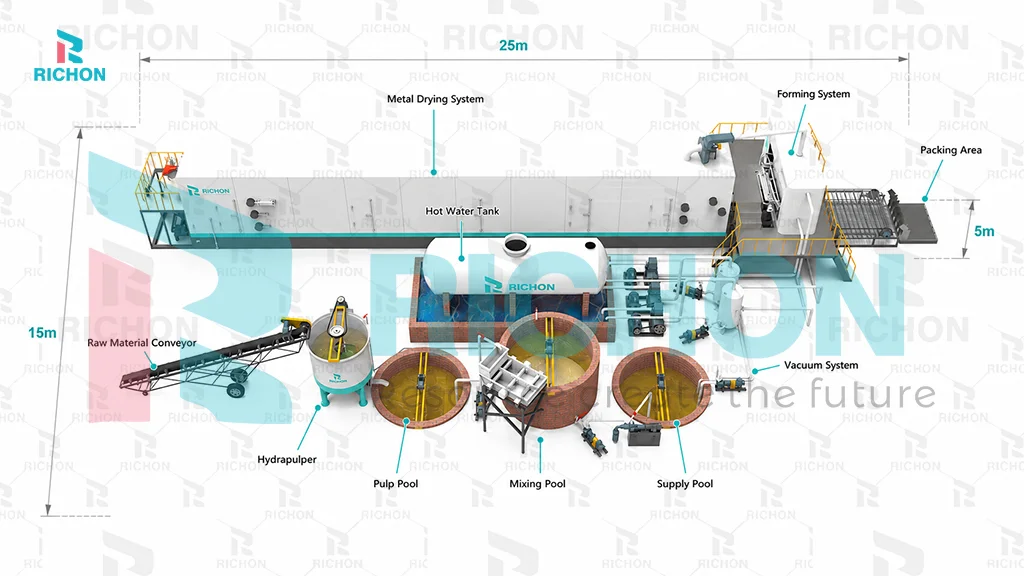
Before choosing a high-capacity line, confirm whether your factory can support it.
Key infrastructure factors include:
- Стабильное трехфазное электроснабжение
- Достаточное количество воды
- Fuel supply for drying
- Enough workshop floor space
- Raw material storage area
- Finished product storage area
- Ventilation and drainage
- Maintenance space around equipment
For example, an 8,000 pcs/h line may look attractive on paper, but if electricity supply is unstable or drying fuel is expensive, actual production may be difficult.
Для увеличения производственных мощностей необходима более развитая инфраструктура, а не просто более крупное оборудование.
For utility planning, see our egg tray machine electricity consumption guide.
Вы также можете оставить отзыв. how much water is needed for egg tray production.
For space planning, read our egg tray factory layout guide.
8. Capacity Selection by Project Type
Different project goals require different capacity strategies.
Small Local Business
Recommended range:
1000–2000 шт./часПодходит для:
- Small poultry areas
- First-time investors
- Market testing
- Limited capital
- Natural drying or simple drying setup
This type of project focuses on low entry risk and simple operation.
Standard Local Factory
Recommended range:
2,000–3,000 pcs/hПодходит для:
- Stable local demand
- Regional poultry farms
- Brick dryer projects
- Moderate investment budget
This is often a practical starting range in many African and Southeast Asian markets.
Regional Supply Factory
Recommended range:
4,000–5,000 pcs/hПодходит для:
- Regional distributors
- Larger egg packaging demand
- More stable sales channels
- Automatic forming and stronger drying system
This range requires better production management and stronger raw material supply.
Industrial Production Factory
Recommended range:
6,000–8,000 pcs/hПодходит для:
- Large distributors
- Export supply
- Strong factory infrastructure
- Automated drying and stacking
This level is suitable only when sales channels, utilities, and factory management are ready.
For detailed specification differences, read our 3k vs 5k vs 8k vs 10k egg tray production line comparison.
9. Regional Capacity Trends
Capacity choice should adapt to local market structure.
Африка
Many projects are in the 1,000–3,000 pcs/h range. Brick drying systems are common because they match local investment levels, fuel conditions, and practical factory operation.
For a practical African project example, see our 3000 pcs/h egg tray production line project with brick dryer.
Индия
Many investors choose 3000–5000 шт./час lines because regional egg consumption is strong and local production demand is stable.
Russia and Eastern Europe
Some projects prefer 5,000–8,000 pcs/h lines because regional supply and industrial-scale production are more common.
Средний Восток
Automatic lines with metal drying systems may be preferred due to labor cost, factory standards, and quality consistency requirements.
The best capacity is not globally fixed. It depends on local market demand, raw material supply, fuel price, labor cost, and sales channels.
10. Basic ROI Example: 3,000 pcs/h Line
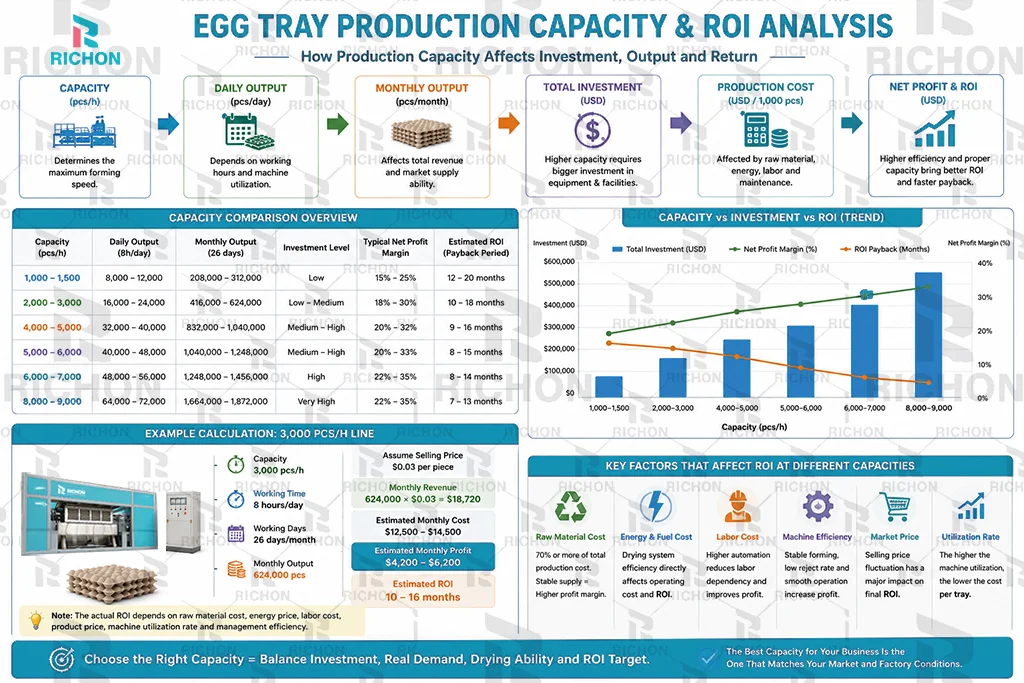
Here is a simplified example for a 3,000 pcs/h egg tray production line.
Basic production assumptions
| Элемент | Example |
|---|---|
| Емкость | 3000 шт./час |
| Working time | 8 hours/day |
| Monthly working days | 26 days |
| Monthly output | 624,000 trays |
Calculation:
3,000 × 8 × 26 = 624,000 trays/monthIf the selling price is stable and production cost is controlled, this capacity can support a practical local business.
However, ROI depends on:
- Цена продажи за поднос
- Стоимость сырья
- Стоимость топлива для сушки
- Стоимость электроэнергии
- затраты на рабочую силу
- Machine utilization rate
- Процент отказов
- затраты на техническое обслуживание
A typical payback period may range from 10–18 months, depending on local conditions. Avoid using ideal output only when calculating ROI.
For detailed profit calculation, read our анализ рентабельности лотков для яиц.
11. Common Mistakes When Choosing Capacity
Many new investors make capacity decisions too quickly.
Common mistakes include:
Mistake 1: Choosing the Biggest Line Too Early
A large-capacity line requires stable demand, utilities, labor, and raw material supply. Without these conditions, high capacity may increase risk.
Mistake 2: Ignoring Drying Bottlenecks
If drying capacity is not enough, the forming machine cannot run at its rated output.
Mistake 3: Underestimating Factory Space
Higher output requires more space for raw materials, drying, packing, storage, and maintenance.
Mistake 4: Only Comparing Machine Price
Low machine price may lead to higher operating cost if the machine has poor efficiency, weak structure, or unstable output.
Mistake 5: Ignoring Future Expansion
The first-stage layout should reserve space for future capacity upgrades.
To avoid common investment errors, read our top mistakes when starting an egg tray business.
12. Engineering Rule of Thumb
Небольшие производственные мощности способствуют гибкости и позволяют снизить первоначальные инвестиции.
Larger capacity requires:
- Стабильные коммунальные услуги
- Strong drying system
- Reliable raw material supply
- Skilled operators
- Better factory layout
- More structured production management
The best egg tray production line is not the biggest one.
It is the one engineered specifically for your market demand, factory conditions, energy supply, labor structure, and long-term business plan.
If you are unsure which configuration fits your project, Richon engineers can help evaluate:
- Целевая вместимость
- Выбор системы сушки
- компоновка завода
- Utility requirements
- Cost and ROI logic
Ознакомьтесь с нашими Решения для производственных линий по выпуску лотков для яиц или contact Richon engineers for capacity planning support.
Часто задаваемые вопросы
Какова наиболее популярная производственная мощность по выпуску лотков для яиц?
Globally, 3000–5000 шт./час is a common range for many new investors because it balances investment, output, and factory operation difficulty.
Не слишком ли велика производительность в 8000 штук в час для начинающих?
It depends on sales channels, factory infrastructure, drying system capacity, and raw material supply. For most beginners, 8,000 pcs/h may be too large unless demand is already confirmed.
Гарантирует ли увеличение производственных мощностей увеличение прибыли?
No. Profit depends on machine utilization rate, drying efficiency, energy cost, raw material cost, labor structure, and selling price.
What capacity is suitable for Africa?
Many African starter projects are in the 1,000–3,000 pcs/h range, often using natural drying or brick drying systems depending on local fuel and weather conditions.
What capacity is suitable for industrial production?
For industrial-scale production, 5,000–8,000 pcs/h lines are more common, especially when the factory has stable sales channels, sufficient utilities, and a reliable drying system.
Нужны рекомендации по пропускной способности для вашего рынка?
Укажите желаемую производительность, местные условия влажности/энергопотребления и тип лотка. Наши инженеры предложат подходящий вариант. 3000–8000 шт./час конфигурация и решение для сушки.
- Контрольный список планировки и инженерных коммуникаций завода
- Оценка узких мест сушки
- Справочная информация по оценке затрат и рентабельности инвестиций.
Получите быструю инженерную проверку.
Ответ в течение 24 часов (рабочих дней).
Связаться с нашими инженерами →