


How Much Space Is Needed for an Egg Tray Factory? Layout Guide
Introduction
When planning an egg tray manufacturing project, one of the first questions investors ask is:
How much space is required for an egg tray factory?
The required factory size depends on several key factors, including:
- Production capacity of the egg tray machine
- Type of drying system used
- Raw material storage requirements
- Finished product storage and logistics area
A properly planned layout improves production efficiency, reduces material handling distance, and ensures stable factory operations.
In this guide, our engineers explain the typical space requirements for egg tray factories, along with practical layout recommendations based on real project experience.
If you are still evaluating equipment capacity, you may also review our Egg Tray Production Line overview.
Typical Egg Tray Production Line Layout
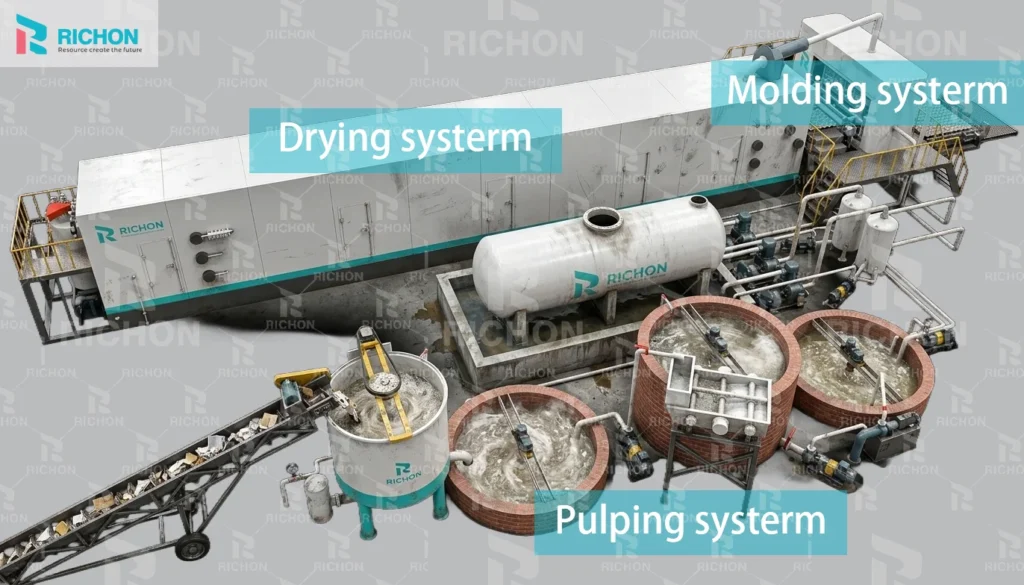
A typical egg tray factory is divided into several functional areas:
| Area | Function |
|---|---|
| Waste paper storage | Raw material storage |
| Pulping system | Waste paper recycling and pulp preparation |
| Forming machine | Egg tray molding |
| Drying system | Removing moisture from trays |
| Stacking & packing | Finished product handling |
| Finished goods warehouse | Product storage |
| Utility area | Boiler, air compressor, pumps |
These sections are usually arranged in a linear production flow to minimize transportation distance.
Space Requirement by Production Capacity
Different machine capacities require different factory sizes.
Below are typical layout references based on engineering projects.
Small Capacity Line (1000–3000 pcs/h)
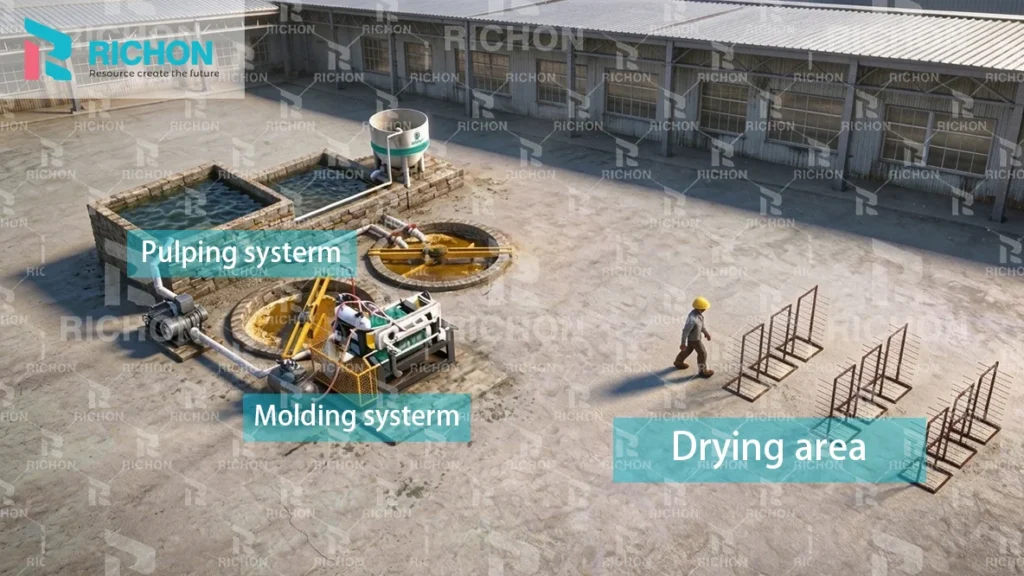
Small egg tray factories often use natural drying, which requires additional outdoor space.
Typical space requirement:
| Area | Size |
|---|---|
| Workshop | 200–300 m² |
| Drying yard | 500–1000 m² |
| Raw material storage | 100–200 m² |
Total recommended area: 800–1500 m²
This configuration is common in:
- Africa
- Southeast Asia
- South America
Medium Capacity Line (3000–5000 pcs/h)
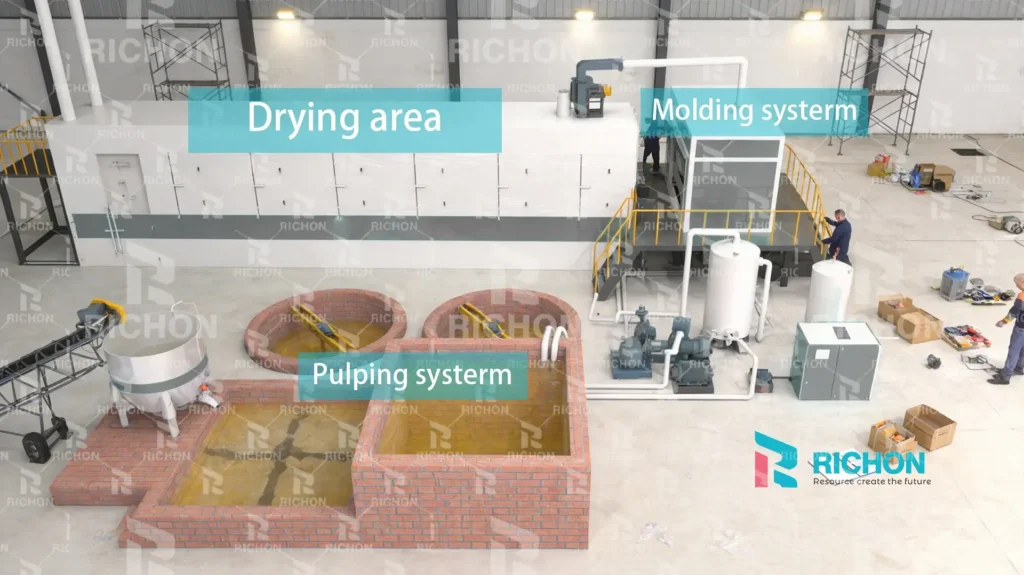
Medium-capacity production lines typically use metal drying systems, which significantly reduce required land area.
Typical space requirement:
| Area | Size |
|---|---|
| Production workshop | 400–600 m² |
| Raw material storage | 200–300 m² |
| Finished product warehouse | 200–300 m² |
Total recommended area: 800–1500 m²
Metal drying systems allow continuous production and higher automation levels.
For a detailed comparison of drying technologies, see Drying System Comparison
Large Capacity Line (5000–8000 pcs/h)
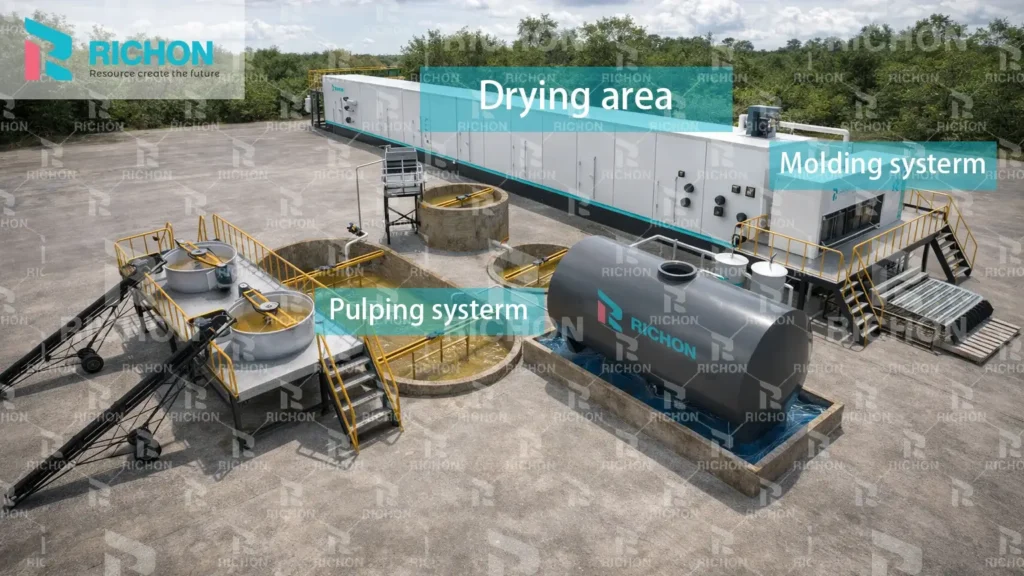
Large egg tray production lines require larger workshops to accommodate:
- Multiple forming machines
- Automated stacking systems
- Large drying tunnels
Typical space requirement:
| Area | Size |
|---|---|
| Production workshop | 800–1200 m² |
| Raw material storage | 300–500 m² |
| Finished product warehouse | 300–500 m² |
Total recommended factory area: 1500–2500 m²
Key Factors Affecting Factory Size
Several factors determine the final factory layout.
Drying Method
Drying systems significantly influence space requirements.
| Drying Method | Space Requirement |
|---|---|
| Natural drying | Large outdoor area |
| Brick dryer | Medium building space |
| Metal dryer | Compact industrial layout |
Metal dryers are increasingly popular because they:
- Reduce land usage
- Provide stable drying conditions
- Enable automated production lines
Raw Material Storage
Egg tray factories consume 4–10 tons of waste paper per day, depending on capacity.
Factories should reserve space for:
- 3–7 days of waste paper storage
- Raw material sorting area
- Pulping system feeding
You can learn more about raw materials in our article: Raw Materials for Egg Tray Production
Finished Product Storage
Finished egg trays are lightweight but bulky.
Typical storage requirements:
- 1 day production ≈ 20–40 m³ storage volume
- Warehouses should allow forklift access and pallet stacking
Example Factory Layout for a 3000 pcs/h Egg Tray Line
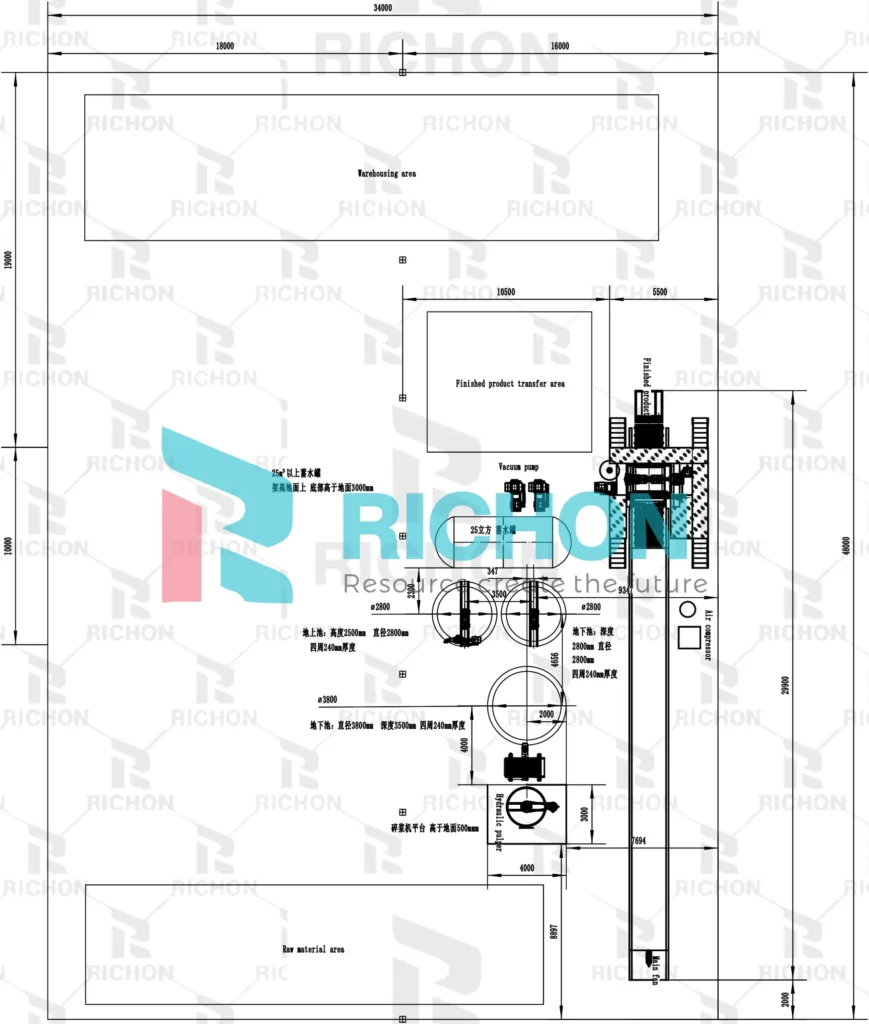
Typical production flow:
Waste Paper Storage
        ↓
Pulping System
        ↓
Egg Tray Forming Machine
        ↓
Drying System
        ↓
Stacking & Packing
        ↓
Finished Product Warehouse
This linear layout improves efficiency and reduces internal transportation.
Engineering Recommendation
From an engineering perspective, the most efficient egg tray factories follow three layout principles:
1️⃣ Straight production flow
2️⃣ Separate raw material and finished product zones
3️⃣ Adequate maintenance and equipment service space
A well-designed layout can significantly improve production efficiency and reduce operating costs.
If you are planning a project, our engineers can provide factory layout drawings and equipment configuration suggestions.
You can also review our Egg Tray Production Line page to explore different machine capacities and system configurations.
For customized layout recommendations, please contact our team via the Contact page.
Need a Capacity Recommendation for Your Market?
Share your target output, local humidity/energy conditions, and tray type. Our engineers will suggest a suitable 3,000–8,000 pcs/h configuration and drying solution.
- Factory layout & utilities checklist
- Drying bottleneck evaluation
- Cost & ROI estimation reference
