


How to Choose the Right Egg Tray Production Line Capacity (1,000–8,000 pcs/h Guide)
Choosing the right egg tray production line capacity is one of the most critical decisions when starting a pulp molding project.
Many investors focus only on machine price.
Experienced engineers evaluate market demand, drying efficiency, mold configuration, utility stability, and long-term ROI.
Based on over 30 years of pulp molding engineering experience, this guide explains how to select the right capacity — whether 3,000 pcs/h, 5,000 pcs/h, or 8,000+ pcs/h.
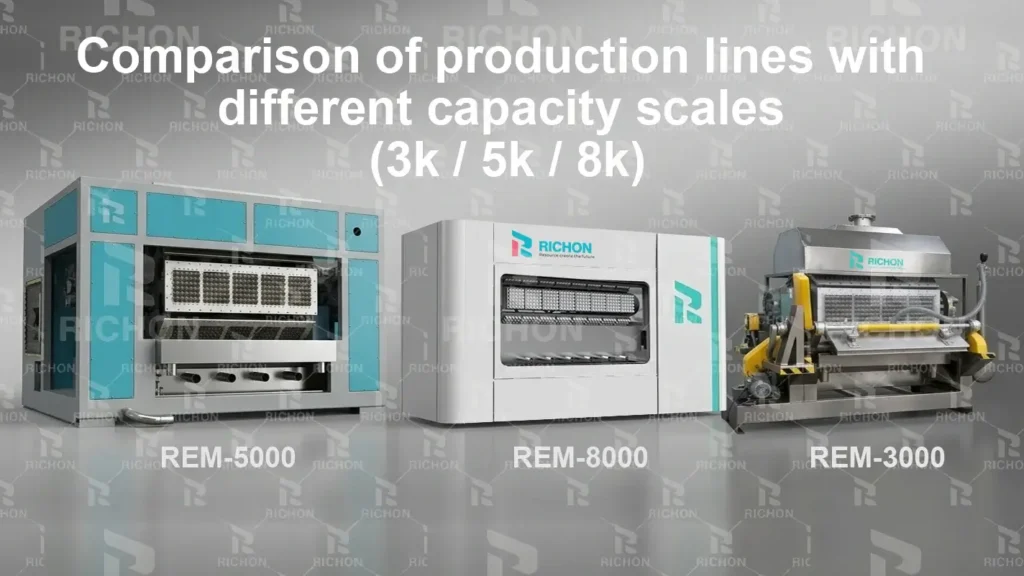
Step 1 – Analyze Real Market Demand Before Choosing Capacity
Before selecting a machine model, evaluate:
- Daily egg consumption in your region
- Number of poultry farms and distributors
- Supermarket or export contracts
- Seasonal demand fluctuations
In emerging markets such as India, Cameroon, and Eastern Europe, 3,000–5,000 pcs/h lines are common entry-level configurations.
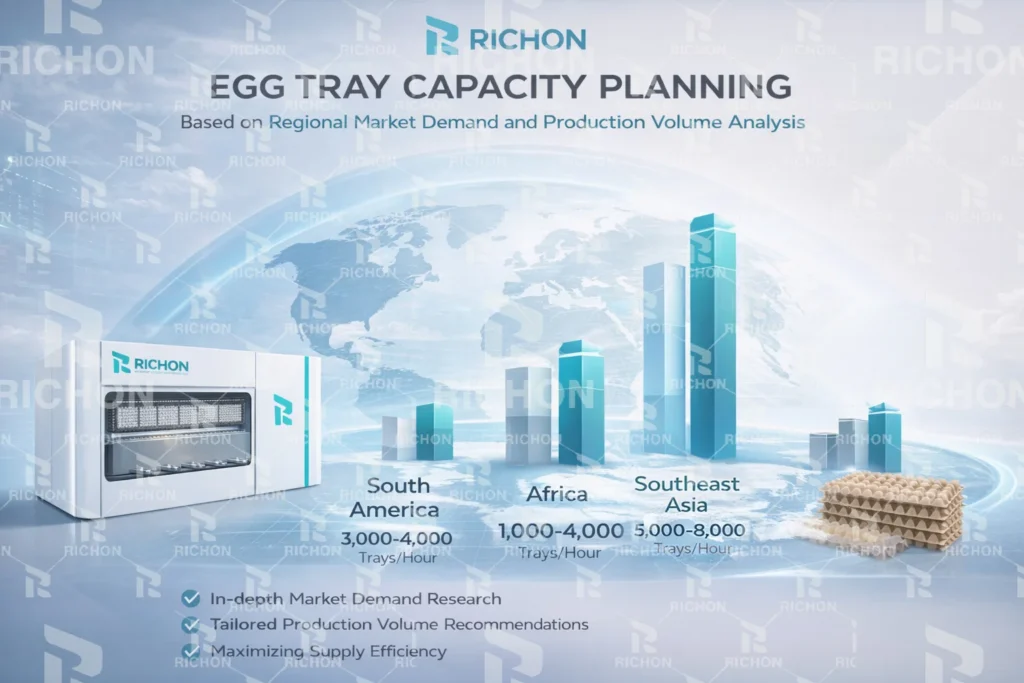
Choosing capacity without validating real demand often leads to:
- Low equipment utilization
- High per-unit production cost
- Cash flow pressure
You can review typical configuration differences on our
👉 Egg Tray Production Line overview
Production capacity must match real sales potential, not theoretical maximum output.
Step 2 – Match Capacity with Investment Budget
Capacity selection directly affects investment level and payback period.
| Capacity | Investment Level | Suitable For |
|---|---|---|
| 1,000–2,000 pcs/h | Small entry workshop | Testing market |
| 3,000 pcs/h | Standard configuration | Stable local supply |
| 5,000 pcs/h | Fully automatic line | Regional distribution |
| 8,000+ pcs/h | Fully automatic system | Large-scale commercial supply |
However, forming capacity alone does not define total investment.
You must consider:
- Drying system type
- Automation level
- Mold configuration
- Labor structure
For a detailed cost breakdown and ROI reference, see
👉 Cost & Investment Analysis
Higher capacity requires stronger infrastructure — not just a bigger machine.
Step 3 – Drying System Determines Real Output
One of the most common misunderstandings:
Forming speed does not equal real production output.
The drying system is often the bottleneck.
Available drying options include:
- Natural drying (climate dependent)
- Brick drying system
- Fully automatic metal drying line
In humid regions or long rainy seasons, natural drying may reduce effective output by 30–50%.
Before choosing higher capacity, compare drying technologies carefully.
You can review technical differences here:
Drying stability determines whether your 5,000 pcs/h machine actually delivers 5,000 pcs/h in real conditions.
Step 4 – Mold Configuration Affects Cycle Time and Product Range
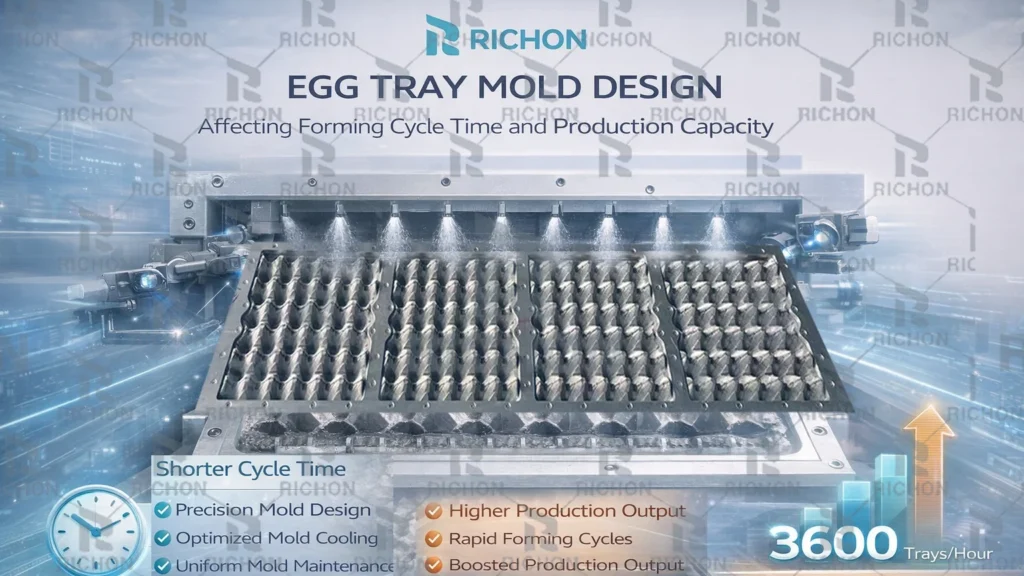
Capacity is also influenced by mold design and forming efficiency.
Different mold structures affect:
- Pulp absorption speed
- Vacuum efficiency
- Product thickness
- Production cycle time
A well-designed mold system improves forming stability and reduces reject rate.
For technical details about mold structure and material selection, see
👉 Mold Technology
Ignoring mold optimization may limit real output even if machine capacity is high.
Step 5 – Evaluate Utilities and Factory Infrastructure
Before upgrading to 8,000+ pcs/h, confirm:
- Stable three-phase electricity supply
- Sufficient water availability
- Continuous fuel supply for drying
- Adequate workshop floor space
Oversizing capacity without infrastructure preparation increases operational risk.
Engineering planning should always precede equipment scaling.
Global Capacity Trends by Region
Based on installation experience:
- Africa → 1,000–3,000 pcs/h dominant models
- India → 4,000 pcs popular startup capacity
- Russia → 5,000–8,000 pcs regional supply level
- Middle East → Preference for automated metal drying systems
Capacity choice must adapt to local market structure and utility environment.
Basic ROI Example – 3,000 pcs/h Line
Example scenario:
Daily Output: ~60,000 trays
Raw Material: Waste paper
Energy: Biomass / Coal / Gas
Labor: 4–6 operators
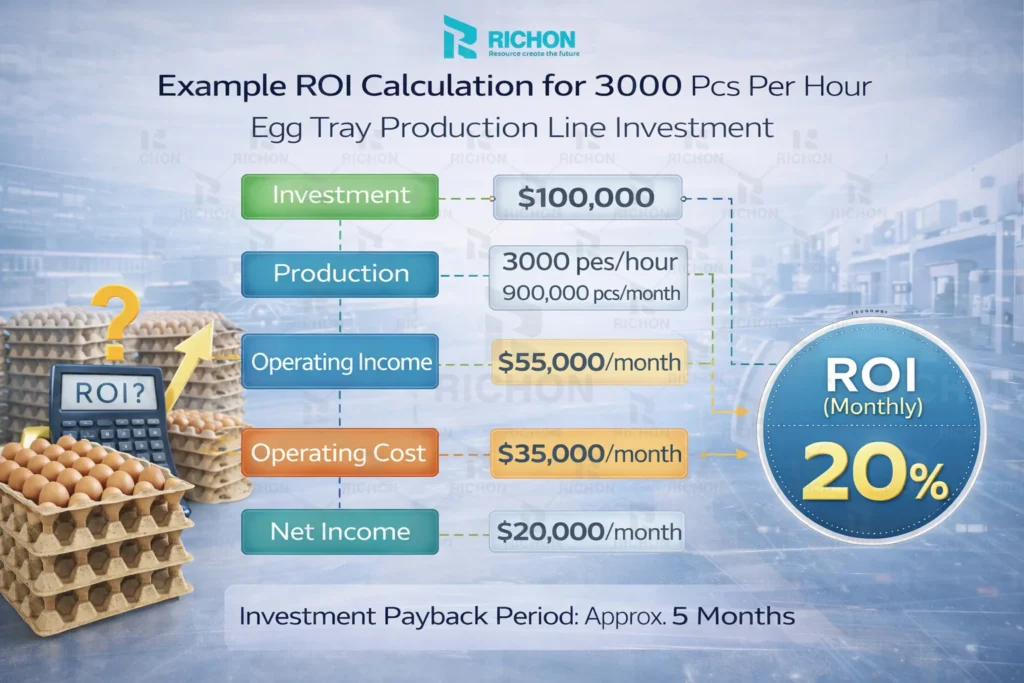
Typical payback period: 10–14 months (depending on local tray price and utility cost)
You can further analyze detailed investment structure here:
👉 Investment Planning Guide
Profitability depends more on utilization rate than theoretical capacity.
Engineering Rule of Thumb
Small capacity favors flexibility and lower initial investment.
Larger capacity demands:
- Stable utilities
- Automated drying
- Structured production management
The best egg tray production line is not the biggest one —
it is the one engineered specifically for your market and factory conditions.
If you are unsure which configuration fits your project, our engineering team can assist with:
- Capacity evaluation
- Layout planning
- Utility calculation guidance
FAQ
What is the most popular egg tray production capacity?
Globally, 3,000–5,000 pcs/h is the most common range for new investors.
Is 8,000 pcs/h too large for beginners?
It depends on sales channel stability and infrastructure readiness.
Does higher capacity guarantee higher profit?
No. Profit depends on utilization rate, drying efficiency, and energy cost.
Need a Capacity Recommendation for Your Market?
Share your target output, local humidity/energy conditions, and tray type. Our engineers will suggest a suitable 1,000–8,000 pcs/h configuration and drying solution.
- Factory layout & utilities checklist
- Drying bottleneck evaluation
- Cost & ROI estimation reference
