


Raw Materials for Egg Tray Production: Waste Paper Types, Pulp Ratio & Cost Guide
Introduction:
Egg tray production is widely known as an environmentally friendly recycling process. Instead of using virgin materials, most egg trays are produced from recycled waste paper, turning discarded paper into valuable packaging products.
However, not all waste paper performs the same in pulp molding.
The type of raw material, pulp concentration, and fiber quality directly affect product strength, production efficiency, and manufacturing cost.
Understanding the correct raw materials is essential when planning a new egg tray manufacturing project.
This guide explains:
- The most commonly used waste paper materials
- Recommended pulp ratios for egg tray production
- Raw material consumption and cost estimation
- How material quality affects egg tray strength and production stability
For a complete overview of equipment and system configuration, see our Egg Tray Production Line guide.
Common Waste Paper Used for Egg Tray Production
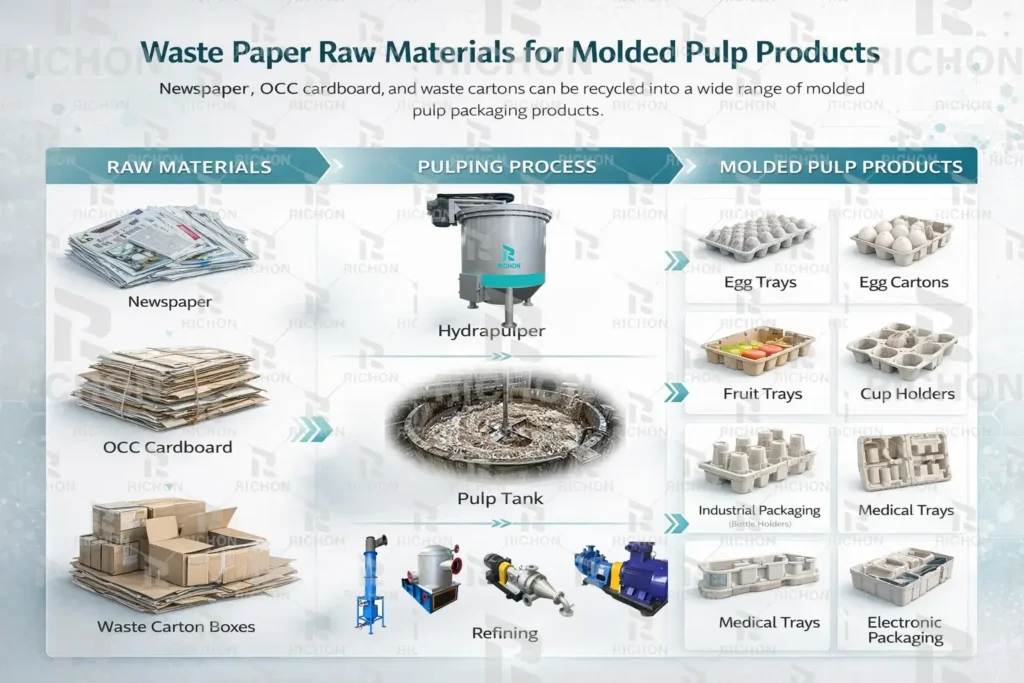
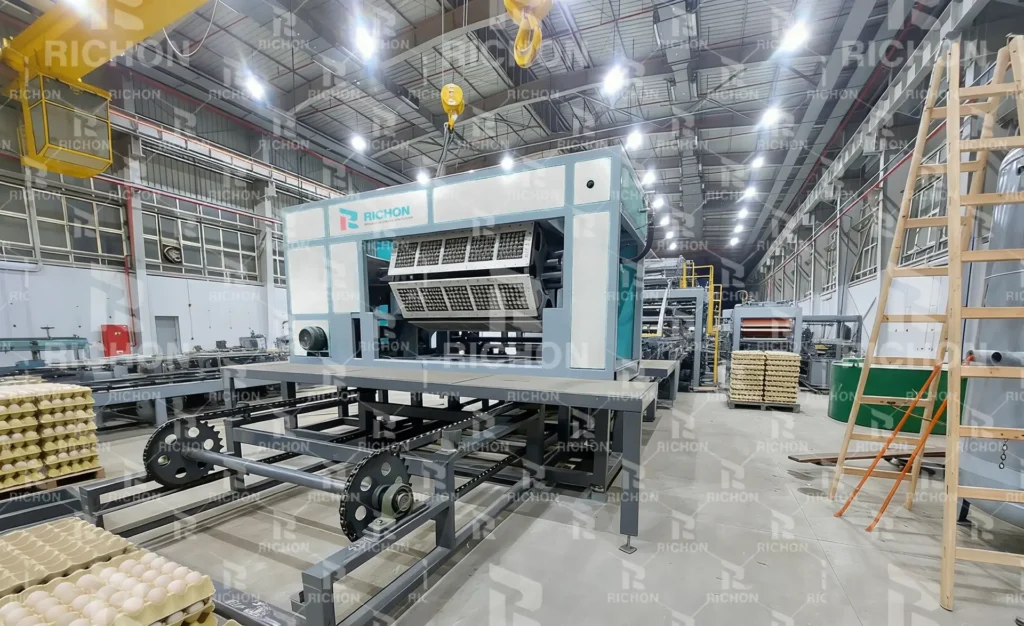
Egg trays are typically produced using low-grade recycled paper fibers.
Unlike printing paper or packaging boards, egg trays do not require high surface quality, making them ideal for recycled materials.
The most commonly used waste paper types include:
Old Newspapers (ONP)
Old newspapers are one of the most popular raw materials because they contain long fibers and good absorbency.
Advantages:
- Easy pulping
- Good fiber bonding
- Stable product strength
However, newspapers are becoming less available in some regions due to digital media.
Office Paper and Printing Waste
Office paper can also be used, although it may require more pulping and screening due to ink and coating layers.
Typical uses:
- Mixed pulp blending
- Improving tray appearance
- Increasing fiber bonding strength
Mixed Waste Paper
In many developing markets, egg tray manufacturers use mixed waste paper from recycling stations.
Advantages:
- Lowest cost raw material
- Easily available in large quantities
However, mixed paper often contains:
- Plastic pieces
- Staples
- Sand or dust
This requires proper pulping and filtration equipment during production.
You can learn more about the complete pulp preparation process in our Egg Tray Production Process guide.
Ideal Pulp Ratio for Egg Tray Manufacturing
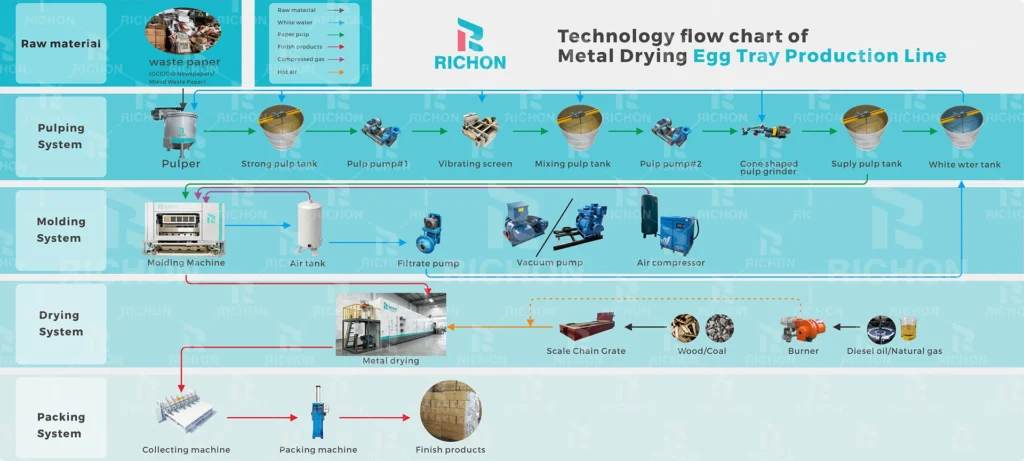
In pulp molding production, pulp consistency plays a crucial role in forming efficiency and product quality.
The pulp ratio refers to the percentage of paper fiber in the water mixture.
Typical pulp concentration:
| Production Stage | Pulp Consistency |
|---|---|
| Pulping tank | 4% – 6% |
| Supply tank | 3% – 5% |
| Forming machine | 3% – 4% |
If the pulp is too thick:
- Mold drainage becomes slow
- Forming cycle time increases
- Production capacity decreases
If the pulp is too dilute:
- Egg trays become thin
- Product strength decreases
Therefore, maintaining a stable pulp concentration between 3% and 5% is considered optimal for most egg tray production lines.
Raw Material Consumption in Egg Tray Production
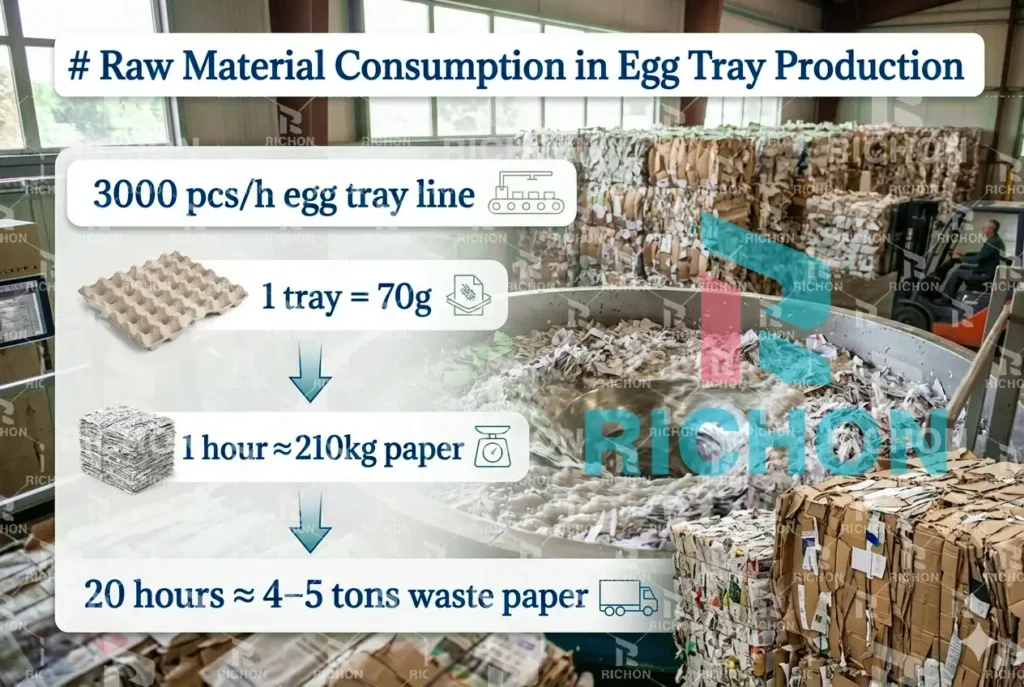
One of the most common questions from new investors is:
How much waste paper is needed to produce egg trays?
The answer depends on:
- Tray weight
- Production capacity
- Moisture content
- Fiber type
Below is a typical consumption example.
Example: 3000 pcs/hour Egg Tray Production Line
Assumptions:
- 30-egg tray weight: 70 g
- Machine capacity: 3000 pcs/hour
Daily raw material consumption:
| Item | Quantity |
|---|---|
| Paper per tray | ~70 g |
| Hourly paper consumption | ~210 kg |
| Daily production (20 hours) | ~4200 kg |
| Waste paper required | ~4–5 tons/day |
This is why stable waste paper supply is essential for a continuous production line.
If you are planning a factory, our Egg Tray Production Line page explains how capacity selection affects raw material consumption and factory design.
Raw Material Cost in Different Regions
Waste paper prices vary significantly depending on the local recycling market.
Typical price ranges:
| Region | Waste Paper Cost |
|---|---|
| Africa | $30 – $60 / ton |
| Southeast Asia | $60 – $100 / ton |
| Middle East | $80 – $120 / ton |
| Europe | $150 – $220 / ton |
In many egg tray factories, raw material cost accounts for 40–60% of total production cost.
Therefore, sourcing reliable local recycling suppliers can significantly improve profit margins.
A full cost breakdown is available in our article:
Egg Tray Machine Price 2026: Complete Cost Breakdown & ROI Guide
How Raw Material Quality Affects Egg Tray Strength
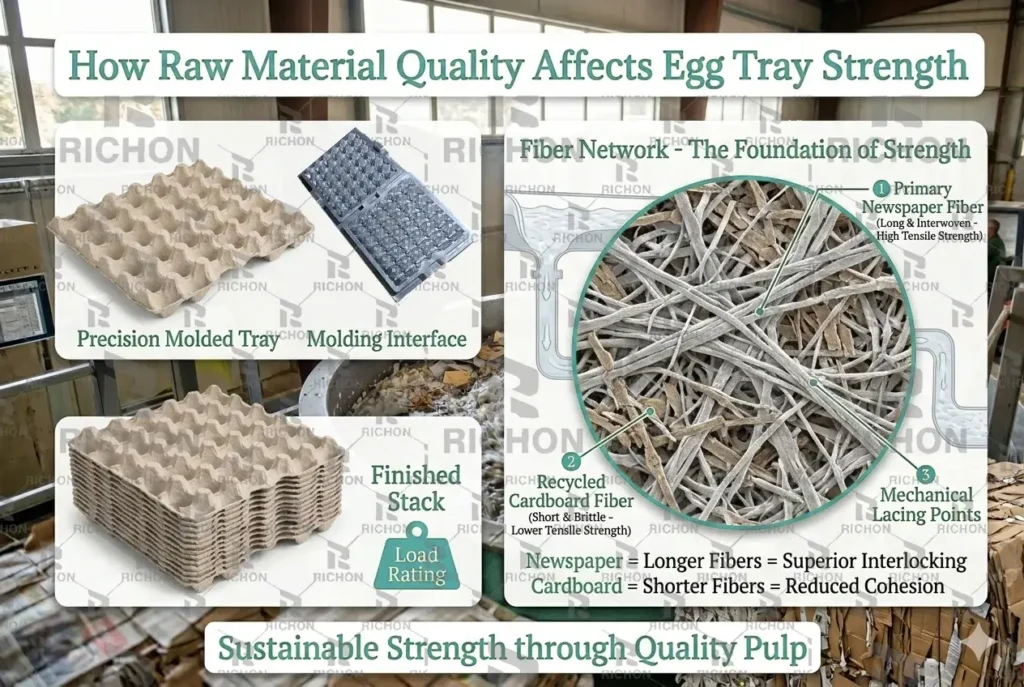
Raw material quality has a direct impact on the mechanical performance of egg trays.
The most important factors include:
Fiber Length
Longer fibers provide stronger bonding between fibers, improving tray durability and stacking strength.
Impurity Content
Impurities such as plastic films, metal staples, or sand particles can:
- Damage molds
- Block vacuum systems
- Reduce product quality
This is why modern egg tray production lines include screening and filtration systems.
Fiber Recycling Cycles
Paper fibers become shorter after repeated recycling cycles.
When fibers become too short:
- Tray edges become fragile
- Compression strength decreases
Mixing different waste paper types can help maintain stable fiber performance.
Mold design also affects final tray quality.
See our Mold Technology guide for more details.
How to Choose the Right Raw Material for Your Project
When planning a new egg tray manufacturing plant, raw material selection should consider:
1️⃣ Local availability
The best raw material is usually the most stable local supply.
2️⃣ Price stability
Frequent price fluctuations can affect production cost.
3️⃣ Pulping efficiency
Some materials require longer pulping time and higher energy consumption.
4️⃣ Product requirements
Higher-quality trays may require better fiber materials.
Most successful egg tray factories use a blended pulp recipe, combining different waste paper types to balance cost and product strength.
Conclusion
Raw materials are the foundation of egg tray manufacturing.
Choosing the right waste paper type and maintaining proper pulp consistency can significantly improve:
- Production efficiency
- Product strength
- Equipment stability
- Manufacturing cost control
For investors planning a new project, understanding raw material supply is just as important as selecting the right equipment.
If you are evaluating equipment options, visit our Egg Tray Production Line page to explore different capacity configurations and system designs.
You can also contact our engineering team through the contact page for factory layout suggestions and equipment recommendations.
Need a Capacity Recommendation for Your Market?
Share your target output, local humidity/energy conditions, and tray type. Our engineers will suggest a suitable 3,000–8,000 pcs/h configuration and drying solution.
- Factory layout & utilities checklist
- Drying bottleneck evaluation
- Cost & ROI estimation reference
