 English
Maintenance Cost of Egg Tray Machine: Real Annual Budget, Spare Parts & Cost Reduction Guide
When investors evaluate an egg tray production line, they often focus on machine price, electricity consumption, and drying cost. But one important factor is frequently underestimated: maintenance cost.
A well-designed egg tray machine does not require high daily maintenance spending, but over time, wear parts, vacuum components, pumps, seals, molds, bearings, and conveyor parts all create operating expenses.
This guide explains the real maintenance cost of an egg tray machine, including:
- what parts usually need replacement,
- how much maintenance budget to prepare each year,
- what affects maintenance frequency,
- how to reduce long-term operating cost.
For buyers planning a new project, this is one of the most practical cost topics after power, fuel, and raw material analysis.
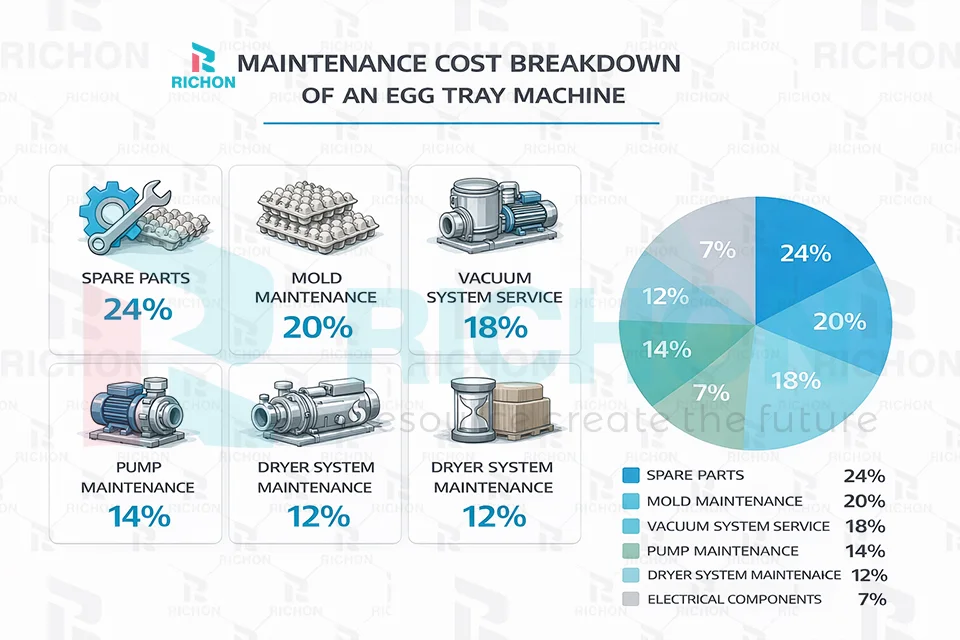
What Is Included in Egg Tray Machine Maintenance Cost?
Maintenance cost is not just about repairing breakdowns. In real production, it includes both preventive maintenance and replacement of wearing parts.
Typical maintenance cost includes:
- mold cleaning and repair,
- vacuum pump servicing,
- slurry pump maintenance,
- bearings and rotating parts replacement,
- seals, hoses, valves, and pipe fittings,
- dryer conveyor chain or transmission component maintenance,
- electrical parts such as sensors, relays, and switches,
- labor cost for maintenance work,
- production downtime caused by machine faults.
From an engineering perspective, the real maintenance budget should always include both:
- planned maintenance expenses,
- unexpected repair risk.
For most factories, the second part is what causes profit fluctuation.
Why Maintenance Cost Matters in Egg Tray Production
A low machine price does not always mean low long-term cost.
In egg tray production, poor maintenance management leads to:
- unstable forming quality,
- higher reject rate,
- longer downtime,
- lower capacity utilization,
- and higher labor intensity.
This is why maintenance cost affects not only your spare parts budget, but also your true production cost per 1,000 trays.
If your line stops frequently, your electricity, labor, and drying costs continue, while saleable output drops. That means maintenance has a direct impact on profitability.
Related reading: Egg Tray Machine Price 2026: Complete Cost Breakdown & ROI Guide
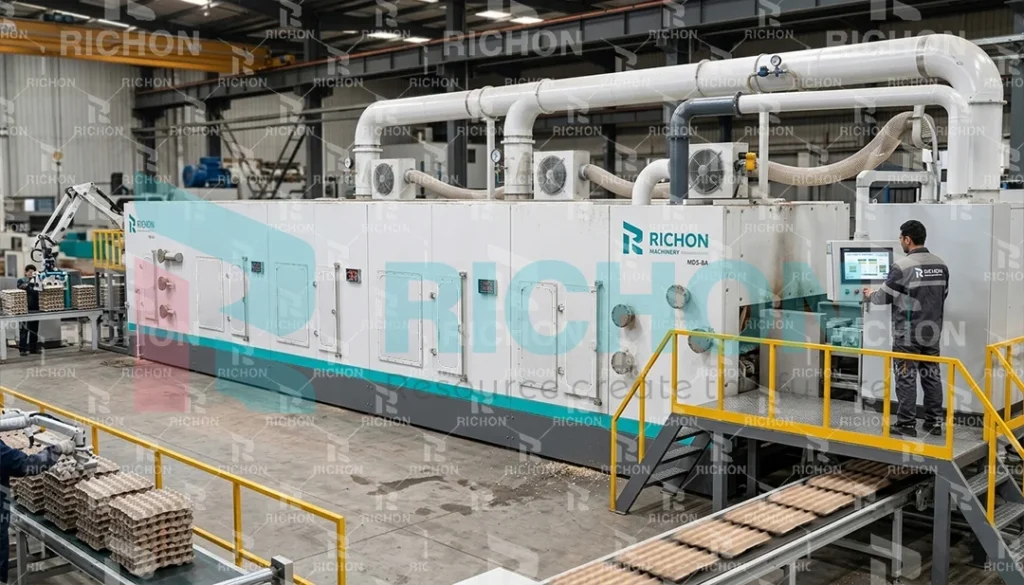
Main Parts That Generate Maintenance Cost
1. Forming Mold and Transfer Mold
Molds are core working parts in egg tray production. Over time, they may face:
- surface wear,
- mesh blockage,
- edge damage,
- vacuum inconsistency,
- deformation caused by poor cleaning or impact.
If molds are not maintained well, tray shape, edge definition, and dewatering efficiency will all decline.
Maintenance expense in this area includes:
- cleaning,
- mesh replacement,
- local repair,
- full mold replacement when wear becomes serious.
Related page: Egg Tray Mold
2. Vacuum System
The vacuum system directly affects dewatering speed and molding stability.
Common maintenance points include:
- vacuum pump oil or lubrication,
- sealing rings,
- pipeline leakage,
- valves,
- vacuum tank cleaning.
When vacuum performance drops, forming efficiency drops immediately. This often shows up as:
- slower cycle speed,
- poor tray shape,
- higher moisture content before drying.
3. Pulp Pump and Agitator System
In the pulping and slurry circulation area, maintenance cost usually comes from:
- pump impeller wear,
- motor load issues,
- bearing replacement,
- shaft seal leakage,
- agitator blade wear.
This part is especially important when the factory uses recycled waste paper with inconsistent impurities.
Related reading: Raw Materials for Egg Tray Production: Waste Paper Types, Pulp Ratio & Cost Guide
4. Dryer Transmission and Heating System
If the line includes a brick dryer or metal dryer, maintenance may involve:
- conveyor chain wear,
- bearings,
- motor reducers,
- fans,
- burners,
- thermal insulation repair,
- belt alignment and drive parts.
Drying system maintenance is often overlooked at the purchase stage, but in medium and large production lines, it can become one of the most important recurring maintenance costs.
Related reading: Egg Tray Drying System Cost: Energy, Fuel & ROI Comparison
5. Electrical and Control Components
Electrical maintenance is usually not the biggest expense, but it affects production continuity.
Common issues include:
- sensor failure,
- relay aging,
- switch damage,
- wiring looseness,
- PLC interface problems,
- moisture-related electrical instability.
In humid factory environments, this area deserves more attention than many buyers expect.
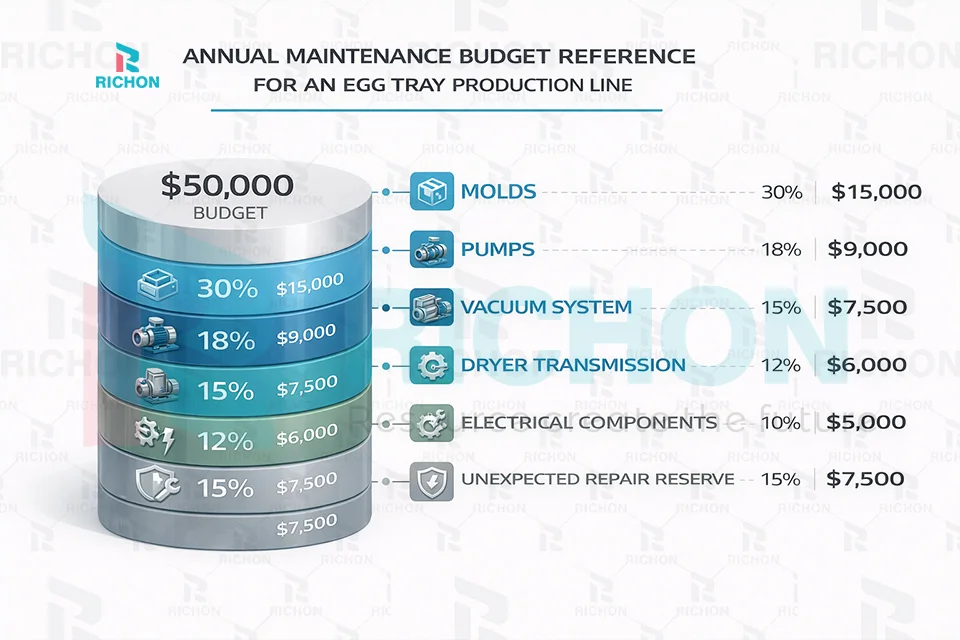
Typical Maintenance Cost Structure
Below is a practical reference structure for annual maintenance spending in an egg tray production line. Actual numbers vary by line size, automation level, material cleanliness, maintenance discipline, and operating hours.
| Maintenance Area | Typical Share of Maintenance Budget |
|---|---|
| Mold and mold accessories | 20%–30% |
| Pumps, bearings, seals | 20%–25% |
| Vacuum system | 10%–20% |
| Dryer transmission and heating parts | 20%–30% |
| Electrical components | 5%–10% |
| Unexpected repair and downtime buffer | 10%–15% |
The key point is this:
maintenance cost is not evenly distributed.
Lines with better mold care and stable raw material control usually spend less on emergency repair and more on planned maintenance.
How Much Does Egg Tray Machine Maintenance Cost Per Year?
For most projects, maintenance cost is better estimated as a percentage of equipment investment, rather than as a fixed single number.
Practical reference range
For a well-operated egg tray production line:
- annual maintenance cost is often around 3%–7% of equipment value
- lines with poor management or heavy-duty operation may go higher
- high automation does not always mean higher maintenance cost; in many cases it reduces total breakdown frequency when the system quality is good
General budgeting logic
| Line Type | Annual Maintenance Budget Reference |
|---|---|
| Small line | relatively low, but more sensitive to manual misuse |
| Medium line | stable if preventive maintenance is followed |
| Large automatic line | higher spare-parts value, but better control and lower unplanned stoppage risk |
A better way to explain this to buyers is:
- small projects usually worry about cash flow,
- medium projects worry about part replacement frequency,
- large projects worry most about downtime cost.
That last point is critical.
For a high-capacity line, one serious breakdown may cost more in lost production than in spare parts.
Related reading: Egg Tray Profit Margin: How Much Can You Really Earn? (Full ROI Analysis)
What Causes Maintenance Cost to Increase?
Not all maintenance cost comes from machine quality alone. In many cases, operating conditions and quality problems are the bigger reason.
Poor raw material quality
If waste paper contains too much impurity, plastic, sand, or hard particles, pump wear and mold blockage increase quickly.
Inadequate cleaning
When molds, pipelines, and pumps are not cleaned regularly, resistance rises and part wear accelerates.
Improper lubrication
Bearings, reducers, chains, and moving mechanisms fail much faster without proper lubrication schedules.
Unstable operating habits
Frequent stop-start cycles, overload operation, and non-standard operator behavior all shorten component life.
Poor factory environment
Humidity, dust, and inadequate drainage can damage motors, electrical components, and mechanical assemblies.
Delayed preventive maintenance
Factories that only repair after breakdown usually spend more than factories that inspect and replace parts on schedule.
Preventive Maintenance vs Breakdown Repair
The cheapest maintenance strategy is not “repair nothing.”
The cheapest strategy is planned preventive maintenance.
Preventive maintenance
- routine cleaning,
- lubrication,
- checking vacuum leakage,
- inspecting pump seals,
- monitoring mold condition,
- checking chain tension and bearings,
- replacing worn parts before failure.
Breakdown repair
- emergency shutdown,
- rush spare-parts purchase,
- higher labor pressure,
- unstable output,
- delayed customer delivery.
From a business perspective, preventive maintenance gives two major advantages:
- lower real production cost,
- more predictable ROI.
This is especially important for export-oriented buyers who need stable daily output.
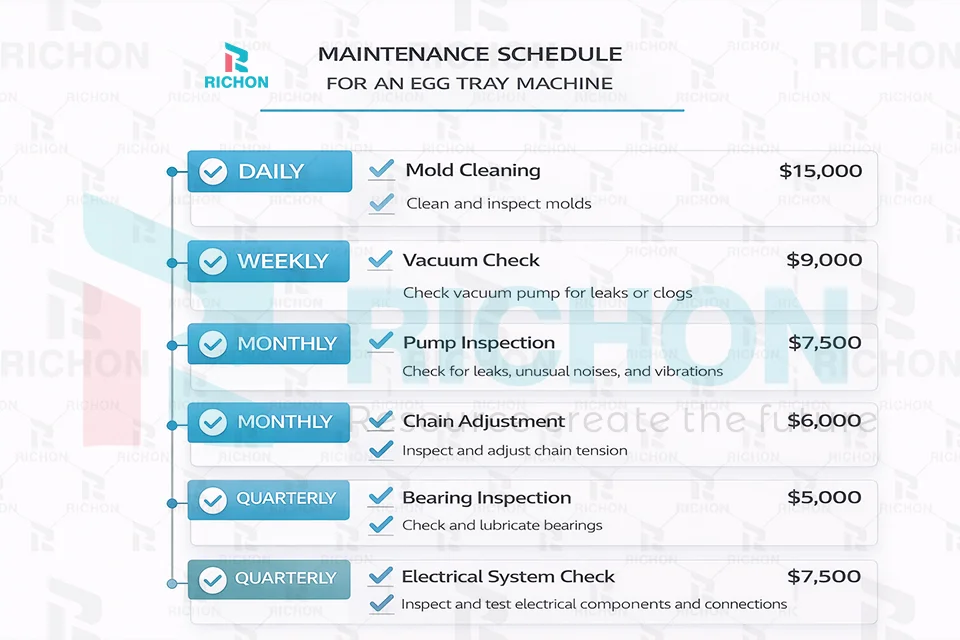
Maintenance Frequency by System
The exact cycle depends on model, operating hours, and raw material cleanliness, but the following maintenance logic is practical for content purposes.
Daily checks
- mold cleanliness,
- vacuum pressure stability,
- pump noise and leakage,
- basic lubrication points,
- electrical abnormality,
- dryer chain or conveyor observation.
Weekly checks
- pipeline leakage,
- bearing heat,
- reducer condition,
- pulp circulation smoothness,
- sensor response.
Monthly checks
- seal wear,
- vacuum pump condition,
- motor coupling,
- mold fixing condition,
- burner or heat system inspection.
Quarterly or semi-annual maintenance
- bearing replacement for high-load points,
- mold mesh repair or replacement,
- chain adjustment,
- fan inspection,
- deeper electrical system inspection.
This kind of schedule reduces surprise failures and makes spare-parts planning much easier.
Real Hidden Cost: Downtime
When discussing maintenance cost, many buyers only think about replacement parts.
But the bigger hidden cost is often downtime.
If a line stops for several hours because of:
- vacuum failure,
- pump damage,
- dryer transmission fault,
- mold damage,
the real loss includes:
- lost output,
- wasted labor time,
- wasted energy during restart,
- delayed shipment risk.
That is why a stable line with slightly higher part quality can often be cheaper in the long run than a low-cost machine with frequent interruptions.
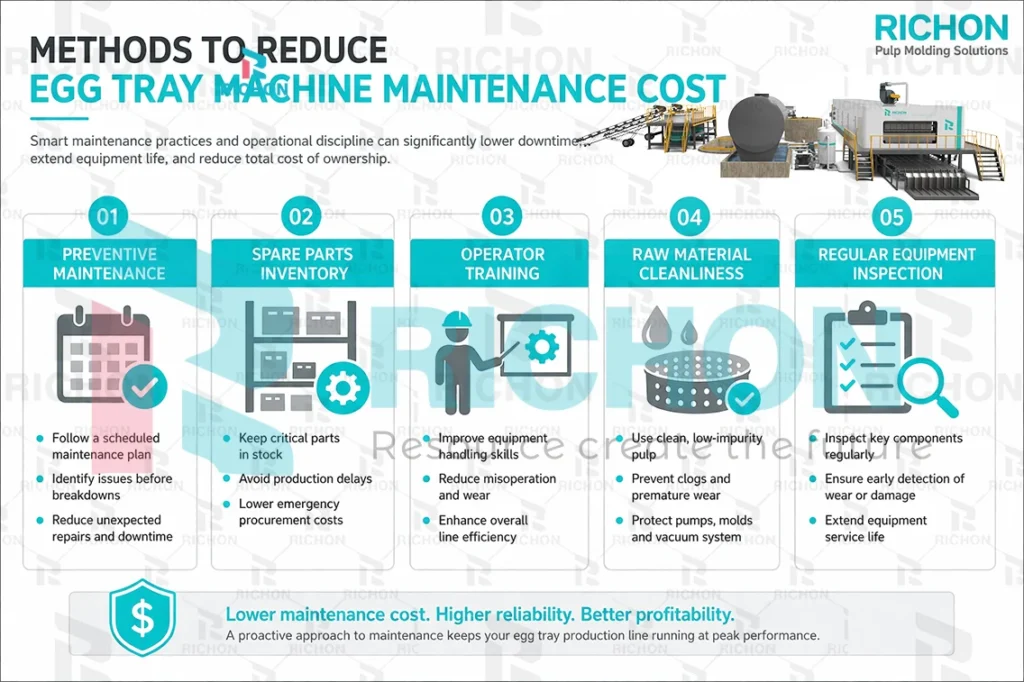
How to Reduce Egg Tray Machine Maintenance Cost
1. Use cleaner raw material input
Better sorting and screening reduce wear on pumps, pipelines, and molds.
2. Choose a well-matched capacity
An oversized or poorly matched line often creates unstable operation and avoidable maintenance pressure.
Related reading: How to Choose the Right Egg Tray Production Line Capacity (1,000–8,000 pcs/h Guide)
3. Maintain the drying system properly
Many factories focus on forming but ignore dryer chain, fan, burner, and conveyor inspection.
4. Keep a basic spare-parts inventory
Fast replacement of common wearing parts reduces downtime and protects delivery schedules.
5. Train operators
Good operator habits reduce accidental damage, overload operation, and daily misuse.
6. Build a real maintenance schedule
A maintenance checklist is much cheaper than emergency shutdown.
Is a More Automatic Egg Tray Machine More Expensive to Maintain?
Not necessarily.
This is a common misunderstanding.
A more automatic line may use more advanced control systems, but it also usually offers:
- more stable cycle control,
- less manual interference,
- lower operator error,
- more predictable production.
So the correct comparison is not:
“automatic vs manual = which one has more parts”
The correct comparison is:
“which system creates lower total operating cost per year, including downtime risk”
In many medium and large factories, a stable automatic line is actually easier to manage over time.
How Maintenance Cost Connects to Total Production Cost
Maintenance is one part of the bigger operating-cost picture.
A serious buyer should evaluate these topics together:
- raw material cost,
- electricity consumption,
- drying system fuel cost,
- labor cost,
- maintenance cost,
- downtime risk.
Related reading: What Determines the Real Production Cost of an Egg Tray Production Line?
And for energy reference: How Much Electricity Does an Egg Tray Machine Use? Power Consumption Guide
FAQ: Maintenance Cost of Egg Tray Machine
Is egg tray machine maintenance expensive?
Normally, no. For a well-designed and well-operated line, maintenance cost is manageable and usually far lower than drying energy cost or raw material cost. The problem starts when preventive maintenance is ignored.
Which parts wear fastest in an egg tray production line?
Common wearing areas include mold accessories, pump seals, bearings, vacuum parts, and dryer transmission components.
Does a larger line always have higher maintenance cost?
The absolute spare-parts value may be higher, but larger lines often have better operational stability. The more important factor is downtime cost, not only part price.
How can I reduce maintenance cost?
Use cleaner raw material, train operators, keep spare parts ready, and follow a preventive maintenance plan.
Is mold maintenance important?
Yes. Mold condition directly affects tray shape, water removal efficiency, and product consistency.
Conclusion
Egg tray machine maintenance cost is not the biggest visible cost in production, but it strongly affects machine stability, output consistency, and long-term profitability.
A buyer who only compares machine price may miss the real operating picture.
A buyer who understands maintenance budget, spare-parts planning, and downtime risk makes a much better investment decision.
If you are comparing different egg tray production solutions, maintenance cost should always be evaluated together with:
- capacity,
- energy consumption,
- drying method,
- raw material quality,
- and expected ROI.
For a project-specific recommendation, it is better to calculate maintenance planning as part of the full operating-cost analysis, not as an afterthought.
Need a Capacity Recommendation for Your Market?
Share your target output, local humidity/energy conditions, and tray type. Our engineers will suggest a suitable 3,000–8,000 pcs/h configuration and drying solution.
- Factory layout & utilities checklist
- Drying bottleneck evaluation
- Cost & ROI estimation reference
