 English
Richon Capacity Solutions
1000 pcs/h Egg Tray Production Line for Small-Scale Production
The Richon REM3-1 egg tray production line provides a reference output of 800–1000 trays per hour. It is designed for small commercial projects that need coordinated pulping, forming, drying, labor, utility and factory-layout planning rather than a forming machine selected on capacity alone.
- 800–1000 pcs/h Verified reference forming capacity
- 3 molding stations Entry-level REM3-1 forming configuration
- 3–5 operators Planning reference based on handling and automation
- Flexible drying routes Natural, brick or compact mechanical drying
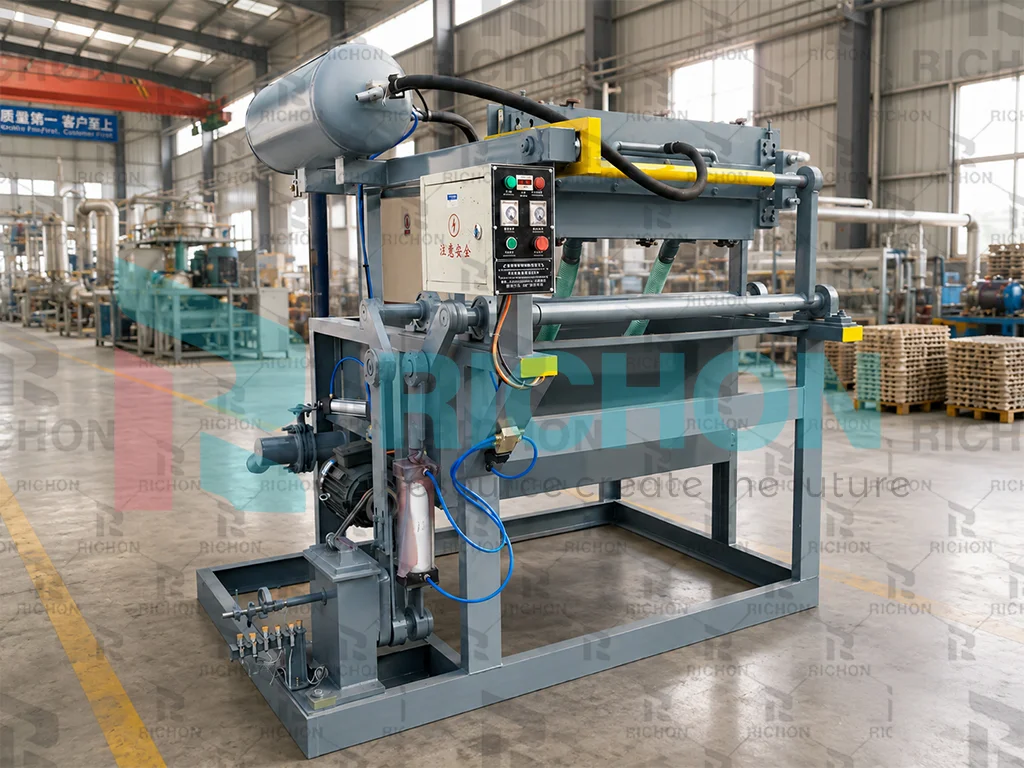
REM3-1 Quick Overview
- Capacity 800–1000 pcs/h
- Installed Power 32 kW
- Running Reference 22.4 kW
- Labor Reference 3–5 persons
Quick Engineering Answer
Is a 1000 pcs/h Egg Tray Production Line Right for Your Project?
A 1000 pcs/h egg tray production line is generally suitable for a small commercial project that needs manageable initial investment, flexible daily production and lower pressure on electricity, labor and factory space. The complete line should be selected by matching the forming machine with pulping capacity, drying method, utilities, tray handling and expected daily sales—not by hourly forming output alone.
The Richon REM3-1 provides a reference forming capacity of 800–1000 trays per hour. It is commonly considered when a business is entering a local market, testing customer demand or building an initial production base before moving to a larger capacity. Final suitability depends on the operating schedule, climate, drying conditions, available fuel, workshop size and the number of trays that can actually be sold each day.
REM3-1 Engineering Parameters
1000 pcs/h Egg Tray Line Specifications and Daily Output
The figures below are preliminary planning references for the Richon REM3-1 egg tray production line. Final power, labor, material use and output must be confirmed after the drying method, mold design, automation level, tray specification and local operating conditions are selected.
How the REM3-1 Capacity Is Defined
The published capacity refers to the forming section. A complete project must also provide enough pulping, vacuum, drying and handling capacity to maintain the same production rhythm.
Forming Capacity Must Match the Complete Production System
A practical 1000 pcs/h project coordinates pulp preparation, forming, vacuum, wet-tray handling, drying, water circulation, utilities and operator workflow.
Core REM3-1 Technical Parameters
These figures support preliminary machine selection and utility planning. They must be checked again when the dryer and auxiliary systems are confirmed.
Reference forming output before downtime, rejects and drying limitations are considered.
REM3-1 forming configuration for entry-level commercial production.
Preliminary reference before the selected dryer and auxiliary equipment are confirmed.
Estimated operating reference rather than guaranteed electricity consumption.
REM3-1 Project Planning References
| Model | Richon REM3-1 |
|---|---|
| Reference capacity | 800–1000 egg trays per hour |
| Labor reference | Approximately 3–5 persons, depending on wet-tray handling, drying, stacking and automation. |
| Drying options | Natural drying, brick drying or compact mechanical drying, selected according to climate, fuel, land and production continuity. |
| Suitable products | Common paper egg trays and similar molded-pulp products, subject to mold design and forming-cycle confirmation. |
| Project positioning | Small commercial production, market-entry projects and controlled-capacity startup operations. |
Complete Production System
What Is Included in a 1000 pcs/h Egg Tray Production Line?
A practical REM3-1 project includes more than the egg tray forming machine. Pulp preparation, vacuum, wet-tray handling, drying, process water, electrical controls and finished-product collection must all support the same production rhythm.
The Forming Machine Is Only One Part of the Project
Selecting a machine with an output of 800–1000 trays per hour does not automatically create a complete production line. The pulping system must supply stable pulp, the vacuum system must support the forming cycle, and the drying section must process wet trays without becoming a bottleneck.
Production Flow from Waste Paper to Finished Egg Trays
Every section should be configured for a compatible output so that one slow process does not restrict the complete line.
- 01 Waste Paper Sorting
- 02 Hydrapulping
- 03 Pulp Adjustment
- 04 Tray Forming
- 05 Wet Tray Transfer
- 06 Drying
- 07 Tray Collection
- 08 Packing and Storage
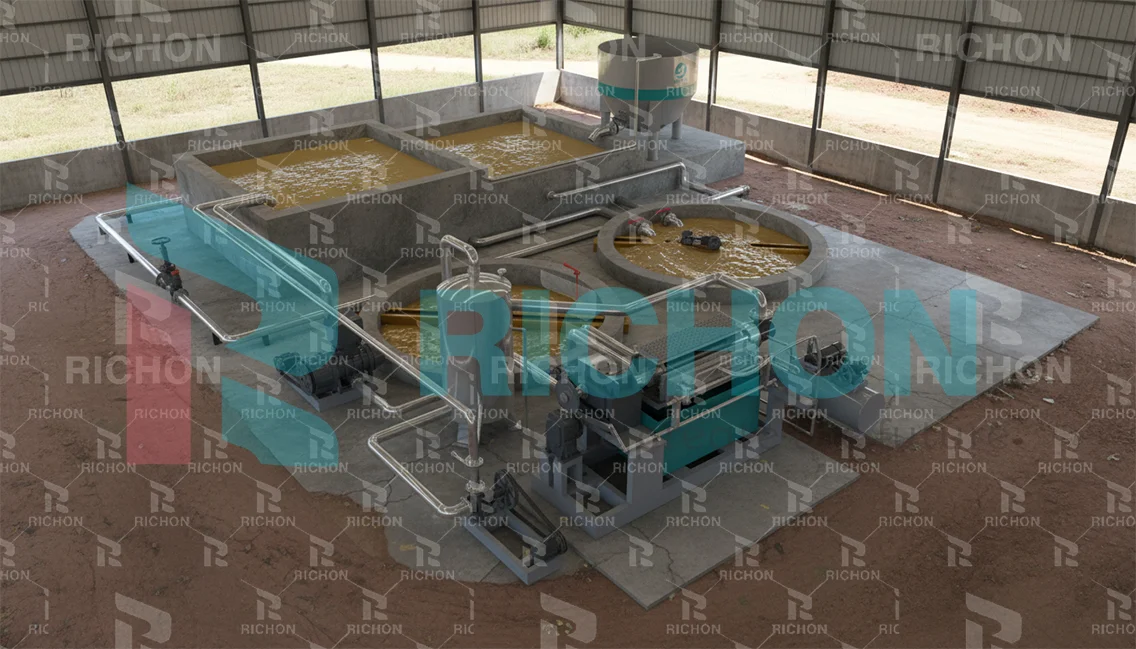
Pulp Preparation and Water Circulation
Stable pulp consistency and water circulation help control tray weight, fiber distribution and forming stability.
Waste Paper Preparation
Waste paper is sorted to remove plastic, metal and excessive contaminants before entering the pulping system.
Hydrapulper and Pulp Tanks
The hydrapulper separates waste paper into fibers. Mixing, storage and supply tanks maintain continuous pulp circulation.
Process-Water Recycling
Water removed during forming is returned to the pulping system, reducing fresh-water makeup and stabilizing pulp preparation.
Forming, Vacuum and Wet-Tray Handling
These systems determine how the pulp is formed, dewatered, released and transferred without damaging wet trays.
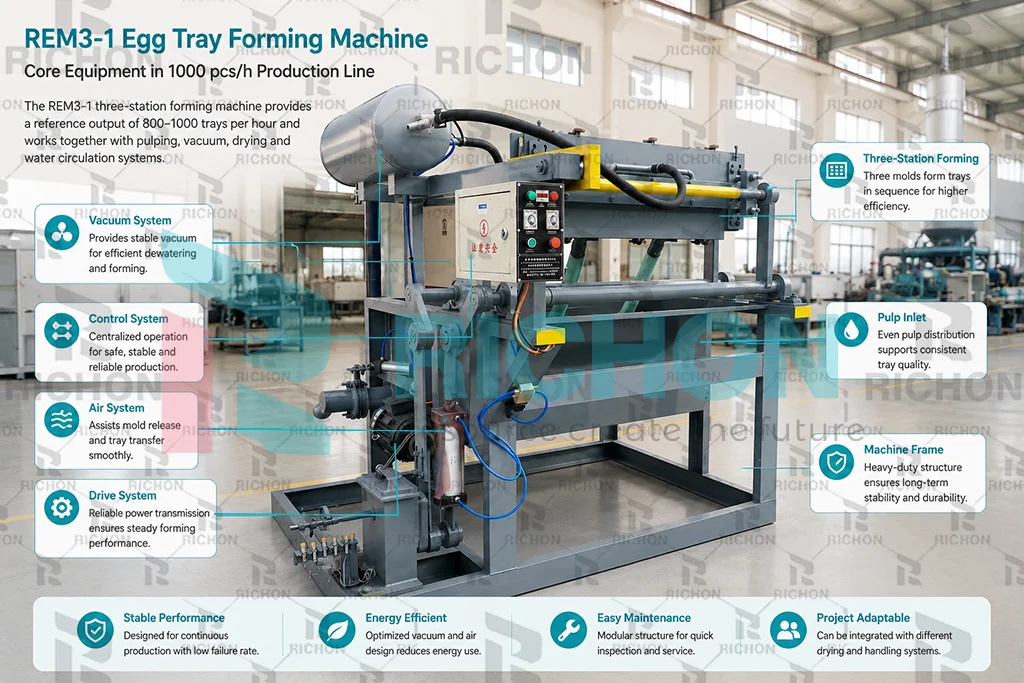
REM3-1 Forming Machine
The three-station forming system provides a reference output of 800–1000 trays per hour under suitable operating conditions.
Vacuum and Compressed Air
Vacuum removes water through the molds, while compressed air assists tray release and transfer during the forming cycle.
Wet-Tray Transfer
Wet trays may be handled manually, placed on drying racks or transferred toward mechanical drying equipment.
Drying, Collection and Electrical Control
The drying route and finished-tray handling method affect labor, factory space, operating continuity and project investment.
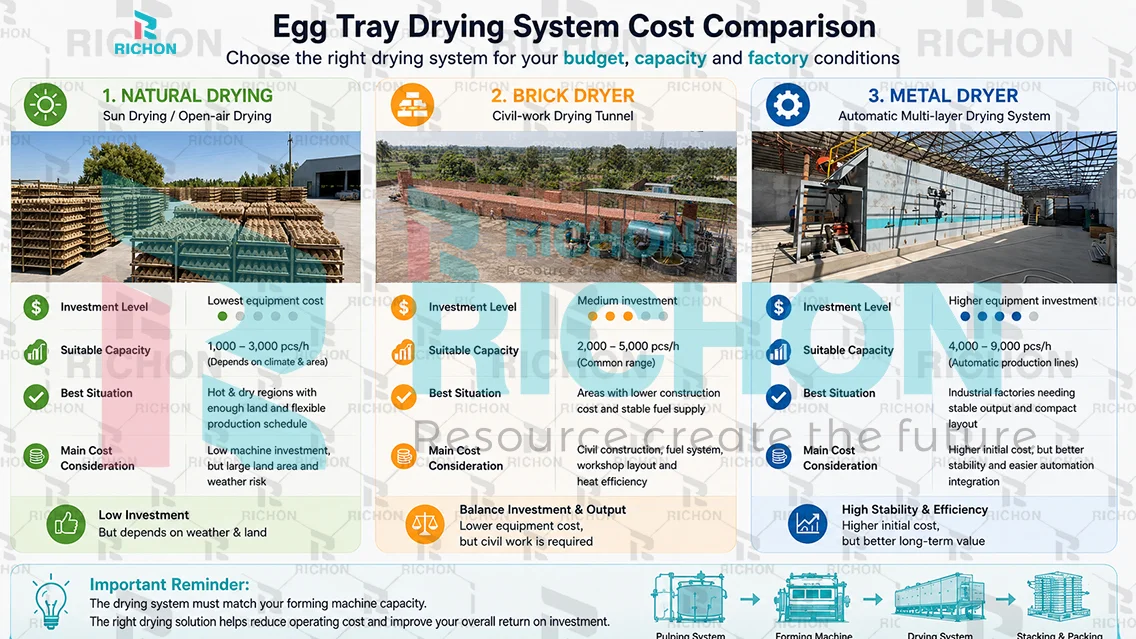
Drying System
Natural drying, brick drying or compact mechanical drying can be selected according to climate, land, fuel and production needs.
Tray Collection and Packing
Dried trays are inspected, counted, stacked and prepared for finished-product storage or customer delivery.
Electrical Control
Motors, pumps, agitators and forming equipment require coordinated controls matched to the local voltage and power supply.
Not every 1000 pcs/h project needs the same dryer, automation level or tray-handling equipment. Richon confirms the equipment list after reviewing daily demand, product specification, climate, fuel, power, workshop space and expansion plans.
Capacity Selection
When Should You Choose a 1000 pcs/h Egg Tray Production Line?
The REM3-1 is designed for controlled-capacity commercial production, but it is not the correct choice for every project. Daily sales, operating hours, drying conditions, labor availability and future expansion plans should be reviewed before the machine capacity is confirmed.
Choose the REM3-1 When
The following conditions generally match a small commercial 800–1000 pcs/h project.
- Local demand is still developing The business is building customer channels or confirming the number of trays that can be sold consistently.
- Daily sales are approximately 6,000–10,000 trays The planned working schedule and expected order volume fit the practical output of an entry-level commercial line.
- Initial investment must remain controlled The project needs a complete production system without immediately moving into a larger automated capacity.
- Natural drying is practical Local climate, land and production schedules allow wet trays to be dried without a large continuous dryer.
- Three to five operators are available Local labor can support pulping, wet-tray handling, drying, inspection, stacking and packing.
- The project needs a manageable starting scale The investor prefers to establish production and sales before considering a larger capacity.
Consider a Larger Line When
Choosing a larger capacity at the beginning may reduce the risk of early production shortages.
- Confirmed orders already exceed the planned output Existing customer demand requires more trays than the REM3-1 can produce during the available working hours.
- Daily demand may exceed 12,000–15,000 trays A higher-capacity forming and drying system may provide more practical production time and reserve capacity.
- Production must continue throughout the year Seasonal rain, high humidity or strict delivery schedules may require more automated forming and mechanical drying.
- The business will supply several regions Distribution to multiple cities or large poultry farms normally requires greater production reserve and storage capacity.
- Expansion is expected in the near term Buying a very small line may create duplicate equipment, relocation and reconfiguration costs when capacity increases.
- Lower labor dependence is a priority A larger automated line may better support continuous transfer, mechanical drying and finished-tray stacking.
Match Capacity to Real Daily Sales
Machine selection should start with expected saleable output rather than the highest hourly capacity shown in a specification table. Working hours, utilization rate, drying time and rejected products must also be considered.
Review the Operating Schedule
Demand below this level may not require a full daily shift. Review market development, labor utilization and drying arrangements before finalizing the project.
Typical 1000 pcs/h Project
This range generally fits an 8–10 hour production schedule before actual utilization, drying limitations and rejected trays are deducted.
Compare Higher Capacities
Consistent demand above this level may justify a larger forming machine, stronger dryer capacity and a layout designed for continuous production.
The correct capacity depends on daily customer demand, operating shifts, expected utilization, drying continuity, finished-product storage and future expansion. Richon can compare the REM3-1 with larger models before the configuration is finalized.
Factory Layout Planning
Factory Space and Utility Planning for a 1000 pcs/h Egg Tray Line
Factory size cannot be calculated from the forming machine alone. Drying method, raw-paper storage, pulp tanks, wet-tray handling, finished-product storage, maintenance access and future expansion all affect the final layout.
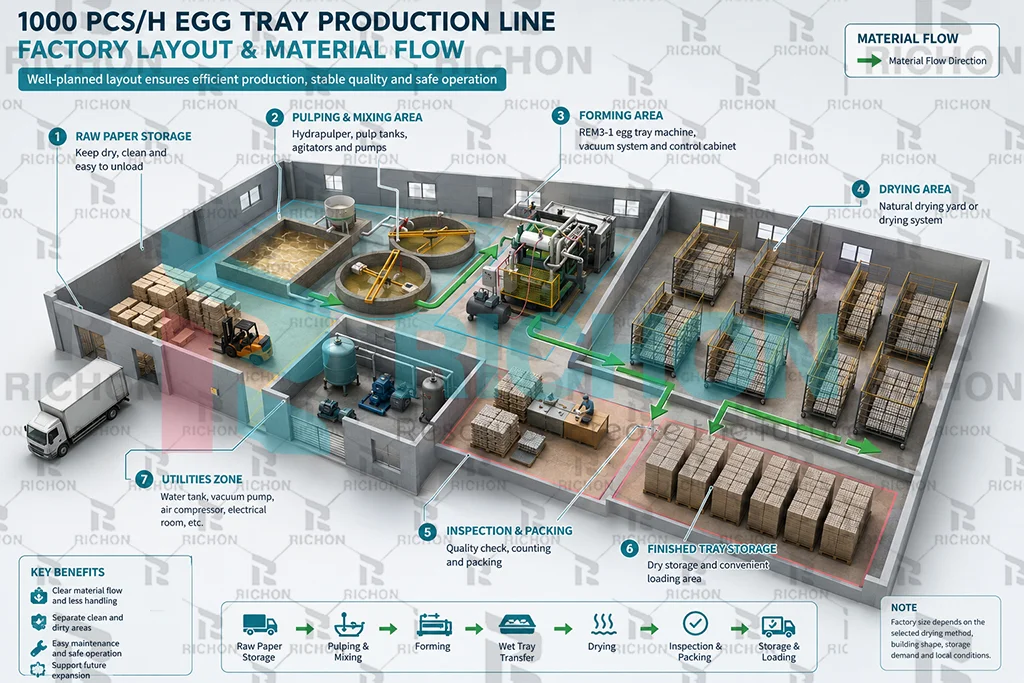
How Much Space Does the Project Need?
Richon should confirm the layout after the building dimensions, drying route and daily operating plan are known. A small forming section may still require substantial land when natural drying and finished-tray storage are included.
- 01 Natural drying requires outdoor land Drying racks, carts, tray movement and weather protection can occupy more space than the forming equipment.
- 02 Brick drying requires fixed civil space The drying channel, hot-air source, fuel area and maintenance access must be included in the building plan.
- 03 Metal drying creates a more compact flow Outdoor land can be reduced, but the dryer, transfer equipment and utility connections require coordinated indoor space.
- 04 Finished trays require significant storage volume Egg trays are lightweight but bulky, so storage and vehicle loading areas should not be underestimated.
Recommended Factory Zones
Separating the main operating zones improves material flow, maintenance access, quality control and worker safety.
Raw Paper Storage
Keep waste paper dry, organized and separated from finished products. Reserve access for unloading and contamination removal.
Pulping and Mixing Area
Position the hydrapulper, pulp tanks, agitators and pumps where water supply, drainage and maintenance access are practical.
Forming Area
Provide clear space around the REM3-1 machine, vacuum equipment, control cabinet, pipelines and wet-tray collection position.
Drying Area
The drying zone may be outdoors, inside a brick channel or integrated with a metal dryer according to the selected system.
Inspection and Packing
Finished trays should be inspected, counted, stacked and packed before entering the storage or delivery area.
Finished-Tray Storage
Reserve dry storage and loading access for bulky tray stacks, customer orders and short-term production inventory.
Plan a One-Direction Material Flow
A clear route reduces repeated handling, wet-tray damage and interference between raw materials, workers and finished products.
Utilities That Must Be Confirmed Before Installation
Utility planning should be completed before foundations, pipelines and electrical work are finalized.
| Utility | Planning Requirement | Why It Matters |
|---|---|---|
| Electricity | Confirm local voltage, phase, frequency, transformer capacity, cable size and protection. | The final electrical load changes with pumps, pulping, forming, air equipment and the selected dryer. |
| Process water | Provide initial system water, circulating-water tanks and controlled fresh-water makeup. | Stable water circulation supports pulp consistency and reduces unnecessary fresh-water consumption. |
| Drainage | Plan floor slope, cleaning-water drainage and controlled collection points. | Poor drainage creates unsafe floors, contamination and difficult maintenance. |
| Compressed air | Confirm pressure, air volume, compressor position and piping route. | Compressed air supports mold release and wet-tray transfer. |
| Vacuum system | Reserve pump space, piping routes, cooling water and maintenance access. | Stable vacuum directly affects forming speed and tray dewatering. |
| Fuel and ventilation | Required only for fuel-based drying systems and designed according to local safety rules. | Fuel storage, combustion air and exhaust routing affect safety and drying performance. |
Buyers sometimes measure only the forming equipment and ignore pulp tanks, access aisles, drying racks, fuel equipment, tray storage and vehicle loading. This can create congestion, unsafe maintenance conditions and expensive layout changes after installation.
Investment and Profitability Planning
What Determines the Cost and ROI of a 1000 pcs/h Egg Tray Line?
The forming-machine price is only one part of the project investment. Drying, pulping, factory preparation, utilities, transport, installation and working capital must be included before profitability or payback can be evaluated.
Six Main Parts of the Initial Investment
A reliable project budget should cover the complete production system rather than only the price of the forming machine.
Pulping and Forming Equipment
This includes the hydrapulper, pulp tanks, agitators, pumps, REM3-1 forming machine, vacuum equipment, air system and electrical controls.
Drying System
Natural drying has lower equipment investment, while brick or metal drying adds construction, thermal equipment, fuel handling and transfer requirements.
Factory and Civil Work
Floors, foundations, pulp pools, drainage, drying areas, electrical rooms, storage, ventilation and loading access can represent a significant local investment.
Utility Installation
Transformers, cables, water pipelines, pumps, compressed-air piping, vacuum piping, fuel systems and exhaust equipment should be included in the budget.
Freight and Installation
International freight, customs, inland transport, unloading, installation support, commissioning and local technician costs vary by destination.
Working Capital
The project also needs funds for waste paper, fuel, electricity, labor, packaging, spare parts, transport and customer-payment cycles after production begins.
Calculate Saleable Output Before Estimating Profit
Theoretical machine output should not be used directly as the number of trays sold. Utilization, rejects and drying limitations must be deducted.
Daily Saleable Tray Output
Hourly forming output × operating hours × utilization rate × qualified-product rate
Startup, cleaning, mold adjustment, maintenance, drying delays and damaged trays reduce actual saleable output.
Estimated Operating Profit
Tray sales revenue − raw paper − energy − electricity − labor − maintenance − packing and delivery
Taxes, financing, rent, depreciation and local administrative costs may also need to be included in a complete business model.
Factors That Shorten or Extend the Payback Period
ROI is influenced by both market conditions and production efficiency. Higher machine output alone does not guarantee a faster payback.
Stable Customer Demand
A production line creates value only when qualified trays can be sold consistently without excessive inventory.
Selling Price
Tray specification, quality, local competition, delivery terms and customer volume affect the achievable selling price.
Production Utilization
Long idle periods, unstable pulp supply, dryer bottlenecks and repeated adjustment reduce the return generated by the equipment.
Qualified-Product Rate
Cracked, deformed, under-dried or inconsistent trays consume material and energy but do not create full sales revenue.
Drying Efficiency
Matching dryer capacity and insulation to the forming output helps control fuel cost and production delays.
Future Expansion
A layout with expansion space can reduce relocation and duplicated civil-work costs when the market grows.
Information Needed for a Project-Specific ROI Review
Richon can prepare a more practical investment and operating-cost reference after the local market, utilities, raw materials, drying conditions and production schedule are known. The calculation should compare the REM3-1 with larger alternatives when future demand is uncertain.
- ✓ Expected daily tray sales
- ✓ Local tray selling price
- ✓ Waste-paper purchase price
- ✓ Electricity tariff and voltage
- ✓ Fuel type and local price
- ✓ Labor cost per shift
- ✓ Drying method and climate
- ✓ Factory size and existing utilities
A low equipment price does not automatically create a profitable project. Missing dryer capacity, insufficient storage, unstable demand, high fuel cost, low product quality or excessive downtime can extend the payback period even when the forming machine reaches its rated output.
Capacity Comparison
1000 vs 2000 vs 3000 pcs/h Egg Tray Production Lines
The best capacity is not always the largest machine or the lowest initial investment. Market demand, operating shifts, drying conditions, labor, utility capacity and future expansion should be compared before the production line is selected.
Compare the Three Project Positions
Each capacity supports a different business stage. The forming machine, dryer and factory layout should be planned as one system.
Small Commercial Entry Project
Suitable for investors who need a manageable production scale, flexible drying and lower initial utility pressure.
- Typical project stage Market entry, local sales development or controlled startup.
- Drying approach Natural drying is often evaluated first, with brick or compact mechanical drying used when required.
- Main advantage Lower entry pressure on investment, utilities and factory preparation.
- Main limitation Limited reserve when customer demand grows quickly.
Growing Regional Production
Suitable when the market has moved beyond initial testing and the project needs more daily output without entering a larger commercial scale immediately.
- Typical project stage Growing customer base, regional supply or increasing daily orders.
- Drying approach Natural, brick or mechanical drying should be compared against climate and production continuity.
- Main advantage More production reserve and stronger ability to serve growing orders.
- Main limitation Requires greater investment, utilities, storage and dryer throughput than a 1000 pcs/h line.
Stable Commercial Production
Suitable when the project has established sales, stronger factory utilities and a drying route designed for reliable daily production.
- Typical project stage Established local demand, multiple customer groups or regional distribution.
- Drying approach Brick or metal drying is normally more important when stable continuous production is required.
- Main advantage Greater daily output, stronger production reserve and better support for commercial distribution.
- Main limitation Higher requirements for utilities, factory layout, drying, storage and working capital.
Capacity Selection Comparison
This table provides a project-positioning reference rather than a fixed technical quotation.
| Selection Factor | 1000 pcs/h | 2000 pcs/h | 3000 pcs/h |
|---|---|---|---|
| Project stage | Market entry or small local production | Growing commercial demand | Established commercial market |
| Initial investment pressure | Lower | Medium | Higher |
| Utility requirement | Lower relative pressure | Moderate | Stronger power, water, air and drying requirements |
| Drying selection | Natural drying commonly evaluated first | Natural, brick or mechanical drying | Brick or metal drying often preferred for continuity |
| Production reserve | Limited when demand increases quickly | Moderate reserve for market growth | Stronger reserve for established sales |
| Factory and storage | Smaller production system but drying may still need land | More space for equipment, drying and inventory | Integrated material flow and larger storage are important |
| Best suited to | First commercial project or controlled-capacity startup | Regional suppliers with growing orders | Stable commercial operation and broader distribution |
Stay with 1000 pcs/h When
The project still needs to control investment and confirm a stable local sales channel.
- Daily demand fits a normal REM3-1 operating schedule.
- Natural drying is reliable in the local climate.
- The customer base is still being developed.
- Lower startup investment is more important than reserve capacity.
Upgrade Capacity When
The cost of insufficient production may be greater than the additional investment in a larger line.
- Confirmed orders already approach the practical daily capacity.
- Expansion is expected shortly after production begins.
- Stable year-round delivery and mechanical drying are required.
- The project will supply multiple customers or regions.
Moving from 1000 to 2000 or 3000 pcs/h changes more than the forming equipment. Pulping, vacuum, drying, utilities, factory space, finished-tray storage and working capital should be recalculated before the larger capacity is selected.
Frequently Asked Questions
Questions About the 1000 pcs/h Egg Tray Production Line
The answers below provide preliminary guidance on REM3-1 output, labor, drying, raw materials, factory planning, expansion and project profitability.
Equipment, Output and Operation
These questions explain the capacity, labor and material requirements of the REM3-1 production line.
01 What capacity does the REM3-1 egg tray line produce?
The REM3-1 has a reference forming capacity of 800–1000 egg trays per hour. This figure describes the forming section rather than guaranteed dried and saleable output.
Actual production depends on pulp consistency, mold condition, vacuum stability, drying throughput, downtime, rejected trays and operator performance.
02 How many trays can the line produce in one day?
At the reference forming rate, an 8-hour shift provides a theoretical output of approximately 6,400–8,000 trays, while a 10-hour schedule provides approximately 8,000–10,000 trays.
Saleable daily output will normally be lower after startup, cleaning, maintenance, drying delays and rejected products are deducted.
03 How many workers are required for a 1000 pcs/h line?
A preliminary labor reference is approximately 3–5 people per shift. The final number depends on the drying route, wet-tray transfer, tray collection, packing and level of automation.
Natural drying usually requires more manual tray handling than an integrated mechanical drying system.
04 What raw materials can be used to make paper egg trays?
Common materials include waste cartons, newspapers, office paper, book paper and other recyclable paper fibers. Plastic, metal, excessive adhesive and heavily contaminated materials should be removed before pulping.
Raw-paper composition affects pulp strength, tray weight, surface quality and forming stability.
Drying, Factory Planning and Investment
These answers cover dryer selection, factory space, future expansion and ROI planning.
05 Which drying method is best for a 1000 pcs/h project?
Natural drying is usually evaluated first when the climate is warm and dry, sufficient land is available and production can tolerate weather variation.
Brick or compact metal drying may be more suitable in rainy, humid or space-limited locations that require stable daily delivery. Review the drying-system comparison before confirming the project.
06 How much factory space is needed?
There is no single fixed factory area because the dryer, storage requirement, building shape and material flow have a major effect on the layout.
Natural drying requires more outdoor land, while mechanical drying creates a more compact process but adds integrated equipment and utility space. See the egg tray factory layout guide .
07 Can the 1000 pcs/h production line be expanded later?
Some auxiliary systems, storage areas and factory utilities can be planned with future expansion in mind. However, increasing output may require a larger forming machine, stronger pulping, additional vacuum capacity and a higher-throughput dryer.
If expansion is expected soon, compare the 2000 pcs/h solution and 3000 pcs/h solution before purchasing.
08 What is the expected payback period of the project?
A reliable payback period cannot be calculated from the machine price alone. It depends on local tray selling prices, saleable output, waste-paper cost, electricity, drying energy, labor, maintenance, transport and customer demand.
Richon can prepare a project-specific cost and ROI reference after the local market, operating schedule, utilities and drying conditions are provided.
Capacity, power, labor, dryer size, factory layout and operating cost should be confirmed after Richon reviews the tray specification, daily demand, climate, utilities, fuel, building dimensions and expansion plan.
Related Engineering Resources
Plan the Complete 1000 pcs/h Egg Tray Production Project
Machine capacity is only one part of project planning. Review the equipment, drying, production process, factory layout, operating cost and capacity alternatives before confirming the final configuration.
Related Egg Tray Production Guides
These pages provide more detailed information for equipment selection, dryer planning, factory preparation and investment evaluation.
Egg Tray Machine Selection
Compare machine models, forming capacities, core systems, raw materials, molds and project configuration factors.
Explore Egg Tray MachinesEgg Tray Production Line
Understand how pulping, forming, vacuum, drying, collection and electrical controls work as one production system.
View the Complete Production LineEgg Tray Dryer Systems
Review natural, brick and metal drying systems based on climate, factory land, fuel and production continuity.
Explore Dryer SystemsDrying System Comparison
Compare drying investment, land requirements, labor dependence, weather risk and operating continuity.
Compare Drying MethodsEgg Tray Factory Layout
Plan raw-paper storage, pulping, forming, drying, utilities, maintenance access and finished-product storage.
Read the Factory Layout GuideProduction Cost Analysis
Evaluate waste paper, electricity, drying energy, labor, maintenance, qualified output and delivery cost.
Review Production Cost FactorsIs the REM3-1 the Right Capacity for Your Market?
Share your daily sales target, tray specification, local climate, electricity, fuel, factory space and raw-material costs. Richon will compare the REM3-1 with larger alternatives and prepare a preliminary capacity, drying, factory-layout and operating-cost recommendation.
- Capacity and operating-shift comparison
- Natural, brick or metal dryer selection
- Factory layout and utility planning
- Operating-cost and ROI calculation reference