 English
Industrial Pulp Molding Machine for Protective Packaging
Richon reciprocating industrial pulp molding machines are configured for custom molded fiber trays, inserts, end caps and protective packaging. Machine selection is based on your product dimensions, mold structure, forming cycle, target output and downstream drying requirements.
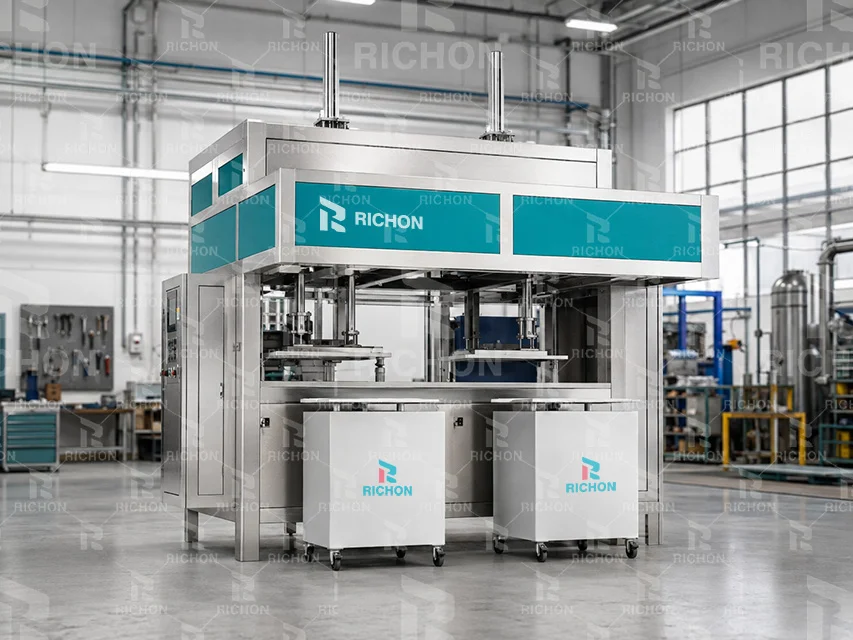
Custom Mold Engineering
Mold dimensions, cavity layout and forming structure are planned around your packaging sample, drawing or product dimensions.
Reciprocating Pulp Forming
Suitable for customized molded fiber products where size, geometry, depth and production cycle vary by project.
Machine + Mold + Drying
Richon evaluates forming equipment, vacuum demand, drying, utilities and factory conditions as one production project.
What Is an Industrial Pulp Molding Machine?
This type of machine is designed for customized molded fiber packaging rather than only standardized products such as egg trays.
An industrial pulp molding machine is a reciprocating forming system used to produce customized molded fiber packaging such as protective trays, inserts and end caps. Prepared pulp is formed on a product-specific mold using vacuum-assisted fiber deposition and dewatering before the wet molded part is transferred for drying and optional finishing.
Unlike rotary egg tray equipment, industrial packaging output is normally calculated for the customer’s specific product. Product dimensions, weight, mold cavity layout, forming cycle and actual operating conditions all affect final production capacity. This makes the machine suitable for projects where packaging geometry and production requirements vary from one product to another.
Richon supplies this machine as part of its broader pulp molding equipment range, with the forming machine, custom molds, vacuum system, drying requirements and factory conditions evaluated together.
Product-Specific Forming
The mold and forming cycle are configured around the dimensions, shape, weight and protection requirements of the customer’s molded fiber product.
Reciprocating Machine Structure
The reciprocating forming concept provides flexibility for customized industrial trays, inserts, end caps and other non-standard protective packaging.
Capacity Calculated by Product
Output is not represented by one universal pcs/h value. Capacity is calculated after the product and mold configuration are confirmed.
What Products Can an Industrial Pulp Molding Machine Make?
A reciprocating industrial pulp molding machine can produce custom molded fiber packaging based on the customer’s product shape and protection requirements. The finished packaging geometry is mainly determined by the custom mold rather than by one fixed standard tray design.
Protective Packaging Trays
Custom molded trays can support, position and separate products during storage, handling and transportation.
Molded Fiber Inserts
Product-specific inserts can be formed around components that require locating, spacing or protective support inside an outer package.
Industrial End Caps
Molded pulp end supports can protect selected areas of a product and help reduce movement within the transport package.
Component Positioning Trays
Customized cavities can organize industrial parts, accessories or assembled components according to their dimensions and required spacing.
Fragile Product Inserts
Mold geometry can be developed to provide positioning and separation for products that require additional protection during transportation.
Custom Molded Fiber Products
Other non-standard molded pulp packaging can be evaluated according to the customer’s sample, drawing, dimensions and required production target.
For industrial packaging projects, the product comes first. Richon evaluates the packaging shape and dimensions before determining mold cavities, forming cycle, machine configuration and production capacity.
Why Use a Reciprocating Pulp Molding Machine for Industrial Packaging?
Industrial protective packaging is often developed around a specific product rather than a fixed standard tray. A reciprocating pulp molding machine provides greater flexibility for projects where mold dimensions, cavity layout, product geometry and forming requirements change according to the packaging design.
A reciprocating pulp molding machine is particularly suitable for customized industrial molded fiber packaging because the forming system can be configured around the customer’s product-specific mold. Instead of optimizing the machine around one standardized tray format, Richon evaluates the packaging dimensions, mold cavities, forming cycle and required production target before confirming the final machine configuration.
Flexible Mold Dimensions
Industrial packaging products may vary significantly in length, width, depth and cavity arrangement. The machine and mold platform can therefore be selected according to the actual molded fiber product instead of one fixed tray specification.
Customized Product Geometry
Protective trays, inserts and end caps often contain different support points, cavities and positioning structures. Product-specific molds allow the forming system to match these customized packaging geometries.
Adjustable Forming Requirements
Product weight, wall structure, pulp drainage and mold cavity layout influence the required forming cycle. For this reason, industrial packaging projects are evaluated product by product rather than assigning one universal production speed.
Better Fit for Custom Projects
When a manufacturer needs to produce a defined molded fiber package for a particular component or finished product, machine selection can begin with the packaging sample, drawing or dimensions and then work backward to the required mold and equipment configuration.
Reciprocating Forming vs Standard Egg Tray Production
These two machine types serve different production priorities. A rotary egg tray machine is typically selected for repeated production of standardized tray products, where capacity can be described more directly in trays per hour.
For industrial molded fiber packaging, however, capacity is product-specific. Richon first confirms the molded product, mold layout and forming requirements before calculating the expected output and production line configuration.
How Does a Reciprocating Industrial Pulp Molding Machine Work?
The production process converts prepared fiber pulp into custom molded packaging through vacuum forming, dewatering and wet-product transfer. The mold design and forming conditions are adjusted according to the customer’s finished product.
In a reciprocating industrial pulp molding system, prepared pulp is supplied to the forming section and fibers are deposited onto a product-specific forming mold by vacuum. Water is removed through the mold drainage structure, the wet molded product is released or transferred from the forming position, and it then enters the drying stage. Depending on the required finished-product quality, hot pressing, shaping or trimming can be added as optional downstream processes.
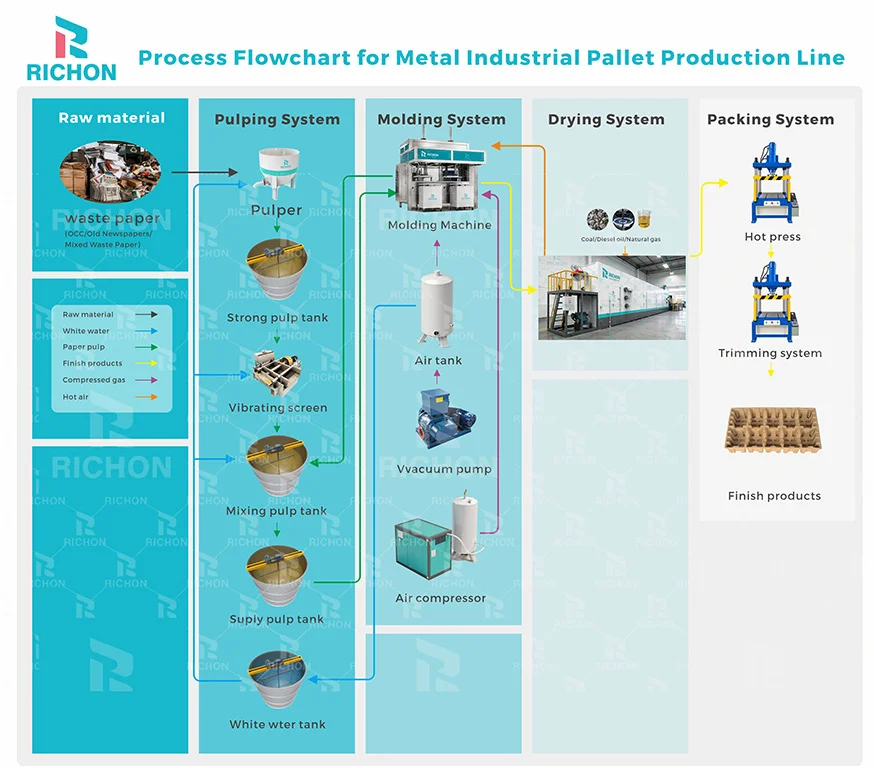
Industrial packaging products can differ in size, weight, depth and cavity structure. The forming and dewatering settings therefore need to be matched to the actual molded product rather than one fixed tray standard.
Pulp Preparation
Recycled paper or other suitable fiber material is pulped, screened and mixed to prepare a stable pulp suspension for the forming process.
Pulp Supply & Conditioning
Prepared pulp is supplied to the forming section with process conditions adjusted according to the molded product and production requirements.
Vacuum Forming
The forming mold moves into the required forming position. Vacuum draws pulp fibers onto the mold surface until the required wet molded structure is created.
Dewatering
Water passes through the mold mesh and drainage channels while the fiber layer remains on the forming surface, reducing the moisture load before drying.
Wet Product Transfer
After forming and initial dewatering, the molded wet part is released or transferred from the forming mold for the next production stage.
Drying
Remaining moisture is removed through the selected drying system according to product weight, structure, moisture load and target production.
Optional Finishing
Depending on the required surface quality, dimensional accuracy and finished packaging design, hot pressing, shaping or trimming can be added after drying.
Why the Forming Cycle Is Product-Specific
Industrial molded fiber products can differ greatly in dimensions, weight, cavity depth, wall structure and mold layout . These variables affect vacuum forming time, dewatering and transfer conditions. This is why Richon calculates production capacity only after the customer’s actual product and mold configuration are confirmed.
Main Systems of an Industrial Pulp Molding Machine
An industrial pulp molding project combines the forming machine, pulp supply, vacuum, transfer and control systems into one coordinated process. The final system configuration depends on the molded packaging product, mold layout and required production conditions.
The core of a reciprocating industrial pulp molding machine is the forming and transfer system, supported by pulp preparation, vacuum dewatering, water separation, machine motion and process control. These systems must be matched to the customer’s mold dimensions, product geometry and forming cycle rather than selected as isolated components.
Machine Frame & Forming Platform
The main machine structure supports the forming mold, transfer mechanism and repeated operating cycle. Machine dimensions are selected according to the required mold area and project configuration.
Reciprocating Forming System
The forming section carries the product-specific mold through the required reciprocating movement and forming positions so that pulp fibers can be deposited and the wet molded structure can be created.
Custom Forming & Transfer Molds
Mold geometry defines the finished packaging shape, while forming, drainage and transfer surfaces are engineered according to product dimensions, cavities and release requirements.
Pulp Supply System
Prepared pulp must be supplied to the forming section under stable process conditions. Pulp circulation and consistency are coordinated with the mold structure and required molded product weight.
Vacuum & Dewatering System
Vacuum draws fibers onto the forming mold and removes water through the mold drainage structure. The required vacuum performance depends on product geometry, mold area and forming conditions.
Water Separation & Recovery
Water removed during forming and dewatering is separated from the vacuum airflow and can be returned to the production process according to the complete pulp preparation and water circulation design.
Wet Product Transfer
After forming, the wet molded product must be released or transferred reliably without excessive deformation before entering the selected drying process.
Machine Motion System
The machine motion system coordinates the reciprocating forming, positioning and transfer sequence. Its final configuration is selected according to the required machine structure and operating cycle.
Electrical Control System
The control system coordinates forming, vacuum, transfer and other machine actions so that the production cycle can operate according to the settings established for the customer’s product.
The Machine Is Configured Around the Molded Product
Richon does not determine industrial pulp molding equipment from a single standard output number. The customer’s product dimensions, molded weight, mold cavities, forming cycle, drying requirement and production target are reviewed first, and these conditions are then used to define the production line configuration.
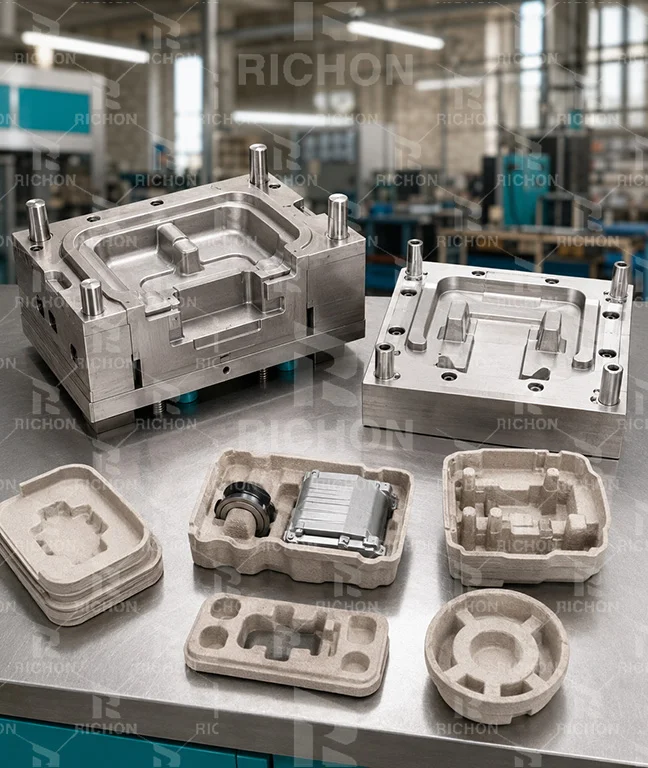
Custom Mold Design for Industrial Pulp Packaging
For industrial molded fiber packaging, the mold is one of the main factors that determines the product and machine configuration. Richon evaluates the customer’s packaging sample, drawing or product dimensions before confirming mold layout, forming requirements and expected capacity.
Industrial pulp molding molds are designed around the finished packaging geometry. Product dimensions, cavity arrangement, support points, drainage requirements and release conditions influence the final mold structure. Once the mold concept is established, Richon can evaluate the forming area, production cycle and suitable industrial pulp molding machine configuration.
What Information Should the Customer Provide?
Richon can begin the mold and machine evaluation after receiving basic information about the molded fiber packaging product.
From Product Design to Machine Configuration
The industrial pulp molding project is evaluated in sequence rather than selecting a machine from one fixed production capacity.
Key Mold Design Factors
These factors can affect forming stability, wet-product release and the final production cycle.
Mold Design Directly Affects Forming Performance
Vacuum channels, drainage, mold geometry and product release should be evaluated together. Learn more about Richon’s pulp molding mold design principles and how mold structure influences production stability.
How Is Industrial Pulp Molding Machine Capacity Calculated?
Industrial molded fiber packaging does not have one universal production capacity. Output must be calculated according to the customer’s actual product, mold cavities, forming cycle and operating conditions.
Industrial pulp molding machine capacity is product-specific. The number of pieces produced per hour depends mainly on the number of cavities in each mold cycle, the actual forming cycle time and operating efficiency. Product weight can then be used to estimate output in kilograms per hour. For this reason, Richon confirms the customer’s molded fiber product and mold layout before providing a production capacity figure.
Estimated Pieces per Hour
This calculation estimates how many finished molded pieces can be formed per hour after the cavity layout, production cycle and expected operating efficiency are known.
Estimated Molded Product kg/h
Weight-based output can be useful for evaluating pulp demand, downstream drying load and the overall production line balance.
What Factors Affect Actual Production Capacity?
A higher theoretical cavity count does not automatically mean higher stable production. Forming, dewatering, transfer and downstream processing must all work together.
Why Richon Does Not Publish One Fixed pcs/h Capacity
Standardized tray products can often be compared by a relatively simple pieces-per-hour rating. For example, Richon’s standard egg tray production capacity solutions are organized around defined tray output ranges.
Industrial molded fiber packaging is different because two customers may use the same forming equipment for products with completely different dimensions, molded weights and cavity arrangements. Therefore, a product-specific capacity calculation is more accurate than publishing one universal pcs/h figure.
The current production line power range is 54–77 kW, but electrical power alone does not define production capacity. Actual output must still be calculated from the customer’s product, mold cavity layout, forming cycle and complete line configuration.
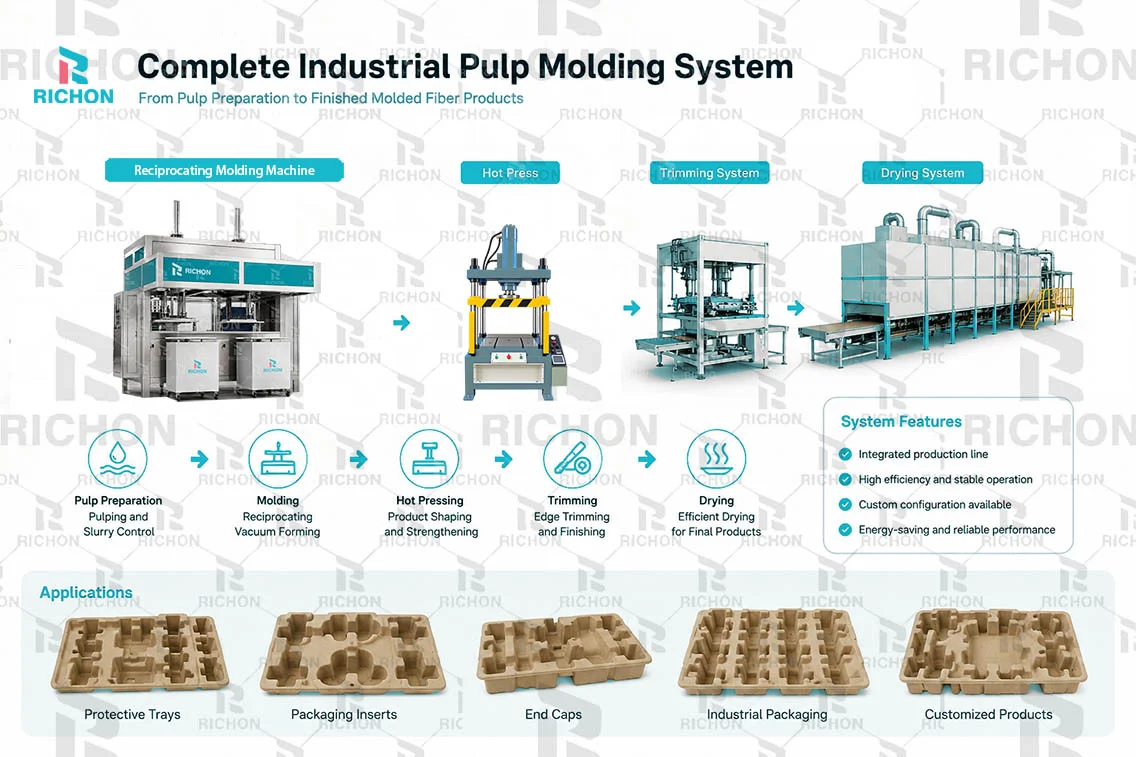
Complete Industrial Pulp Molding Production Line & Drying System
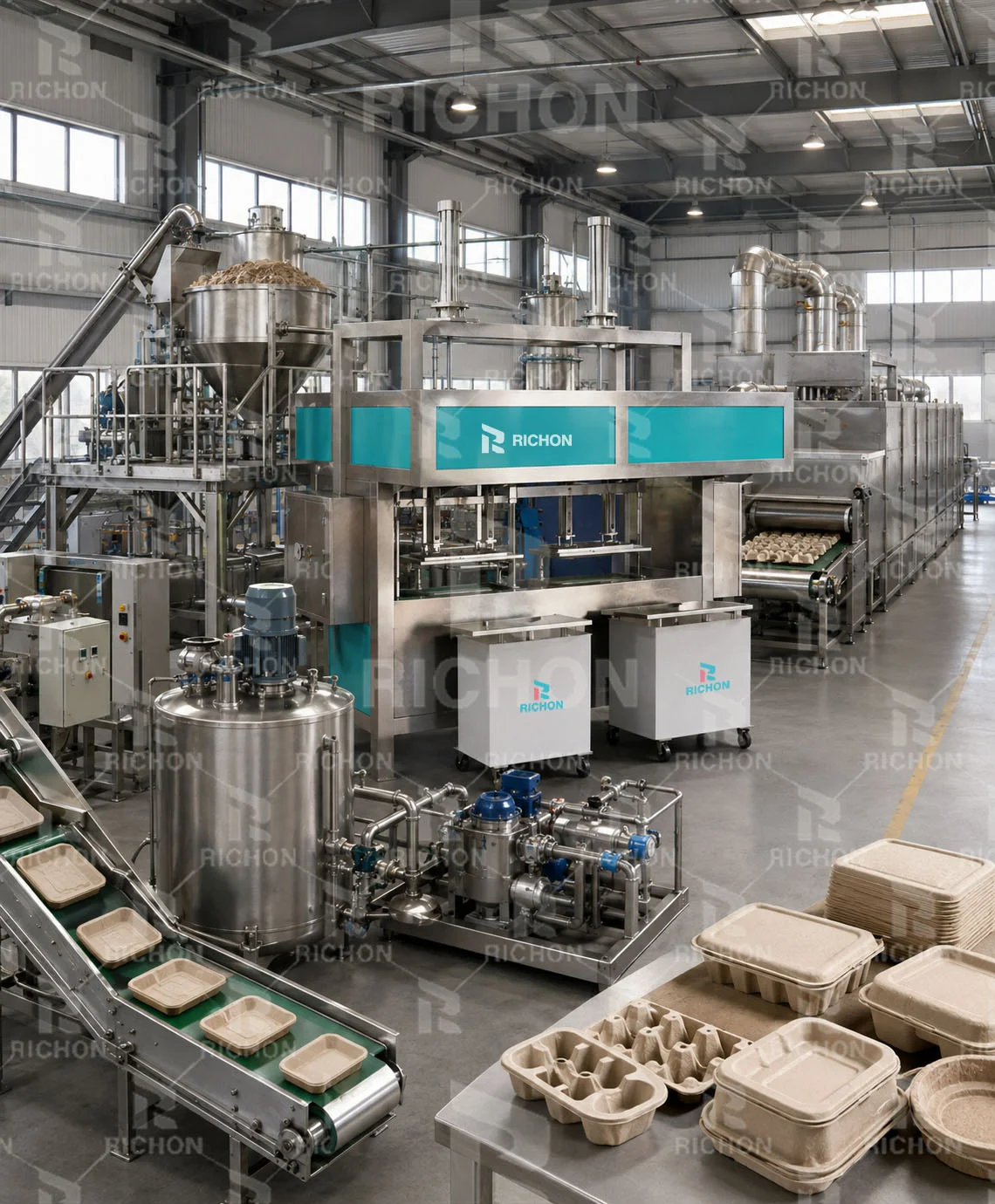
The forming machine is only one part of an industrial molded fiber project. Stable production also depends on pulp preparation, vacuum, water circulation, drying and downstream processing being matched to the actual product and production target.
A complete industrial pulp molding production line normally combines raw-material pulping, pulp preparation, reciprocating vacuum forming, wet-product transfer, drying and optional finishing. The capacity of each section should be balanced around the customer’s molded product so that the forming machine does not produce more wet material than the drying system can process.
Raw Material & Pulping
Suitable recycled fiber material is broken down and mixed with water to prepare pulp for the molded fiber production process.
Pulp Preparation & Supply
Pulp consistency and circulation are prepared according to the product weight, mold structure and forming requirements.
Reciprocating Vacuum Forming
Product-specific molds form the customized protective packaging through vacuum-assisted fiber deposition and dewatering.
Vacuum & Water Separation
The vacuum system supports fiber forming and moisture removal, while separated process water can be integrated into the production water-circulation design.
Wet Product Transfer
Formed wet products are released or transferred from the forming section and prepared for the downstream drying stage.
Drying System
The drying section removes the remaining product moisture and must be sized according to wet-product output, molded weight and required operating conditions.
Optional Finishing
Hot pressing, shaping, trimming or other finishing processes can be evaluated when required by the finished packaging design.
A reliable industrial pulp molding project should balance pulp preparation capacity, forming output, vacuum performance, wet-product handling and drying capacity. Increasing one section alone does not guarantee higher stable production if another section becomes the bottleneck.
Reciprocating vs Rotary Pulp Molding Machine
Neither forming system is universally better. The correct choice depends on whether the project prioritizes custom industrial packaging flexibility or continuous production of standardized molded pulp products.
A reciprocating pulp molding machine is generally better suited to customized industrial trays, protective inserts and end caps where product geometry, mold dimensions and cavity layouts vary by project. A rotary pulp molding machine is generally better suited to continuous production of standardized products such as egg trays, where repeated mold sets and stable high-volume operation are the main priorities.
| Comparison Factor | Reciprocating Pulp Molding Machine | Rotary Pulp Molding Machine |
|---|---|---|
| Primary Application |
Industrial Packaging
Customized molded fiber trays, inserts, end caps and protective packaging. |
Standardized molded pulp products such as egg trays, fruit trays and similar repeat-production products. |
| Product Geometry | More suitable when the finished product has custom dimensions, cavities or protective structures. | Better suited when the product geometry remains relatively standardized during continuous production. |
| Mold Configuration | Mold layout is normally developed around the customer’s specific packaging product. | Uses repeated mold sets optimized for continuous rotary forming cycles. |
| Product Change | Suitable for projects where different custom products may require different molds and forming settings. | More efficient when the same standardized product is produced continuously for long production runs. |
| Capacity Method | Product-specific. Capacity is calculated from mold cavities, forming cycle, product weight and operating conditions. | Often described more directly in pieces or trays per hour for a defined standard product. |
| Forming Cycle | Cycle settings can be evaluated according to product geometry, drainage and wet-product transfer requirements. | Designed around repeated rotary indexing and continuous production of consistent products. |
| Typical Buyer Priority | Product customization, packaging protection, mold flexibility and project-specific configuration. | Stable output, continuous production and standardized high-volume tray manufacturing. |
| Best Starting Information | Product sample, CAD file, packaging drawing, dimensions, molded weight and target output. | Required tray type, standard dimensions and target pieces-per-hour capacity. |
For Custom Industrial Molded Fiber Packaging
A reciprocating machine should be considered when the project begins with a specific industrial product that requires a customized pulp packaging tray, insert or protective structure.
- Custom protective packaging geometry
- Product-specific mold dimensions
- Capacity calculated from actual product
- Flexible industrial packaging projects
For Standardized Continuous Tray Production
A rotary machine should be considered when the manufacturer intends to produce a stable standardized pulp tray product continuously and production capacity is the primary selection criterion.
- Standard tray dimensions
- Repeated high-volume production
- Capacity commonly compared by pcs/h
- Long production runs of the same product
How Should You Choose the Forming System?
Richon recommends starting with the product instead of selecting a machine only from rated capacity.
What Affects Industrial Pulp Molding Machine Cost?
Industrial pulp molding machine cost cannot be determined accurately from one standard model price because the equipment is configured around the customer’s product, mold, capacity, drying and automation requirements.
The price of an industrial pulp molding machine depends mainly on the required forming area, custom mold structure, cavity layout, vacuum system, target production capacity, drying configuration and optional finishing equipment. Because each molded fiber packaging product can have different dimensions and production requirements, Richon prepares the machine quotation after reviewing the customer’s actual product and project conditions.
Forming Machine Size
The required mold area and product dimensions affect the size and structural configuration of the reciprocating forming machine.
Custom Mold Design
Mold dimensions, cavity quantity, product geometry, drainage and transfer requirements influence the engineering and manufacturing cost of the mold system.
Production Target
Required hourly or daily output affects cavity layout, forming cycle, pulp preparation capacity, vacuum demand and downstream equipment.
Vacuum & Dewatering
Product area, molded weight and forming cycle determine the required vacuum and water-separation configuration for stable production.
Drying System
Drying capacity, local energy conditions and finished-product requirements can represent a significant part of the complete production line investment.
Automation Level
The required production sequence, product handling and downstream integration influence the final automation and control configuration.
Optional Finishing
Hot pressing, shaping, trimming or other finishing equipment can be added when required by the final molded packaging specification.
Factory Utilities
Electrical supply, water circulation, compressed air where required, workshop space and installation conditions affect total project cost.
Project Scope
The equipment price covers all equipment in the agreed configuration list, manufacturing inspection and factory trial operation. Include hot pressing or trimming in that list if selected. Ocean freight, other shipment or delivery charges under the agreed trade terms, and installation fees are calculated separately.
Think in Terms of Total Project Cost, Not Machine Price Alone
For industrial molded fiber packaging, the forming machine is only one part of the investment. The complete project should be evaluated as an integrated production system.
Machine Power Is Only One Part of Operating Cost
The current industrial pulp molding production line power range is 54–77 kW. However, installed power should not be confused with actual electricity cost because real consumption depends on equipment load, operating time, production cycle and complete line configuration.
Electricity should also be evaluated together with drying energy, labor, raw material, water circulation and maintenance. Learn more about Richon’s approach to pulp molding energy consumption .
What Does Richon Need to Prepare an Accurate Quotation?
The more accurately the molded product and production target are defined, the more accurately Richon can select the mold, machine, drying system and complete project configuration.
How Richon Configures an Industrial Pulp Molding Project
Industrial molded fiber projects should begin with the customer’s actual packaging product. Richon uses the product, mold design, production target, drying conditions and factory requirements to build the machine configuration instead of selecting equipment from one fixed model list.
Richon configures an industrial pulp molding project by first reviewing the customer’s molded fiber packaging product, then determining the mold structure and cavity layout, calculating product-specific capacity, selecting the reciprocating forming system, matching the drying and utility requirements, and finally preparing the complete equipment and factory proposal.
Receive Product Information
The project starts with a product sample, packaging drawing, CAD file or finished-product dimensions so that Richon can understand what molded fiber packaging must be produced.
Evaluate Packaging Geometry
Product dimensions, cavity depth, support points, positioning requirements and stacking conditions are reviewed before the forming solution is selected.
Develop Mold Configuration
Richon evaluates mold dimensions, cavity quantity, drainage, forming surface and wet-product transfer requirements according to the packaging design.
Calculate Product Capacity
Expected output is calculated from mold cavities, forming cycle, product weight and actual operating conditions instead of using one universal pcs/h value.
Select the Forming Machine
The reciprocating machine structure is selected according to the required mold area, production cycle, forming conditions and the customer’s target output.
Match Vacuum & Drying
Vacuum performance and downstream drying capacity are matched to product weight, moisture load, wet-product output and local operating conditions.
Plan Factory Requirements
Electrical supply, water circulation, workshop dimensions, production flow and installation conditions are reviewed so that the equipment fits the actual factory environment.
Prepare Technical Proposal
Richon combines the confirmed machine, mold, production capacity, drying scope and project requirements into the final technical configuration and quotation.
Richon Industrial Pulp Molding Project Logic
The sequence below explains why the finished product should be defined before the final machine configuration is confirmed.
Define Product Quality and Trial Requirements
Richon supports discussion of product dimensions, molded weight, fit and finished-product quality requirements using the packaging drawing or sample. Product-specific inspection methods and acceptance conditions are agreed in the technical proposal.
Review mold engineering principles alongside the product specification. Manufacturing inspection and factory trial operation are included for the agreed equipment configuration. The trial scope and product conditions are confirmed separately from installation, which is quoted separately.
Send Richon Your Packaging Product or Drawing
Share the product dimensions, sample, CAD file, approximate molded weight and required output. Richon can then evaluate the mold, production capacity, reciprocating machine, drying system and complete project configuration.
Industrial Pulp Molding Machine FAQ
These answers cover the main questions buyers should clarify before selecting a reciprocating industrial pulp molding machine for customized protective packaging production.
What is an industrial pulp molding machine?
An industrial pulp molding machine uses prepared fiber pulp, vacuum forming and product-specific molds to produce customized molded fiber packaging such as protective trays, inserts and end caps.
The reciprocating forming system is particularly useful when the mold dimensions, cavity layout and product geometry vary according to the customer’s packaging project.
What products can a reciprocating pulp molding machine make?
It can be configured to produce customized molded fiber protective trays, packaging inserts, industrial end caps, component positioning trays and other non-standard molded pulp packaging.
The actual product range depends on mold dimensions, product geometry, forming requirements and the compatible operating range of the selected machine.
Why use a reciprocating machine for industrial packaging?
A reciprocating forming system is suitable for industrial packaging projects where product geometry, mold size, cavity arrangement and forming conditions are customized.
Rotary systems are generally better suited to continuous production of standardized products, while reciprocating machines provide greater flexibility for product-specific packaging projects.
Can one machine produce different molded pulp products?
Potentially yes. Different products can be produced by changing the mold and adjusting the forming settings, provided that the new mold dimensions, product geometry, transfer requirements and production conditions are compatible with the machine.
Richon should evaluate each new product before confirming that an existing machine configuration can produce it reliably.
How is industrial pulp molding machine capacity calculated?
Capacity is calculated according to the customer’s customized product. The main factors include the number of mold cavities, forming cycle time, operating efficiency, product dimensions and molded product weight.
Because two products can have completely different sizes and cavity layouts, Richon does not use one universal pcs/h value for all industrial pulp molding projects.
Can Richon design the mold from my sample or drawing?
Richon can evaluate mold configuration from a finished packaging sample, dimensioned drawing, CAD file, 3D model or detailed product dimensions.
The mold layout is then reviewed together with cavity quantity, drainage, forming conditions, wet-product transfer and expected production capacity.
What raw materials can be used for industrial molded pulp packaging?
Industrial molded fiber packaging can commonly use suitable recycled paper and paperboard-based fiber materials. The actual pulp recipe should be selected according to the required product strength, forming behavior, surface quality and end-use conditions.
Raw material selection should therefore be confirmed together with the finished packaging specification rather than using one fixed fiber recipe for every product.
How do I choose the correct machine and drying system?
Start by confirming the molded fiber product, mold dimensions, cavity layout and target production. Richon can then determine the suitable reciprocating forming machine and calculate the expected wet-product output.
The drying system should then be matched to product weight, moisture load, forming output, local energy conditions, factory space and operating hours. The current production line power range is 54–77 kW, while actual output remains product-specific.
Get a Machine Configuration Based on Your Packaging Product
Send Richon your product sample, drawing, dimensions, approximate molded weight and target production requirement. We can use this information to evaluate the mold layout, expected capacity, reciprocating forming machine, drying requirement and complete project configuration.