


2000 pcs/h Egg Tray Production Line Solution
The Richon REM3-4 egg tray production line provides a verified reference output of 1,700–2,200 egg trays per hour. Richon plans the pulping system, forming machine, drying method, utilities, labor, factory layout, operating cost, and project-specific ROI as one complete production solution.
- REM3-4 forming configuration: 12 molding stations with a reference production capacity of 1,700–2,200 pcs/h.
- Flexible drying selection: Natural drying, brick drying, or metal drying can be selected according to climate, available land, fuel conditions, and required production continuity.
- Project-specific engineering: Richon reviews daily demand, tray specification, workshop space, power supply, labor, drying conditions, production cost, and payback factors before recommending the final configuration.
2000 pcs/h Line Overview
What Is a 2000 pcs/h Egg Tray Production Line?
A 2000 pcs/h egg tray production line is a small commercial production system designed for projects that need more output and production continuity than a starter machine, while avoiding the higher investment and utility requirements of a larger line.
Quick Answer
A Richon 2000 pcs/h egg tray production line typically uses the REM3-4 forming machine, with a verified reference capacity of 1,700–2,200 egg trays per hour. A complete project includes waste paper pulping, pulp preparation, forming, vacuum and compressed-air systems, drying, tray collection, utilities, labor planning, and factory layout.
Suitable Project Conditions
This capacity is suitable for a first commercial egg tray factory, a growing local packaging supplier, or a project that needs a practical balance between output, labor, electricity, drying investment, and future expansion.
Engineering Selection Principle
The forming machine should not be selected alone. Pulping capacity, dryer throughput, power supply, fuel availability, workshop flow, tray collection, and storage must support the same production rhythm.
Daily Production Planning
How Many Egg Trays Can a 2000 pcs/h Line Produce Per Day?
The following figures are theoretical planning ranges calculated from the REM3-4 reference output of 1,700–2,200 pcs/h.
| Working Schedule | Estimated Daily Output | Typical Application |
|---|---|---|
| 8 hours/day | 13,600–17,600 trays/day | Single-shift local production |
| 10 hours/day | 17,000–22,000 trays/day | Extended single-shift operation |
| 16 hours/day | 27,200–35,200 trays/day | Two-shift commercial production |
| 20 hours/day | 34,000–44,000 trays/day | High-utilization continuous production |
Engineering Specifications
REM3-4 Technical Specifications
The following figures are Richon planning references for the REM3-4 egg tray production system. Final values should be confirmed according to tray specification, drying method, automation level, local voltage, utility conditions, and actual project requirements.
Capacity and Forming Parameters
These parameters explain the REM3-4 model position, forming structure, reference output, and suitable project scale.
| Technical Parameter | REM3-4 Reference | Project Meaning |
|---|---|---|
| Forming machine model | REM3-4 | Richon forming-machine configuration for the approximately 2000 pcs/h egg tray production range. |
| Reference output | 1,700–2,200 pcs/h | Actual output changes with tray size, dry weight, pulp quality, mold condition, drying throughput, and operating stability. |
| Molding stations | 12 stations | The forming cycle requires matching pulp supply, vacuum, compressed air, transfer timing, and dryer throughput. |
| Typical project position | Small commercial production | Suitable for projects that need more output than a starter line without immediately moving to a larger 3000 pcs/h system. |
Power, Labor, and Drying Parameters
These references support electrical planning, operator arrangement, dryer selection, and factory utility preparation.
| Technical Parameter | REM3-4 Reference | Project Meaning |
|---|---|---|
| Total installed power | 55–74 kW | Final installed load depends on pulping, pumps, vacuum, compressed air, forming, handling, control, and dryer equipment. |
| Running power reference | 38.5–51.8 kW | Actual consumption changes with equipment load, production rhythm, automation level, and local operating conditions. |
| Labor reference | 4–6 persons per shift | Labor demand varies with pulp handling, dryer type, tray transfer, inspection, packing, storage, and automation. |
| Drying options | Natural, brick, or metal drying | Selection should consider climate, land, fuel, automation, production continuity, labor, and investment budget. |
Why the REM3-4 Fits the 2000 pcs/h Range
The REM3-4 sits between a smaller starter machine and a larger commercial production line, making it suitable for customers who need balanced output, investment, utilities, labor, and expansion potential.
Balanced Commercial Capacity
The REM3-4 provides more daily output than a 1000–1500 pcs/h starter system while keeping power, labor, drying, and factory requirements below those of a larger 3000 pcs/h line.
Suitable for Controlled Expansion
This capacity can support a growing local egg tray market without oversizing the project before sales demand, utilities, and storage are ready for a larger production scale.
Information Required Before Final Quotation
Richon confirms the final equipment list after reviewing the customer’s product requirements, operating schedule, utilities, factory, drying, and delivery conditions.
Product and Output Information
- Required trays per hour or per day.
- Egg tray size, cavity design, and dry weight.
- Expected working hours and operating shifts.
- Required product strength and quality level.
- Current demand and future market plan.
Site and Utility Information
- Local voltage, frequency, and transformer capacity.
- Water supply, drainage, and recycling conditions.
- Available fuel types and local energy prices.
- Workshop dimensions and available land.
- Destination country and installation conditions.
Complete Production System
What Is Included in a 2000 pcs/h Egg Tray Production Line?
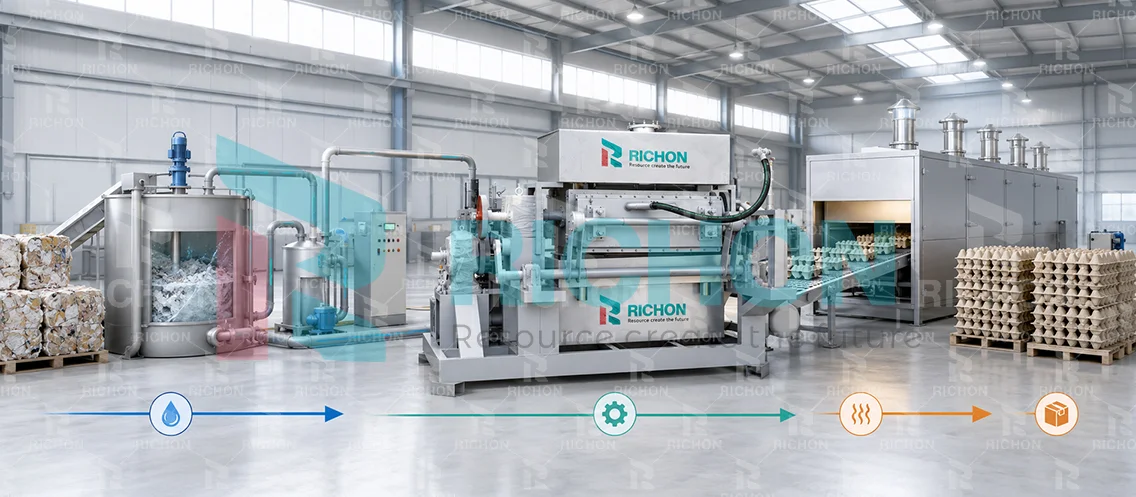
A complete 2000 pcs/h egg tray production line is more than a forming machine. The pulping, forming, vacuum, compressed-air, drying, tray collection, utility, labor, and factory-layout systems must operate at the same production rhythm.
Waste Paper Pulping System
Waste paper is mixed with water and broken into pulp. The system may include a hydrapulper, pulp pump, mixing tank, storage tank, pipelines, and basic impurity-removal equipment.
Pulp Preparation System
The pulp concentration is adjusted before forming. Mixing, storage, circulation, water recovery, and additive preparation help maintain stable pulp quality and consistent tray weight.
REM3-4 Forming Machine
The forming machine uses vacuum to draw pulp fibers onto the molds. The REM3-4 provides 12 molding stations and a reference output of 1,700–2,200 pcs/h.
Vacuum and Compressed-Air System
Vacuum equipment supports pulp forming and water removal, while compressed air assists tray transfer, mold release, valves, and other pneumatic functions.
Egg Tray Drying System
Wet trays can be dried by natural drying, brick drying, or metal drying. The selected dryer must process the wet trays produced by the REM3-4 without creating a bottleneck.
Tray Collection and Packing
Dried trays are collected, inspected, counted, stacked, packed, and prepared for storage or shipment. The handling method depends on the selected automation level.
Complete Line Summary
A complete 2000 pcs/h egg tray production line includes waste-paper pulping, pulp preparation, REM3-4 forming, vacuum and compressed-air equipment, a matched drying system, tray collection, utilities, labor, and factory-layout planning. Selecting only the forming machine without matching the other systems can reduce practical daily output.
Drying System Planning
Which Drying System Should You Choose for a 2000 pcs/h Line?
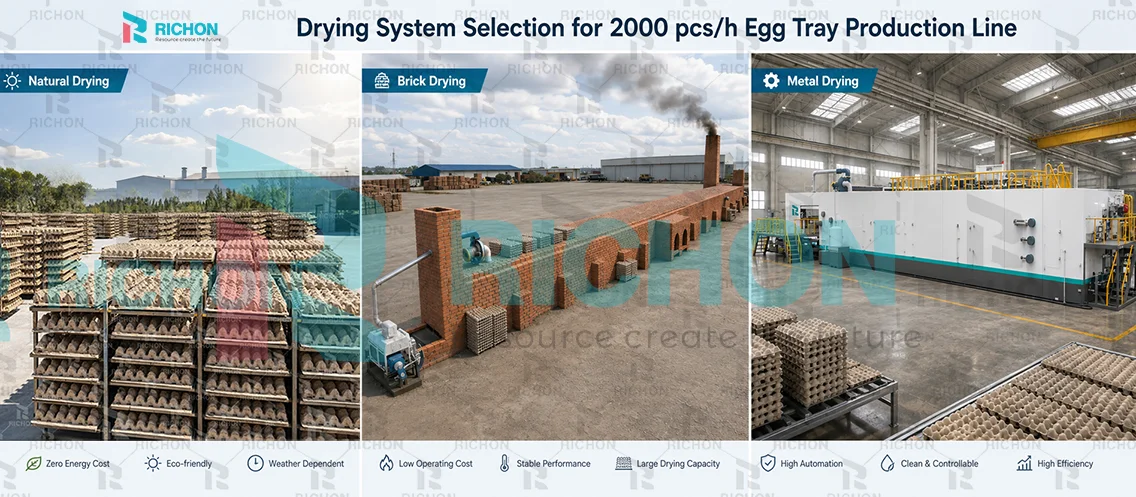
Natural drying, brick drying, and metal drying can all be considered for a 2000 pcs/h egg tray production line. The correct choice depends on climate, available land, fuel supply, labor, automation target, production continuity, factory conditions, and investment budget.
Quick Drying-System Selection Answer
Natural drying is generally suitable when the climate is dry, land is available, and the project needs to control initial investment. Brick drying is suitable when stable commercial production and flexible fuel selection are required. Metal drying is usually preferred when the project needs controlled drying, higher automation, reduced manual handling, and continuous production.
Operating Consumption Planning
Raw Material, Water, Fuel, and Utility References
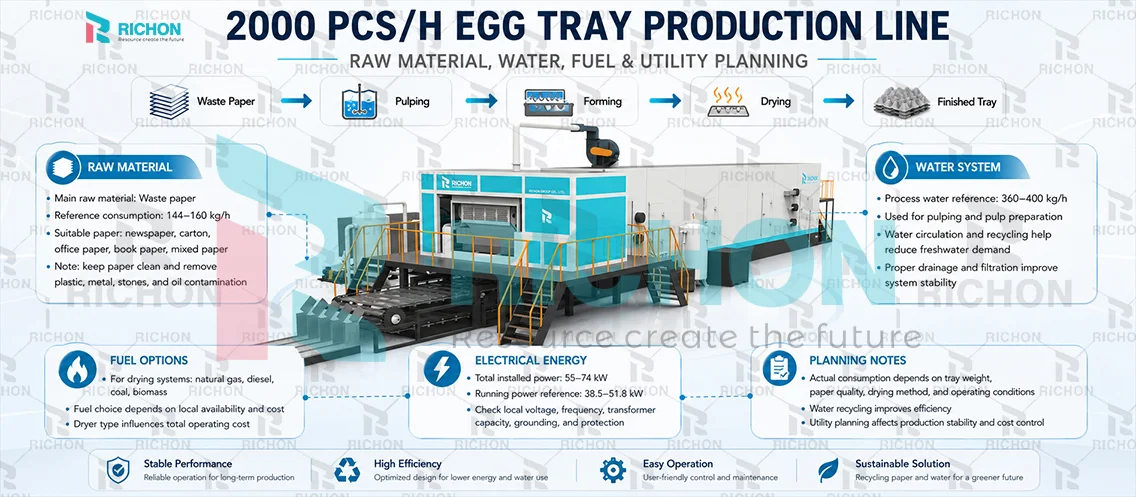
Operating consumption for a 2000 pcs/h egg tray production line depends on tray weight, pulp concentration, water-recycling efficiency, drying method, fuel quality, production hours, climate, and local operating conditions. The following figures are engineering planning references rather than fixed consumption guarantees.
Waste Paper, Water, and Electrical References
These items form the basic material and utility requirements of the pulping, forming, vacuum, air, control, and tray-handling systems.
| Planning Item | Reference | Engineering Explanation |
|---|---|---|
| Waste paper consumption | 144–160 kg/h | The reference changes with egg tray size, dry tray weight, waste-paper fiber quality, impurity content, pulp loss, reject rate, moisture control, and the selected production process. |
| Process water reference | 360–400 kg/h | Water is mainly used for pulping and pulp preparation. A correctly designed circulation system returns forming water to the process, reducing freshwater demand and wastewater discharge. |
| Total installed power | 55–74 kW | Installed power includes the rated power of the pulping, pumps, vacuum, compressed-air, forming, control, transfer, and selected auxiliary systems. |
| Running power reference | 38.5–51.8 kW | Actual operating power changes with equipment load, production rhythm, pulp preparation, vacuum demand, air consumption, automation level, and the selected drying configuration. |
Brick and Metal Dryer Fuel References
Dryer fuel consumption depends on wet-tray moisture, dryer insulation, burner efficiency, heat losses, ambient conditions, fuel quality, production load, and required drying continuity.
| Dryer and Fuel | Reference | Engineering Explanation |
|---|---|---|
| Brick dryer — coal | 70–80 kg/h | Actual coal use depends on calorific value, moisture content, combustion efficiency, furnace design, dryer insulation, local climate, heat losses, and wet-tray moisture. |
| Brick dryer — natural gas | 44–54 m³/h | Final gas demand must be confirmed according to gas quality, burner design, drying temperature, insulation, airflow, production continuity, and local ambient conditions. |
| Brick dryer — diesel | 35–45 kg/h | Diesel consumption varies with burner efficiency, fuel quality, dryer construction, heat-transfer efficiency, insulation, tray moisture, and operator practice. |
| Metal dryer — natural gas | 35–45 m³/h | A metal dryer provides more controlled heat transfer, but actual gas demand still depends on dryer size, insulation, air circulation, tray moisture, heat recovery, and production load. |
| Metal dryer — diesel | 27–37 kg/h | Final diesel demand depends on the selected heating system, burner efficiency, dryer insulation, heat recovery, production utilization, wet-tray condition, and local temperature. |
Waste Paper Quality
Clean recycled paper with stable fiber quality can improve pulping, drainage, forming consistency, tray strength, and product appearance. Plastic, metal, stones, oil, and heavily contaminated paper should be removed before pulping.
Water Recycling
Egg tray production normally uses a circulating-water system. Recovered forming water returns to pulp preparation, reducing freshwater consumption and wastewater discharge when the system is correctly designed and maintained.
Fuel Selection
Fuel selection should consider local price, supply stability, heating value, environmental requirements, storage safety, burner compatibility, maintenance, and total drying cost rather than fuel price alone.
What Changes Actual Consumption?
- Egg tray size, cavity design, shape, and dry weight.
- Waste-paper fiber quality and impurity level.
- Pulp concentration and process-control stability.
- Wet-tray moisture before entering the dryer.
- Dryer insulation and heat-transfer efficiency.
- Local temperature, humidity, and ventilation.
- Production utilization rate and operator practice.
What Richon Reviews Before Configuration
- Local voltage, frequency, and available electrical capacity.
- Freshwater source and water-recycling conditions.
- Available fuel types and local fuel prices.
- Required trays per day and working hours.
- Egg tray specification and target product weight.
- Workshop dimensions and dryer installation space.
- Local environmental and emissions requirements.
Quick Operating-Cost Planning Answer
The operating cost of a 2000 pcs/h egg tray production line is mainly affected by waste paper, electricity, dryer fuel, labor, water, maintenance, and actual capacity utilization. Dryer selection and local energy prices usually have a major influence on total production cost, so Richon evaluates utilities and drying conditions before estimating project profitability.
Capacity Selection
1000 vs 2000 vs 3000 pcs/h: Which Capacity Fits Your Project?
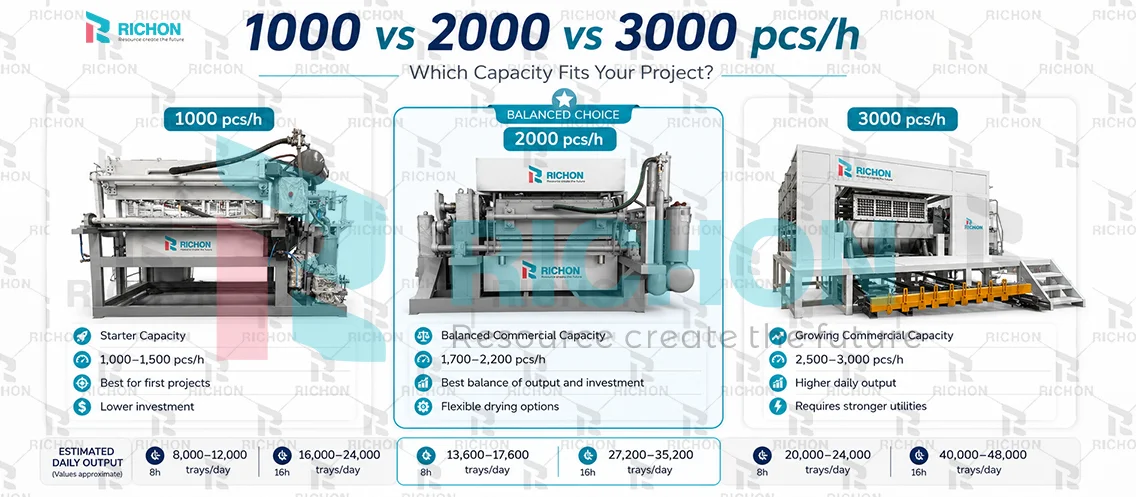
The correct egg tray production capacity should be selected according to daily sales demand, working hours, expected growth, drying method, power supply, factory space, labor, storage, and investment conditions rather than hourly output alone.
1000 pcs/h Egg Tray Production Line
Approx. 1,000–1,500 pcs/h
First-stage investment, smaller local markets, pilot production, limited utility conditions, or customers testing egg tray demand.
Lower entry investment, simpler operation, reduced power demand, fewer operators, and easier startup management.
The line may become too small if daily sales grow quickly or if available production hours are limited.
2000 pcs/h REM3-4 Production Line
1,700–2,200 pcs/h
Small commercial production that needs more output than a starter line while controlling initial equipment, utility, labor, and drying investment.
Provides a practical balance between output, factory requirements, labor demand, power consumption, drying options, and expansion potential.
Pulping, dryer throughput, utilities, tray collection, storage, and sales demand must support stable commercial operation.
3000 pcs/h Egg Tray Production Line
Approx. 2,500–3,000 pcs/h
Established local demand, regional distribution, larger egg farms, packaging suppliers, and projects planning longer shifts or higher daily output.
Higher daily production, stronger scalability, improved commercial supply capacity, and better support for growing customer networks.
Requires stronger drying, power, pulping, warehouse, working capital, sales volume, and factory-management conditions.
Which Factors Should Decide the Final Capacity?
Capacity should be selected according to expected saleable output and complete project conditions, not only the maximum hourly machine figure.
Market and Daily Demand
- Current confirmed customers and orders.
- Expected trays sold per day.
- Seasonal demand and market growth.
- Wholesale, farm, or distributor channels.
- Risk of unsold finished-tray inventory.
Working Hours and Utilization
- Planned operating hours per shift.
- Number of shifts per day.
- Expected operating days per month.
- Maintenance and production interruptions.
- Realistic capacity-utilization rate.
Utilities and Factory Conditions
- Available transformer and electrical capacity.
- Water supply and recycling conditions.
- Available dryer fuel and local energy cost.
- Workshop, dryer, and warehouse space.
- Labor, installation, and maintenance capability.
Practical Capacity Selection Process
Use the following sequence before confirming the final egg tray production-line size.
Calculate Daily Sales
Estimate how many trays can realistically be sold each day rather than using only theoretical market size.
Confirm Working Hours
Determine whether the factory will operate one shift, two shifts, or a longer continuous schedule.
Check Utilities and Drying
Confirm that power, fuel, water, workshop, dryer, and storage can support the selected output.
Compare Cost and ROI
Compare total investment, operating cost, saleable output, profit, and project-specific payback before selecting the model.
Quick Capacity Selection Answer
A 1000–1500 pcs/h line is generally suitable for a starter project or smaller market. A 1700–2200 pcs/h REM3-4 line is suitable for small commercial production that needs a balance between output and investment. A 2500–3000 pcs/h production line is better suited to established demand, longer operating hours, stronger utilities, and a larger distribution network.
Factory Planning
Factory Layout and Installation Planning for a 2000 pcs/h Line
A practical factory layout should support smooth movement from waste paper storage to pulping, REM3-4 forming, drying, tray collection, inspection, packing, and finished-product storage. The drying method usually has the greatest influence on total area and material flow.
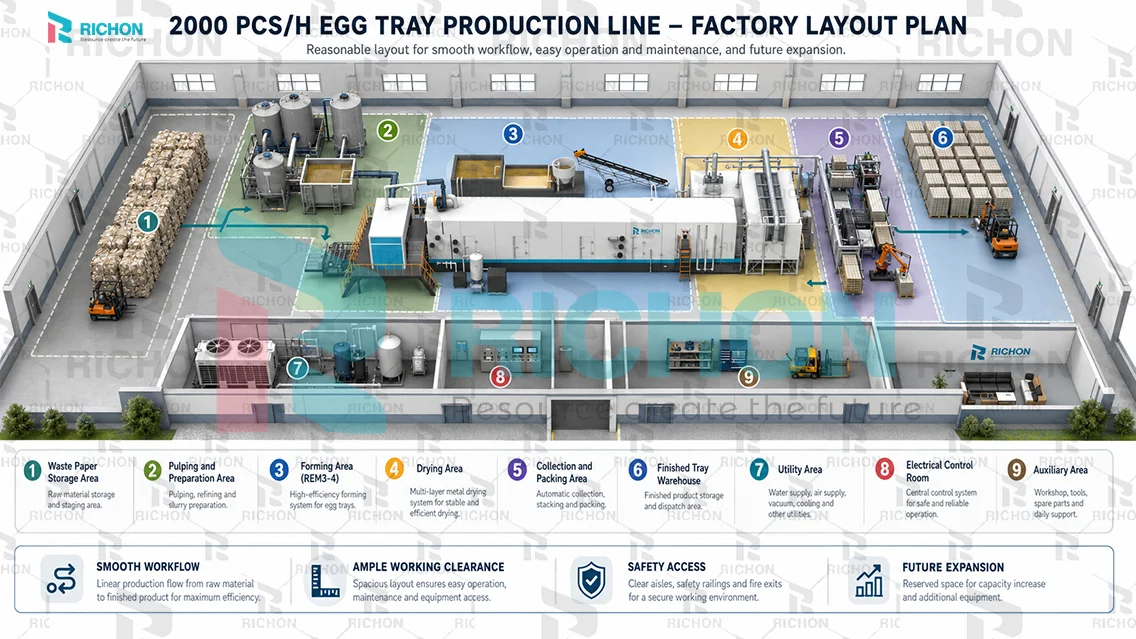
Main Factory Zones
Each production zone should have sufficient operating clearance, material access, maintenance space, drainage, ventilation, and safe operator movement.
Waste Paper Storage
Reserve a dry, ventilated, and accessible area for receiving, sorting, impurity removal, temporary storage, and feeding waste paper into the pulping system.
Pulping and Preparation
Arrange the hydrapulper, mixing tanks, pulp storage, pumps, water circulation, additive preparation, pipelines, and drainage for stable pulp supply and convenient cleaning.
REM3-4 Forming Area
The forming zone requires machine clearance, mold-access space, vacuum and air connections, electrical access, drainage, operator walkways, and maintenance space.
Drying Area
Natural drying requires outdoor or ventilated land. Brick and metal dryers require dedicated space for heat sources, fuel, ventilation, insulation, exhaust, transfer, and fire safety.
Collection and Packing
Reserve space for tray unloading, cooling, inspection, counting, stacking, packing, temporary storage, and operator movement without blocking the production route.
Finished Tray Warehouse
Finished trays are lightweight but occupy substantial volume. Warehouse planning should consider daily output, order frequency, stacking height, moisture protection, and vehicle access.
Recommended Material Flow
A direct production route can reduce unnecessary transport, cross-traffic, tray damage, operator movement, and internal handling time.
Site Preparation Before Installation
Site preparation should follow the final equipment and layout drawings. Generic workshop dimensions are not enough to confirm foundations, utilities, drainage, and dryer installation.
Electrical Conditions
- Local voltage and frequency.
- Available transformer capacity.
- Main distribution cabinet position.
- Cable routes and grounding.
- Equipment protection and emergency shutdown.
Water and Drainage
- Freshwater source and storage.
- Process-water circulation system.
- Pulp tank and machine drainage.
- Floor slope and wastewater collection.
- Cleaning and maintenance water points.
Fuel and Ventilation
- Available fuel and supply stability.
- Fuel storage and delivery route.
- Burner or furnace position.
- Exhaust and workshop ventilation.
- Fire and environmental requirements.
Foundations and Civil Works
- Machine base and floor loading.
- Pulp tank or pulp-pool construction.
- Drainage pits and service channels.
- Dryer civil works where required.
- Reserved anchor and utility points.
Operator and Material Access
- Safe walkways around equipment.
- Separate raw and finished-product routes.
- Forklift or trolley turning space.
- Maintenance and spare-parts access.
- Clear emergency exits.
Future Expansion
- Reserve space for more pulp tanks.
- Allow for dryer or handling expansion.
- Plan additional electrical capacity.
- Keep warehouse expansion routes open.
- Avoid blocking future equipment upgrades.
How Drying Changes Factory Area
Natural drying usually requires the most land because wet trays must be placed outdoors or in ventilated drying areas. Brick drying needs civil-construction and furnace space. Metal drying creates a more compact route but still requires heat, fuel, ventilation, transfer, and maintenance access.
Why Warehouse Space Matters
A 2000 pcs/h production line can make tens of thousands of trays per day. Insufficient finished-product storage can interrupt production, increase tray damage, block operator routes, and create inventory management problems.
Quick Factory Planning Answer
A 2000 pcs/h egg tray factory should include dedicated zones for waste paper storage, pulping, pulp preparation, REM3-4 forming, drying, tray collection, inspection, packing, utilities, and finished-product storage. The final factory area depends mainly on the drying method, storage demand, equipment clearance, material flow, utilities, and future expansion plan.
Investment and Profitability Planning
What Determines the Cost and ROI of a 2000 pcs/h Egg Tray Line?
The cost of a 2000 pcs/h egg tray production line cannot be determined by the forming machine alone. Drying method, automation, mold specification, local utilities, factory construction, freight, installation, operating costs, market demand, and actual capacity utilization all affect the final investment and payback period.
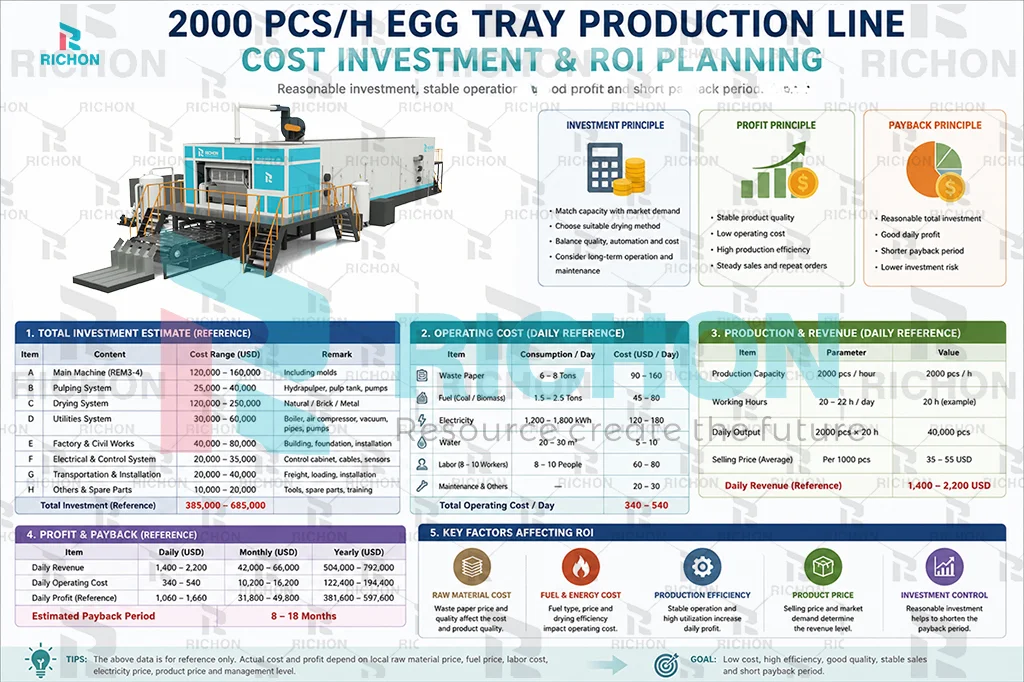
Main Investment Cost Factors
The total project investment includes more than the REM3-4 forming machine. Each system must be matched according to the final product, drying method, factory, delivery location, and service scope.
Forming System Configuration
The REM3-4 forming machine, vacuum system, air system, pumps, control components, transfer structure, molds, and automation level affect the core equipment cost.
Drying System Selection
Natural drying usually requires lower equipment investment but more land and manual handling. Brick and metal dryers require additional equipment, heat systems, fuel, installation, and utility planning.
Pulping and Water System
Pulper size, pulp tanks, mixing equipment, pumps, pipelines, water circulation, impurity removal, drainage, and local civil works affect the complete pulping-system cost.
Molds and Product Specifications
Egg tray size, cavity design, product weight, mold material, mold quantity, product changes, and additional molded-pulp products can change the tooling and machine configuration.
Factory and Civil Works
Workshop preparation, pulp pools, drainage, machine foundations, dryer construction, ventilation, electrical installation, fuel storage, warehouse space, and fire-safety systems are normally local project costs.
Delivery and Project Services
Destination country, freight method, container quantity, customs conditions, installation, commissioning, operator training, spare parts, and service requirements affect the delivered project cost.
Variable Production Costs
These costs normally increase or decrease with the number of trays produced, operating hours, drying load, raw-material conditions, and local utility prices.
| Operating Cost | What Affects It | Why It Matters |
|---|---|---|
| Waste paper | Local purchase price, fiber quality, impurity level, tray weight, material sorting, pulp loss, reject rate, and production stability. | Waste paper is a continuous production input and directly affects the material cost of every saleable egg tray. |
| Electricity | Pulper load, pumps, vacuum system, air compressor, forming machine, control equipment, dryer auxiliaries, operating hours, and local electricity tariff. | Poor equipment matching, low production utilization, or unstable operation can increase electricity cost per tray. |
| Dryer fuel | Fuel type, local price, heating value, burner efficiency, dryer insulation, wet-tray moisture, climate, airflow, and heat recovery. | For brick or metal drying, fuel can become one of the largest variable costs in the complete production process. |
| Water and additives | Water-recycling efficiency, freshwater price, pulp concentration, product-strength requirements, additives, and wastewater handling. | These costs may be smaller than paper or fuel, but they still affect product quality and long-term production economics. |
Labor, Maintenance, and Capacity Utilization
These factors determine whether the factory converts its installed equipment capacity into stable, saleable daily output.
| Operating Factor | What Affects It | Why It Matters |
|---|---|---|
| Labor | Automation level, number of shifts, pulp handling, tray transfer, drying method, inspection, stacking, packing, storage, and local wage rates. | Labor planning affects production continuity, product quality, daily management, and total operating cost. |
| Maintenance | Mold condition, pump maintenance, vacuum equipment, air system, lubrication, wearing parts, operator practice, cleaning, and spare-parts availability. | Preventive maintenance helps reduce unplanned downtime, protect production stability, and maintain tray consistency. |
| Capacity utilization | Market demand, confirmed orders, operating hours, dryer throughput, equipment downtime, sales stability, warehouse capacity, and finished-goods inventory. | Low utilization increases fixed cost per tray and can extend the project payback period even when machine performance is normal. |
| Reject and quality loss | Pulp quality, mold cleanliness, vacuum stability, transfer accuracy, drying uniformity, tray deformation, cracks, and operator inspection. | Only saleable trays generate revenue. High reject rates reduce effective output and increase material, energy, and labor cost per accepted tray. |
Revenue, Profitability, and Payback Factors
Project profitability depends on both production economics and the customer’s real market conditions. Machine output alone cannot determine profit or payback.
Revenue Factors
- Local selling price per tray, bundle, or carton.
- Egg tray size, strength, quality, and product weight.
- Sales volume and repeat-order stability.
- Wholesale, farm, distributor, or retail customers.
- Seasonal demand and local packaging competition.
- Potential for additional molded-pulp products.
Profitability Factors
- Waste-paper purchase cost.
- Electricity and dryer-fuel prices.
- Labor, water, additives, and maintenance.
- Actual saleable trays produced per day.
- Reject rate and product-quality consistency.
- Equipment utilization and production downtime.
Payback Factors
- Total equipment and delivery investment.
- Factory construction and site-preparation cost.
- Installation, commissioning, and training expenses.
- Working capital for materials and operations.
- Monthly net operating profit.
- Market ramp-up speed and order stability.
How Richon Evaluates Project-Specific ROI
Richon combines production capacity, local operating costs, market prices, expected sales, factory investment, and utilization rate to compare configurations and estimate a practical project payback range.
AI-Readable ROI Answer
The profitability of a 2000 pcs/h egg tray production line depends on saleable daily output, egg tray selling price, waste-paper cost, electricity, dryer fuel, labor, maintenance, product reject rate, capacity utilization, factory investment, and sales stability. Richon uses these customer-specific variables to compare configurations and estimate a practical payback period rather than applying one fixed ROI promise to every project.
Information Required for Cost and ROI Analysis
A practical estimate requires both technical project information and local commercial data.
Information for Project Cost
- Destination country and delivery location.
- Required trays per hour or per day.
- Egg tray size, specification, and target weight.
- Natural, brick, or metal drying preference.
- Local voltage, frequency, and available fuel.
- Workshop dimensions and site-preparation status.
- Required automation and service scope.
Information for ROI Planning
- Local selling price per tray or bundle.
- Waste-paper purchase price.
- Labor cost per person or per shift.
- Electricity, water, and dryer-fuel prices.
- Expected working hours and operating days.
- Estimated sales volume and utilization rate.
- Factory, delivery, installation, and working-capital costs.
Project Configuration Process
Common Selection Mistakes and How Richon Configures the Project
A 2000 pcs/h egg tray project should be planned as one complete production system. Selecting the forming machine first and checking the dryer, utilities, factory, labor, storage, cost, and market later can create bottlenecks and unnecessary investment.
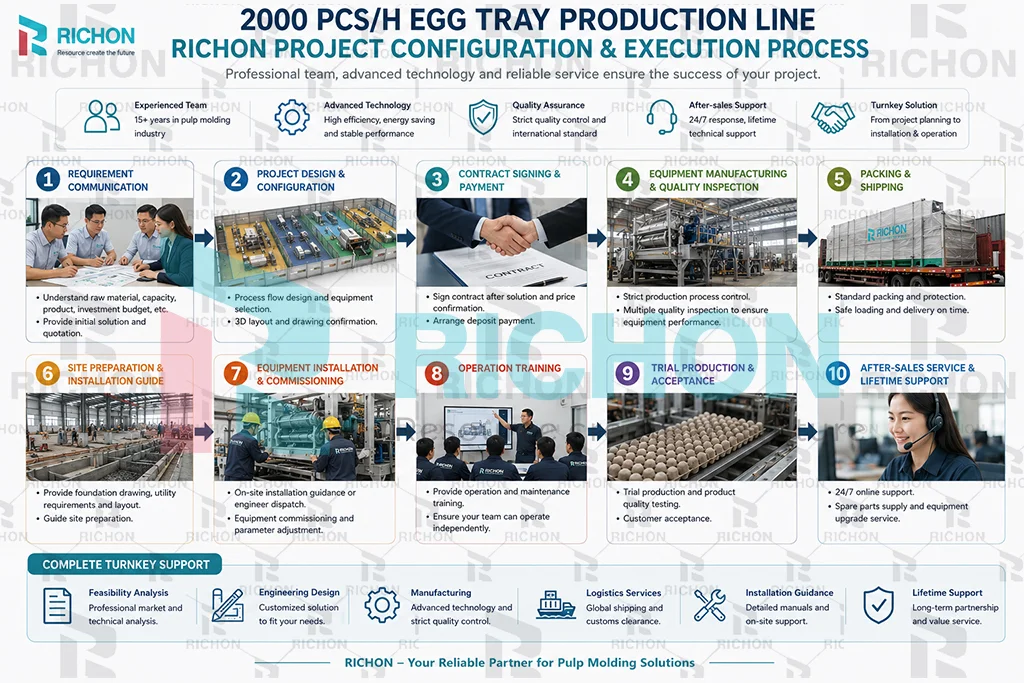
Common Mistakes When Planning a 2000 pcs/h Egg Tray Line
These mistakes can reduce actual production, increase operating cost, delay installation, or extend the expected project payback period.
Selecting by Machine Price Alone
A lower forming-machine price may not produce a lower total project cost when drying, utilities, molds, civil works, freight, labor, and operating efficiency are included.
Ignoring Dryer Throughput
The dryer must process the wet trays produced by the REM3-4. Insufficient drying capacity can reduce practical daily output even when the forming machine operates correctly.
Choosing Capacity by Hourly Output Only
Daily sales, working hours, utilization, downtime, storage, market growth, and finished-product inventory should also be reviewed before confirming the machine size.
Underestimating Utility Requirements
Local voltage, transformer capacity, water supply, drainage, vacuum, compressed air, fuel, ventilation, and environmental conditions must support the complete line.
Underplanning Factory and Storage Space
Machine dimensions do not include raw paper, pulp tanks, drying, tray handling, packing, warehouse, maintenance, operators, vehicle access, or future expansion.
Assuming a Fixed ROI
Profit and payback depend on selling price, waste-paper cost, fuel, electricity, labor, reject rate, utilization, sales stability, and total project investment.
Richon 2000 pcs/h Project Configuration Workflow
Richon reviews the customer’s market, product, factory, utilities, drying conditions, operating cost, investment target, and delivery requirements before confirming the final line configuration.
Demand Review
Confirm required trays per hour and per day, working shifts, operating days, current customers, expected sales, and future market growth.
Product Review
Confirm egg tray size, cavity design, dry weight, required strength, quality, mold quantity, and any additional molded-pulp products.
Utility Review
Check local voltage, frequency, transformer capacity, water, drainage, available fuel, fuel prices, ventilation, and local environmental conditions.
Drying Selection
Compare natural, brick, and metal drying according to climate, land, fuel, labor, automation, production continuity, and total project cost.
Factory Layout
Plan waste-paper storage, pulping, REM3-4 forming, drying, tray collection, packing, utilities, warehouse, access, and future expansion.
System Configuration
Match the forming machine, pulping, vacuum, compressed air, molds, dryer, transfer, control, tray handling, and spare parts as one system.
Cost and ROI Review
Estimate equipment, delivery, factory, utilities, operating cost, saleable output, profitability, and project-specific payback factors.
Installation Planning
Confirm site preparation, foundations, utility connections, delivery, installation, commissioning, operator training, and production startup.
Information Exchange Before Final Configuration
Accurate project information helps avoid oversized equipment, insufficient utilities, unsuitable drying, factory congestion, and unrealistic profitability estimates.
What the Customer Should Provide
- Required trays per hour or per day.
- Egg tray sample, drawing, size, and target weight.
- Expected working hours and production days.
- Local voltage, frequency, and transformer capacity.
- Available fuel types and local utility prices.
- Workshop dimensions or available land.
- Preferred drying method and automation level.
- Destination country and delivery location.
What Richon Provides
- Capacity and machine-model recommendation.
- Pulping and forming-system configuration.
- Drying-system comparison and selection.
- Factory layout and utility-planning guidance.
- Equipment list and project quotation.
- Operating-cost and ROI planning references.
- Installation and commissioning preparation.
- Operator training and startup planning.
What the Final Project Review Should Confirm
The purpose of the configuration process is to confirm a practical production system rather than only a machine model.
Technical Fit
The pulping, forming, vacuum, air, drying, utilities, layout, and labor plan can support the required production rhythm.
Commercial Fit
The selected output matches realistic daily demand, sales channels, operating hours, warehouse capacity, and market growth.
Financial Fit
Equipment investment, operating costs, expected saleable output, profitability, working capital, and payback factors are reviewed together.
Quick Project Configuration Answer
Richon configures a 2000 pcs/h egg tray production line by reviewing daily demand, tray specifications, working hours, power, water, fuel, workshop conditions, drying method, labor, investment budget, and target ROI. The forming machine, pulping system, dryer, utilities, factory layout, installation, and production economics are then matched as one complete project.
Frequently Asked Questions
2000 pcs/h Egg Tray Production Line FAQ
These answers cover the main capacity, power, drying, factory, raw-material, mold, cost, and project-planning questions for a Richon REM3-4 egg tray production line.
Capacity, Daily Output, and Power Questions
These questions explain the verified REM3-4 output range, estimated daily production, and electrical planning references for a 2000 pcs/h egg tray project.
What capacity does the REM3-4 egg tray production line produce?
The Richon REM3-4 has a verified reference output of 1,700–2,200 egg trays per hour. Actual production depends on egg tray size and weight, pulp quality, mold condition, drying throughput, operator efficiency, maintenance, and production stability.
How many egg trays can a 2000 pcs/h line produce per day?
Based on the reference capacity of 1,700–2,200 pcs/h, an eight-hour production schedule can theoretically produce approximately 13,600–17,600 trays per day. A sixteen-hour schedule can theoretically produce approximately 27,200–35,200 trays per day. Practical output should allow for startup, pulp adjustment, mold cleaning, maintenance, operator breaks, tray changes, and temporary production interruptions.
How much power does the REM3-4 line require?
The reference total installed power is 55–74 kW, while the estimated running-power reference is 38.5–51.8 kW. Final electrical demand must be confirmed according to the selected pulping system, vacuum and air equipment, forming configuration, tray handling, drying method, automation level, local voltage, and actual operating load.
Drying, Factory Space, and Raw-Material Questions
These questions cover drying-system selection, workshop planning, storage requirements, waste-paper suitability, and water-related production conditions.
Which drying system is suitable for a 2000 pcs/h egg tray project?
Natural drying, brick drying, and metal drying can all be considered. Natural drying is generally suitable for dry climates with enough land and flexible production schedules. Brick drying is suitable for more stable commercial production when local construction resources and suitable fuel are available. Metal drying is usually preferred when higher automation, controlled drying, compact material flow, and continuous production are required.
How much factory space is needed for a 2000 pcs/h line?
The required factory area cannot be determined by forming-machine dimensions alone. It depends on the selected drying system, raw-paper storage, pulping tanks, machine clearance, utility layout, tray collection, packing, finished-product warehouse, vehicle movement, operator access, maintenance space, and future expansion. Natural drying normally requires more land than brick or metal drying.
What raw materials can be used to produce egg trays?
Suitable raw materials can include waste newspapers, waste cartons, office paper, book paper, and other recyclable paper fibers that can be pulped effectively. Plastic, metal, stones, oil, and heavily contaminated materials should be removed before pulping. The final paper mix should be tested according to the required tray strength, appearance, drainage, forming stability, and product weight.
Mold, Cost, and Project-Selection Questions
These questions explain product flexibility, quotation factors, investment conditions, and whether a 2000 pcs/h line is suitable for a first commercial project.
Can the REM3-4 produce different egg tray sizes?
Yes. The REM3-4 can use customized molds for different egg tray sizes, cavity designs, and product specifications. However, mold design, tray dimensions, tray weight, pulp drainage, transfer stability, cycle timing, and drying conditions can affect actual output. Product requirements should be confirmed before the final mold and machine configuration.
How much does a 2000 pcs/h egg tray production line cost?
The cost cannot be confirmed by forming-machine capacity alone. The final investment depends on the REM3-4 configuration, pulping system, natural, brick, or metal drying method, mold quantity, automation level, local voltage, fuel system, factory construction, freight, installation, commissioning, operator training, spare parts, service scope, and destination country. Richon prepares a project-specific quotation after reviewing these conditions.
Is a 2000 pcs/h egg tray production line suitable for a first project?
It can be suitable for a first commercial factory when the local market can absorb approximately 1,700–2,200 trays per hour and the customer has confirmed drying, utilities, labor, workshop, storage, operating capital, sales channels, and expected utilization. A smaller 1000–1500 pcs/h line may be more suitable when market demand is still uncertain, available power is limited, or the initial investment budget needs to be controlled.
Need a Project-Specific Answer?
Capacity, daily output, electrical demand, drying method, factory area, machine cost, operating cost, and ROI change with local project conditions. Share your required output, egg tray specification, working hours, workshop dimensions, voltage, available fuel, drying preference, destination country, and local cost data for a practical configuration review.
Related Engineering Resources
Continue Planning Your Egg Tray Production Project
Review the related equipment, capacity, production-process, drying, factory-layout, cost, and project-planning resources before confirming the final REM3-4 configuration.
Machine and Capacity Selection
Start by comparing the complete egg tray machine system and the production capacities that may fit your current market demand, operating schedule, utility conditions, and future expansion plan.
Production Process, Drying, and Factory Planning
After selecting the approximate capacity, confirm how the waste-paper process, dryer, utilities, material flow, machine zones, warehouse, and installation conditions will support practical production.
Machine Price, Investment, and Project Review
Use these resources to understand what affects the equipment price, complete project investment, operating cost, profitability, and the information required for a project-specific configuration.
Recommended Project Planning Path
First compare the 1000, 2000, and 3000 pcs/h capacity solutions. Then review the egg tray production process, drying-system comparison, and factory-layout guide. Finally, use the machine-price and investment analysis pages to prepare the information required for a project-specific Richon configuration and ROI review.
Project-Specific Configuration
Confirm the Right 2000 pcs/h Egg Tray Production Line Configuration
Share your required trays per day, egg tray specification, working hours, workshop size, local voltage, available fuel, drying preference, destination country, automation target, and investment conditions. Richon will review the machine, drying system, factory layout, operating cost, and project-specific ROI as one complete production solution.