 English
How to Start an Egg Tray Manufacturing Business in 2026
Complete guide to investment cost, required equipment, production process, and profit analysis for starting a successful egg tray manufacturing business.
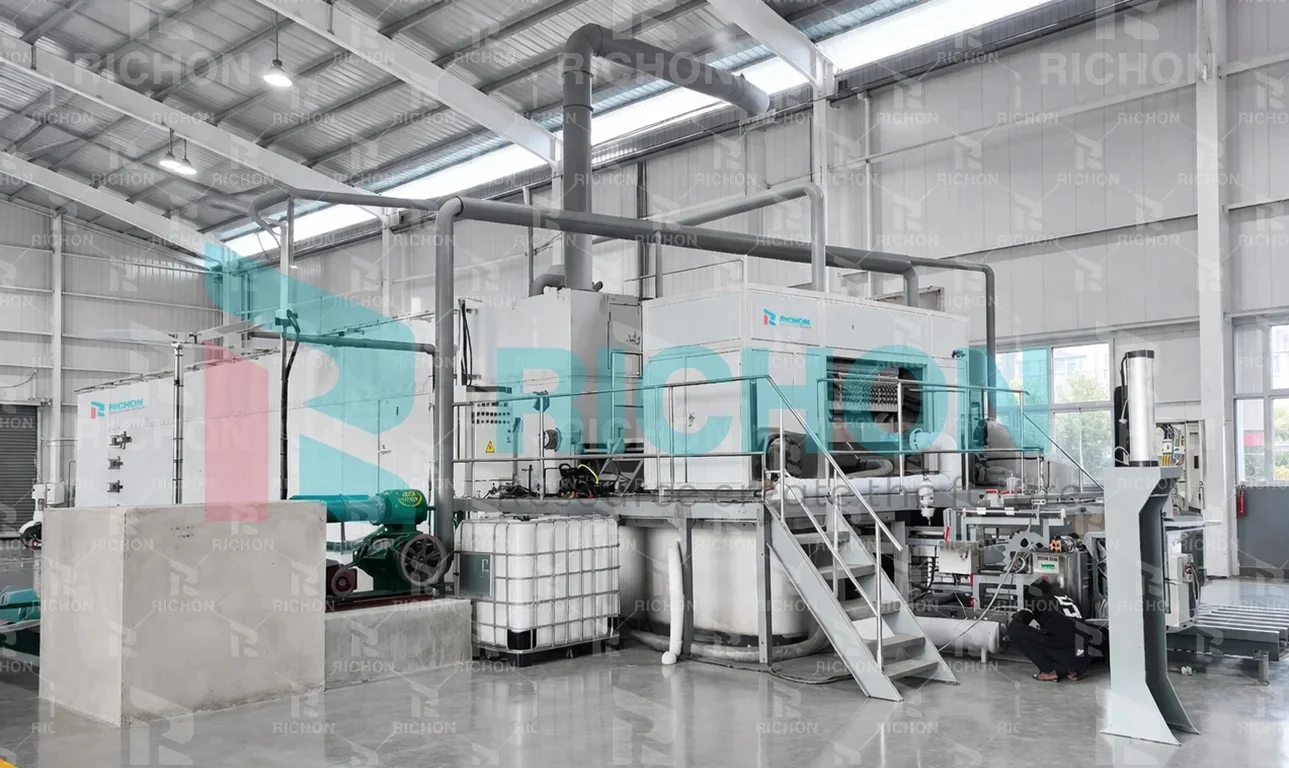
Illustrative factory scene, not evidence of a specific customer, capacity or financial result. View full-size image
How to Start an Egg Tray Manufacturing Business in 2026: Investment, Cost & Profit Guide
The egg tray manufacturing business has become a practical investment opportunity in many regions where poultry farming, recycled paper supply, and sustainable packaging demand are growing.
However, starting an egg tray factory is not just about buying a machine. A successful project requires the right capacity, raw material planning, drying system selection, factory layout, cost control, and reliable technical support.
This guide explains how to start an egg tray manufacturing business in 2026, including investment planning, equipment selection, production cost, profit logic, and key mistakes to avoid.
1. Why Egg Tray Manufacturing Is a Growing Industry
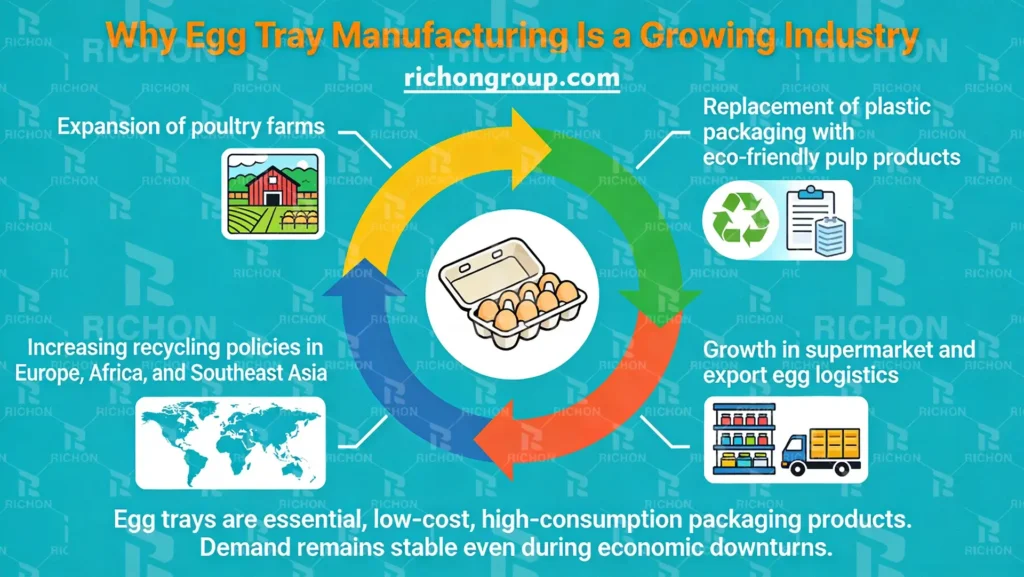
Egg trays are essential packaging products for poultry farms, egg distributors, supermarkets, and export markets. Because eggs need protection during storage and transport, demand for egg trays remains relatively stable in many markets.
Several trends are supporting the growth of egg tray manufacturing:
- Expansion of poultry farming
- Rising demand for recycled paper packaging
- Replacement of plastic packaging in some regions
- Growth of supermarket and export egg logistics
- Increasing interest in low-cost local manufacturing
Paper egg trays are made mainly from recycled waste paper, which makes the business attractive in regions with available waste paper resources and growing egg consumption.
For investors comparing packaging materials, you can also read our egg tray vs plastic tray comparison.
Step 1: Evaluate Your Local Market
Before choosing equipment, investors should first understand the local egg tray market.
Key questions include:
- How many poultry farms are nearby?
- Are egg trays currently imported or locally produced?
- What is the common selling price per tray?
- Are customers using paper trays, plastic trays, or both?
- Is demand seasonal or stable throughout the year?
- What quality level does the market require?
Many beginners make the mistake of choosing machine capacity before confirming the sales market. A better approach is to estimate monthly demand first, then select a production line that matches realistic sales volume.
For example, a small local market may not need a high-capacity automatic line at the beginning. A medium regional market may justify a 3000–5000 pcs/h line. Export-oriented projects may require more stable drying, stacking, and quality control.
For a deeper investment roadmap, see our egg tray business plan guide.
Step 2: Choose the Right Production Capacity
Egg tray production line capacity should match your market demand, investment budget, factory space, and future expansion plan.
Common capacity ranges include:
| Capacity Range | Suitable Project Type |
|---|---|
| 1000–1500 pcs/h | Small starter project |
| 2000–3000 pcs/h | Local market production |
| 3000–5000 pcs/h | Medium commercial factory |
| 5000–8000 pcs/h | Industrial-scale production |
| 8000+ pcs/h | Large automatic project |
For many first-time investors, choosing the largest capacity is not always the best decision. If market demand is not stable, a large line may create pressure from higher investment, energy cost, labor arrangement, and factory layout requirements.
On the other hand, choosing a line that is too small can limit profit potential and make it difficult to supply larger customers.
If you are comparing different output levels, read our egg tray production line capacity guide.
You can also compare different factory scales in our 3k vs 5k vs 8k vs 10k egg tray production line comparison.
Step 3: Estimate the Investment Budget
The price bands below are Richon’s 2026 indicative equipment ex-factory prices in US dollars, including molds. Auxiliary equipment, freight, installation, taxes, factory premises and startup working capital are excluded. Budget these separately; an equipment price is not the total cash required to open a factory.
Small-scale line: 1000–1500 pcs/h
Usually suitable for small local production or beginners.
Published price scope:
- Equipment ex-factory price
- Molds included
- Auxiliary equipment excluded
- Detailed configuration discussed privately
2026 indicative equipment ex-factory price (USD):
$8,000 – $25,000+Freight, installation, taxes, factory premises and startup working capital are excluded; request the detailed equipment scope privately.
Medium-scale line: 2000–4000 pcs/h
This is one of the most common starting ranges for local commercial production.
Published price scope:
- Equipment ex-factory price
- Molds included
- Auxiliary equipment excluded
- Detailed configuration discussed privately
2026 indicative equipment ex-factory price (USD):
$30,000 – $80,000+Fully automatic line: 5000 pcs/h and above
Suitable for industrial factories, larger egg distributors, or export-focused production.
Published price scope:
- Equipment ex-factory price
- Molds included
- Auxiliary equipment excluded
- Detailed configuration discussed privately
2026 indicative equipment ex-factory price (USD):
$80,000 – $200,000+Detailed equipment configurations are not published with these price bands. Request your project-specific scope and written quotation privately. The capacity groups differ from those in the business plan article, so compare written equipment scopes rather than treating the ranges as identical packages. Review our machine price guide and production cost guide before completing the budget.
Step 4: Select the Right Equipment Configuration
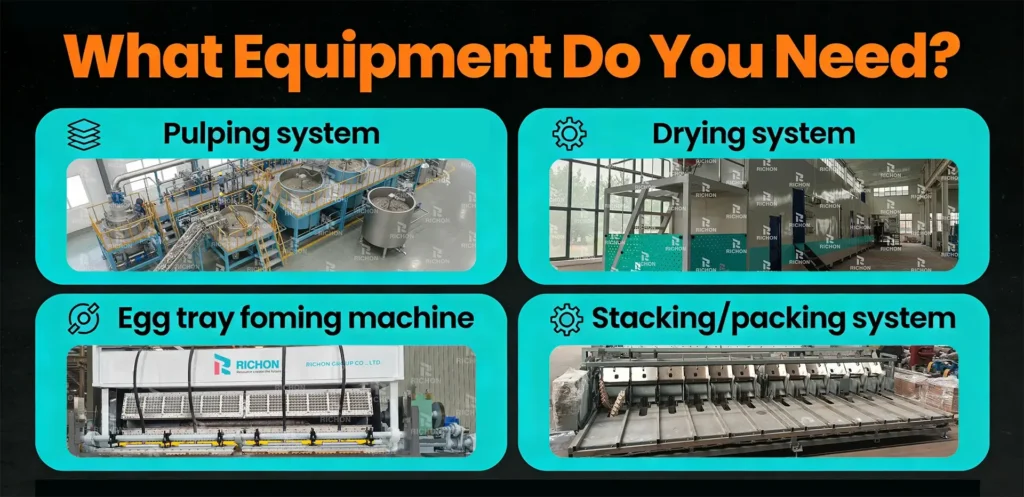
A complete egg tray manufacturing line usually includes:
- Pulping system
- Egg tray forming machine
- Drying system
- Stacking and packing system
- Water circulation system
- Electrical control system
- Molds and auxiliary equipment
The production process generally follows this flow:
Waste Paper → Pulping → Forming → Drying → Stacking → PackingThe equipment configuration should not only match the target capacity, but also the local operating conditions.
For example:
If stable quality and continuous output are required, a metal drying system may be better.
If local labor is affordable, semi-automatic handling may be acceptable.
If labor cost is high, automatic stacking becomes more valuable.
If fuel is flexible and construction cost is low, brick drying may be practical.
You can review complete system options on our egg tray production line page.
To understand each machine section, see our guide on the key components of an egg tray machine.
Step 5: Choose a Suitable Drying System
Drying is one of the most important decisions in an egg tray manufacturing business. It affects investment cost, production stability, fuel consumption, factory layout, and final product quality.
Common drying options include:
Natural drying
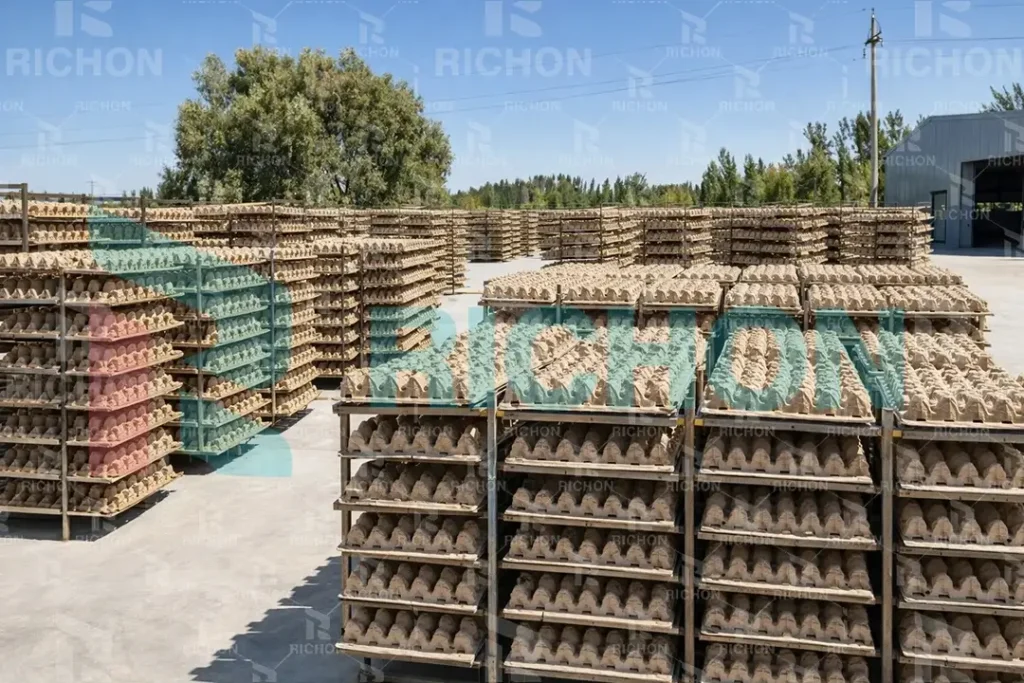
Suitable for very small projects or regions with stable sunlight and low humidity.
Advantages:
- Lowest energy cost
- Simple setup
Limitations:
- Weather dependent
- Large drying space required
- Unstable production speed
Brick drying system
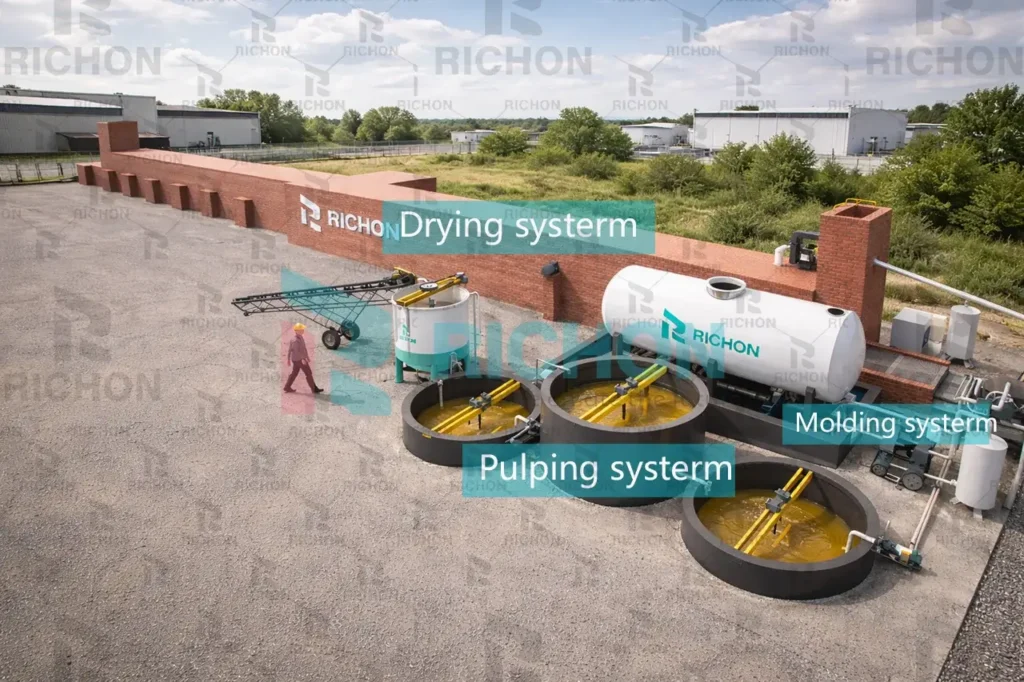
Suitable for many 2000–3000 pcs/h and medium-scale projects, especially where local construction and fuel are practical.
Advantages:
- Lower initial investment than metal dryer
- Flexible fuel options
- Easier local maintenance
- Suitable for practical starter factories
Limitations:
- Requires good airflow design
- Usually needs more manual management
- Drying consistency depends on design and operation
Metal drying system
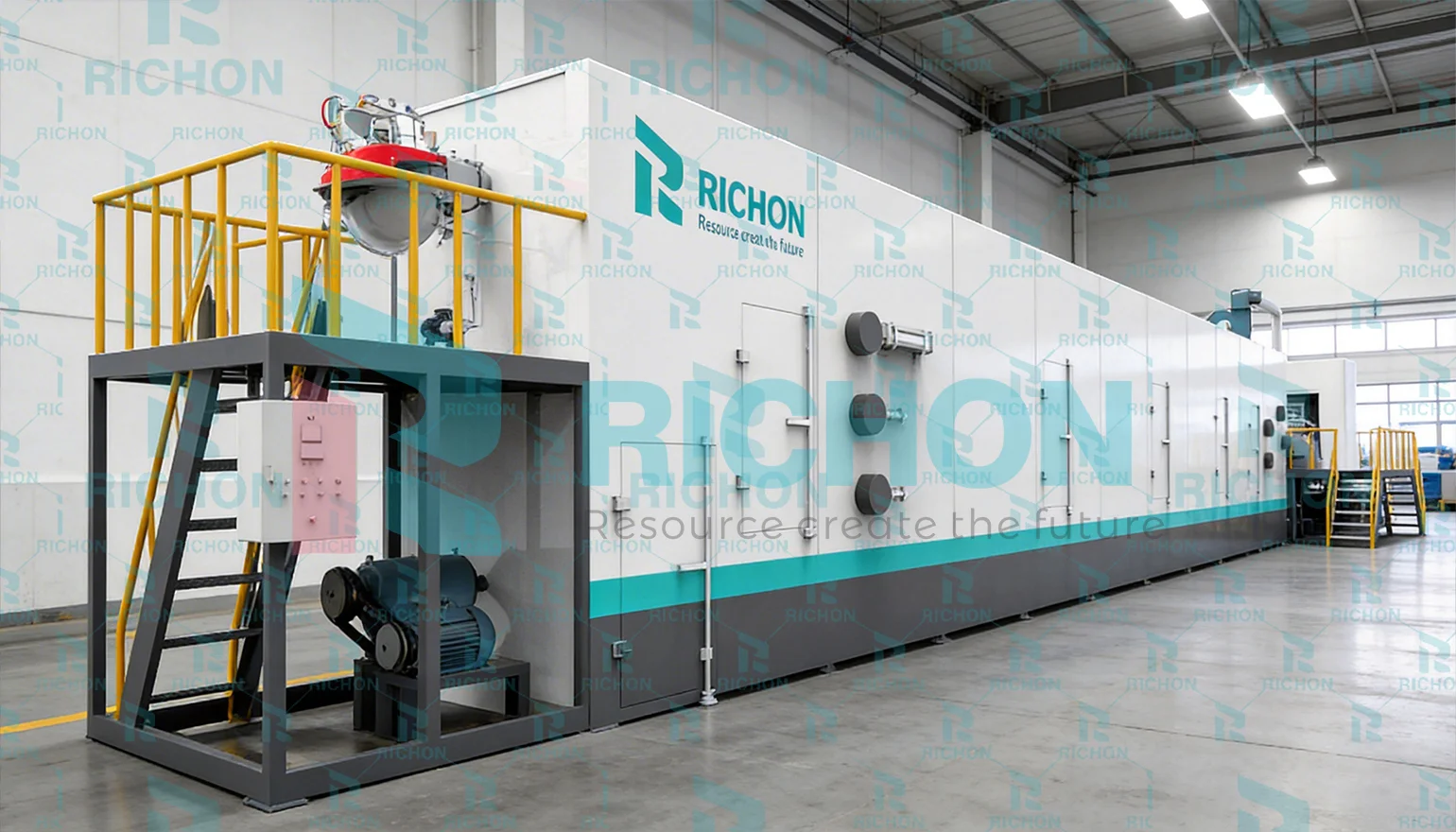
Suitable for higher-capacity or more automated production lines.
Advantages:
- Stable continuous drying
- Better automation
- More suitable for large output
- Easier production control
Limitations:
- Higher requirements for fuel and maintenance
- Higher investment
For fuel and energy comparison, read our egg tray drying system cost analysis.
If you are comparing drying structures, see brick dryer vs metal dryer for egg tray production.
Step 6: Plan Raw Materials and Operating Cost

The main raw materials for egg tray production include:
- Waste paper
- Old newspapers
- OCC cartons
- Recycled cardboard
- Water
- Optional additives depending on product requirements
Raw material cost is one of the largest long-term operating costs. However, the exact percentage varies by region, raw paper quality, drying method, labor cost, and production efficiency.
In many projects, operating cost usually includes:
- Raw material cost
- Drying fuel cost
- Electricity cost
- Water cost
- Labor cost
- Maintenance cost
- Packaging and transportation cost
For a realistic business calculation, investors should not only ask for machine price. They should calculate cost per tray.
Production cost per saleable tray = production cost for the measured period ÷ accepted trays produced during the same period. State which costs are included and whether the figure is cash cost or includes depreciation. Use actual accepted output rather than rated machine capacity.
For a profit calculation, reconcile production costs with the goods actually sold and include the remaining period expenses. Trays in inventory do not automatically create sales revenue or customer payments.
For material selection and pulp ratio details, read our egg tray raw materials guide.
For utility planning, see our egg tray machine electricity consumption guide.
You can also review how much water is needed for egg tray production.
Step 7: Plan Factory Space and Layout
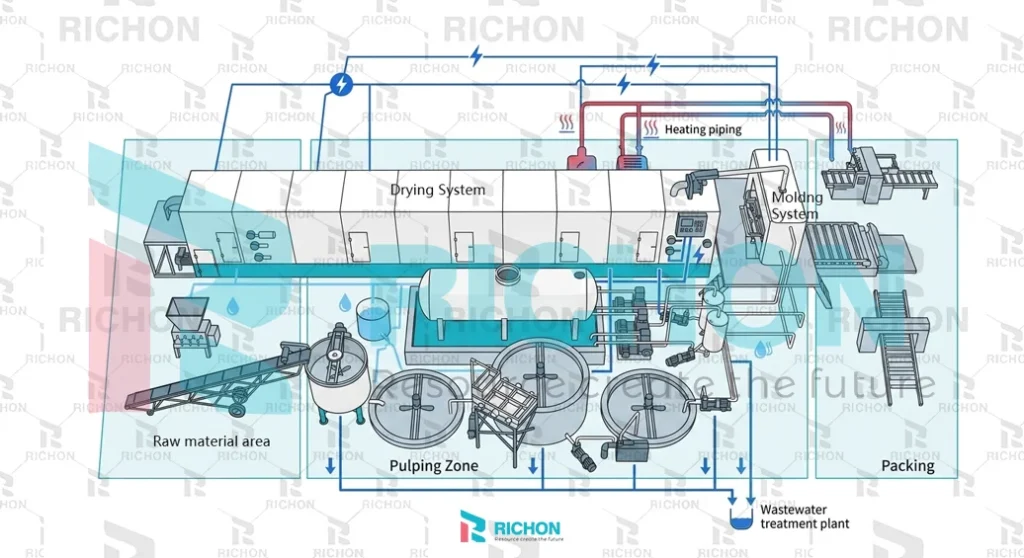
Factory layout affects production efficiency, labor movement, material handling, drying performance, and future expansion.
A typical layout should follow a smooth workflow:
Raw Material Area → Pulping Area → Forming Area → Drying Area → Packing Area → Finished Product AreaImportant layout considerations include:
- Enough space for raw paper storage
- Smooth connection between pulping and forming
- Proper dryer location
- Safe worker movement
- Finished product storage space
- Maintenance space around equipment
- Expansion space for future capacity increase
Poor factory layout can increase labor cost, slow production, and create unnecessary handling problems.
For layout planning, read our egg tray factory space and layout guide.
Step 8: Calculate Profit and ROI
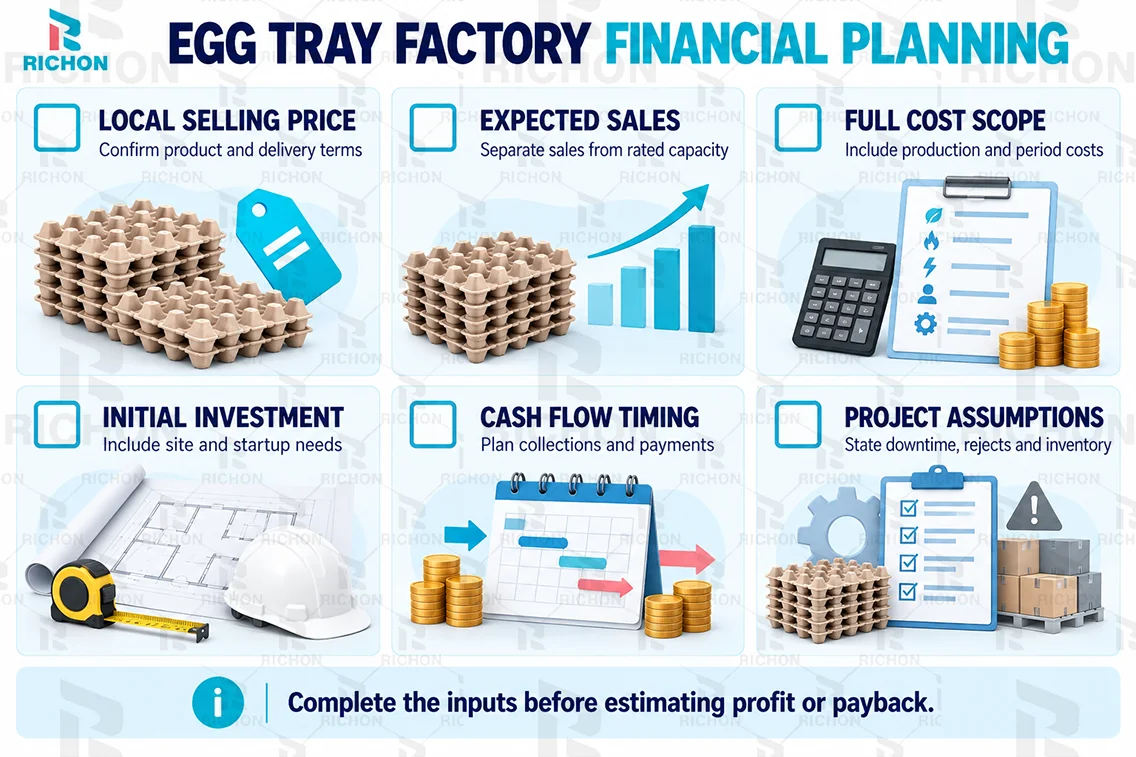
Financial planning inputs must be completed before estimating profit or payback. View full-size image
Start with the price and quantity actually sold, the costs associated with those sales and the remaining expenses for the same accounting period. Keep sales, saleable production and cash received separate.
At an assumed 3,000 pcs/h, 8 operating hours per day and 26 days per month, the nameplate-rate calculation is 624,000 trays before downtime, slower running and rejected trays. If all are accepted and sold at an assumed US$0.03 each, revenue would be US$18,720. This is an approved planning illustration, not measured production, sales or profit.
An ideal net-margin planning target of 20–35% may be tested in your local model. Calculate net profit after all relevant production costs, fuel or purchased heat, overhead, depreciation, financing and taxes, without double counting. Net profit margin = net profit ÷ net revenue × 100. This target is not a verified customer result or a general industry average; actual results may be lower or negative.
For this startup guide, 8–18 months is a separate illustrative cash-payback planning target. Test it using a cash-flow schedule that includes commissioning and production ramp-up, the complete initial investment, working-capital needs, realistic sales and customer payment timing. The business plan’s 6–12-month ideal target is a more ambitious scenario; neither range follows automatically from capacity or equipment price. Neither is a measured average or a promise, and the calculated period may be longer or fail to produce payback.
Use current raw-material prices, energy tariffs, labor and premises costs and local selling prices for the target country or region. Review the business plan and profit margin and ROI guide, then contact Richon by email or in an online meeting for a project-specific model.
Step 9: Choose the Right Manufacturer
Choosing a reliable supplier is critical because egg tray production is not only a machine purchase. It is a complete production system.
When evaluating suppliers, check:
- Real manufacturing capability
- Engineering experience
- Complete production line design ability
- Drying system planning support
- Installation guidance
- Spare parts availability
- Operator training
- After-sales service
- Technical documentation
A low machine price may look attractive at first, but weak engineering support can cause higher long-term cost through downtime, unstable product quality, and poor energy efficiency.
Before purchasing, read our guide on factory or trading company: how to identify a real egg tray machine manufacturer.
Step 10: Avoid Common Startup Mistakes
Many new investors lose money not because the egg tray business is bad, but because early decisions are wrong.
Common mistakes include:
- Choosing the cheapest machine only
- Ignoring drying system cost
- Selecting the wrong capacity
- Underestimating factory layout
- Using unstable raw materials
- Overestimating selling price
- Ignoring maintenance planning
- Choosing an unreliable supplier
These mistakes can increase production cost and reduce profit margin.
To avoid common risks, read our buyer checklist for verifying an egg tray equipment supplier.
Small-Scale vs Fully Automatic: Which Is Better for Beginners?
There is no single best option for all investors.
A small-scale or semi-automatic line may be better if:
- Capital is limited
- Local market is still being tested
- Labor cost is low
- Natural drying or brick drying is practical
A fully automatic line may be better if:
- Demand is already confirmed
- Labor cost is high
- Stable output is required
- Export or large customer supply is planned
- The investor wants better long-term efficiency
For many beginners, the safest strategy is to start with a configuration that matches confirmed demand, then reserve space and planning for future expansion.
Frequently Asked Questions
Is the egg tray manufacturing business profitable?
Yes, it can be profitable when raw material cost, energy cost, machine stability, and market demand are properly controlled. Profit depends on selling price, cost per tray, and stable output.
What is the minimum investment to start?
Richon’s 2026 indicative ex-factory equipment range for the 1,000–1,500 pcs/h group is US$8,000–25,000+, including molds. It excludes auxiliary equipment, freight, installation, taxes, factory premises and startup working capital. This is not a minimum total factory-investment figure. Request a project-specific written quotation and budget the excluded costs separately; detailed configurations can be discussed privately.
How long does it take to recover investment?
The 8–18-month range in this startup guide is an illustrative cash-payback planning target under favorable project conditions, not a guarantee or measured customer average. Test the complete investment and cumulative net cash flow, allowing for startup, realistic sales and payment delays. Raw-material, electricity, fuel or steam, labor, premises and selling prices vary by country and region. Contact Richon by email or in an online meeting to calculate your own scenario; the actual period may be longer, and inadequate net cash flow may prevent payback.
What raw materials are required?
The main raw materials are waste paper, recycled cartons, old newspapers, water, and sometimes additives depending on product requirements.
Which drying system is best for beginners?
For small or medium projects, natural drying or brick drying may be more practical in some regions. For higher output and stable production, a metal drying system is usually more suitable.
Final Thoughts
Starting an egg tray manufacturing business in 2026 can be a practical and scalable opportunity, especially in regions with growing poultry farming, available waste paper, and demand for sustainable packaging.
However, success depends on more than machine price.
A profitable project requires:
- Real market demand
- Proper capacity selection
- Suitable drying system
- Stable raw material supply
- Efficient factory layout
- Reliable equipment supplier
- Clear cost and profit calculation
Before making an investment decision, compare not only machine quotation, but also long-term production cost, product quality, maintenance support, and future expansion potential.
Explore our egg tray production line solutions or contact Richon engineers for project planning support.
Need a Capacity Recommendation for Your Market?
Share your target output, local humidity/energy conditions, and tray type. Our engineers will suggest a suitable 3,000–8,000 pcs/h configuration and drying solution.
- Factory layout & utilities checklist
- Drying bottleneck evaluation
- Cost & ROI estimation reference
