 English

Brick Dryer vs Metal Dryer for Egg Tray Production
A brick dryer and a metal dryer can both run continuously behind an egg tray forming machine. The real difference is how each system is built, controlled, maintained, and fitted into the factory.
In project reviews, the dryer shell is rarely the only issue. Land, civil-work quality, heat source, air circulation, wet-tray transfer, maintenance access, installation schedule, and future expansion usually decide whether the drying section will remain stable after commissioning.
This comparison is therefore based on factory conditions, not on a claim that one dryer is always cheaper or more energy-efficient. If natural drying is also under consideration, start with the egg tray drying system comparison .
Quick Answer: Which Dryer Fits the Project?
Brick dryer
It is normally the stronger candidate when the factory has a permanent site, adequate land, dependable civil contractors, a workable local heat source, and enough time for construction and commissioning.
Metal dryer
It is normally the stronger candidate when the project needs a compact layout, standardized installation, closer temperature and airflow control, easier automation integration, or a clearer path for later equipment changes.
Engineering limit: this is a screening rule, not a performance guarantee. Final output and operating cost depend on insulation, circulation design, heat source, tray loading, maintenance, operator practice, and commissioning.
Brick Dryer vs Metal Dryer: Engineering Comparison
| Decision factor | Brick dryer | Metal dryer |
|---|---|---|
| Construction | Tunnel and heating structure built through civil work at the site | Prefabricated equipment sections assembled and connected at the site |
| Site commitment | Best treated as a permanent part of the factory | Easier to coordinate with a standardized workshop plan and later equipment changes |
| Installation planning | Depends on civil design, local materials, dimensional control, labor, curing, and site coordination | Depends on foundation, utilities, assembly, alignment, and equipment commissioning |
| Footprint | Usually requires dedicated space for tunnel, furnace, access, and material movement | Can be arranged as a more compact integrated drying section |
| Process control | Strongly affected by tunnel geometry, furnace operation, insulation, and operator adjustment | More direct integration of fans, recirculation paths, zones, sensors, and controls |
| Maintenance | Civil structure, furnace, ducts, insulation, and operating condition | Panels, seals, conveyors, fans, sensors, controls, and heat-source equipment |
| Future change | Expansion may require added land and civil modification | Equipment-level or modular changes may be easier, subject to the final design |
| Energy performance | Neither structure has an automatic advantage. Insulation, leakage, fuel, circulation, loading, exhaust, and operating discipline decide the result. | |
How a Brick Dryer Fits the Factory
A brick dryer is not an accessory placed behind the forming machine. It is a fixed part of the plant. The tunnel centreline, rail or conveyor route, furnace position, circulation path, foundations, service doors, and discharge area must be agreed before civil work begins.

Where it can work well
- The site is permanent and enough land is reserved around the drying section.
- Local contractors can hold the required dimensions and insulation quality.
- The heat source is available, permitted, and practical to operate locally.
- The operating team understands furnace, airflow, cleaning, and routine inspection.
Where projects lose control
- Civil drawings and equipment drawings are handled as separate jobs.
- Air leakage and uneven insulation are accepted as construction details rather than process problems.
- Maintenance doors, ash handling, duct cleaning, or safe access are left until installation.
- No land is reserved for a later change in capacity or material flow.
Before selecting this route, confirm the permanent site, usable land, contractor capability, heat-source conditions, environmental requirements, construction schedule, and the team’s ability to manage a site-built thermal system.
How a Metal Dryer Fits the Factory
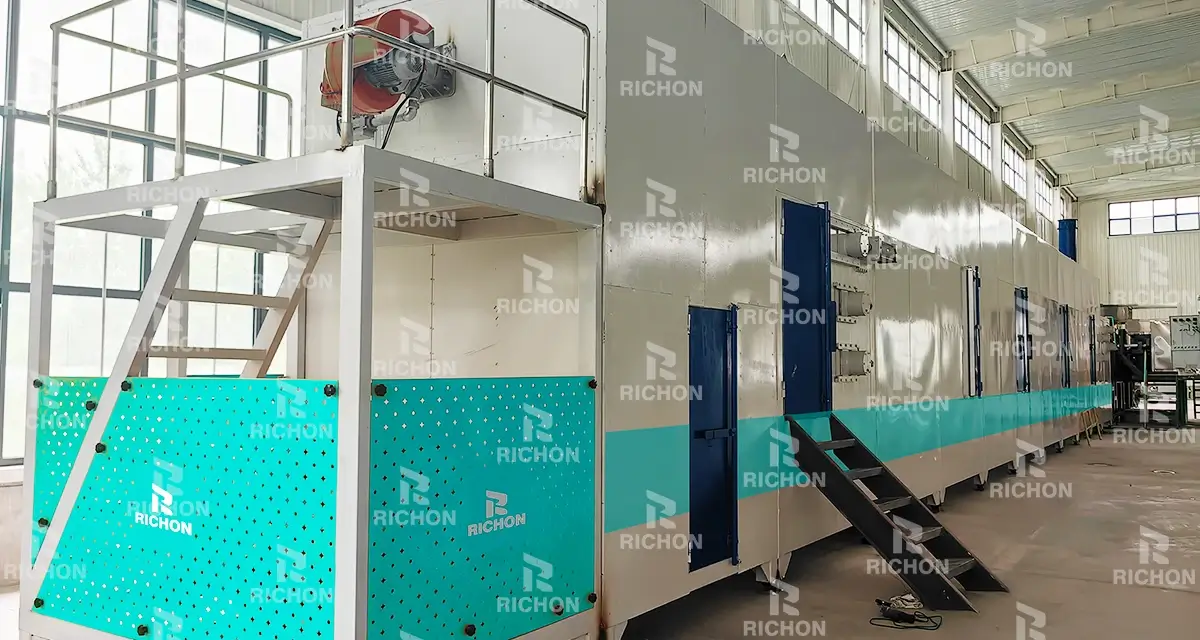
A metal dryer is supplied as an equipment system. Its enclosure, tray conveyor, circulation fans, air paths, control points, and heat-source interface are planned together. That makes the installation more standardized, but it does not remove the need for a proper utility and maintenance plan.
Where it can work well
- Workshop space is limited and the line needs a compact, defined arrangement.
- The project requires closer monitoring, zoning, or automation integration.
- Foundation, utilities, heat source, and assembly conditions can be prepared before delivery.
- The maintenance team can support conveyors, fans, sensors, seals, and controls.
What still needs attention
- Fan and conveyor maintenance cannot be postponed because the enclosure looks complete.
- Panel joints, access doors, and damaged seals must be checked for heat loss.
- Cleaning and corrosion protection must match local dust, moisture, and operating conditions.
- Expansion space and transfer direction still need to be reserved in the first layout.
Airflow, Temperature, and Line Matching
From an operating point of view, wet trays do not respond to brick or sheet metal; they respond to heat transfer, air movement, time, and loading. A well-built dryer of either type can still underperform if the forming section delivers trays faster than the dryer can remove moisture.
During design and commissioning, check the points that operators will actually see:
- air reaches both sides and the full width of the tray path;
- temperature remains stable through the useful drying zone;
- tray spacing and loading do not block circulation;
- wet-tray transfer does not deform products before they enter the dryer;
- doors, joints, ducts, and insulation do not create avoidable heat loss;
- dryer throughput remains compatible with forming output and downstream stacking;
- fans, conveyors, furnace, sensors, and controls can be inspected without stopping the entire factory for routine work.
A dryer quotation should be reviewed together with the forming machine, tray specification, incoming moisture condition, heat source, operating hours, and factory layout. Comparing only the dryer body leaves the main production risks unanswered.
Energy Use and Operating Cost
Statements such as “brick always uses less energy” or “metal always costs more to run” are not reliable engineering conclusions. Actual consumption comes from the complete thermal system.
The calculation should include local fuel or electricity price, fuel quality, insulation, leakage, recirculation and exhaust strategy, wet-tray condition, loading rate, production interruptions, cleaning, and maintenance condition. Two dryers using the same fuel can produce different costs when these conditions are different.
Project-specific figures should only be issued after the heat source, dryer configuration, tray specification, production target, and operating plan are defined. For the wider calculation framework, use the egg tray drying system cost guide.
Compare Total Project Cost, Not Dryer Price Alone
| Cost category | Brick dryer review | Metal dryer review |
|---|---|---|
| Civil works | Foundations, tunnel, furnace area, building materials, insulation, and construction labor | Foundations, equipment area, utility routes, and service clearance |
| Equipment | Furnace, circulation components, transfer system, and site-built structure | Dryer sections, conveyors, fans, controls, panels, and heat-source interface |
| Installation | Civil schedule, dimensional checks, connection, and commissioning | Assembly, alignment, utility connection, controls, and commissioning |
| Factory space | Dryer, furnace, safe access, maintenance, and material movement | Integrated footprint plus operation and maintenance clearance |
| Operation | Fuel, labor, furnace operation, airflow adjustment, cleaning, and repairs | Energy, operators, fans, conveyors, sensors, controls, and scheduled maintenance |
| Future change | May require new civil work or rebuilding | May allow equipment-level changes, subject to module condition and final design |
The lower purchase price is not necessarily the lower installed cost, and the lower installed cost is not necessarily the lower operating cost. Review the complete factory plan over the expected operating period.
Final Selection Checklist
A brick dryer may fit when
- the production site is permanent;
- land and civil-construction resources are available;
- the construction period is acceptable;
- the heat source is practical and permitted locally;
- operators can manage a site-built heating and airflow system;
- future relocation is unlikely.
A metal dryer may fit when
- workshop space is limited;
- standardized installation is important;
- monitoring and automation are project priorities;
- later equipment or layout changes are likely;
- the maintenance team can support mechanical and control components;
- the project needs a more repeatable industrial operating method.
Before making the final choice, review the dryer with the complete egg tray production line, the factory layout plan, and the complete production process. The dryer must match forming output, transfer direction, heat-source access, stacking, and finished-product movement.
Frequently Asked Questions
Is a brick dryer always cheaper than a metal dryer?
No. The comparison must include land, civil work, construction labor, furnace, insulation, equipment, installation time, commissioning, and later modification. The answer changes with the site.
Is a metal dryer always more energy-efficient?
No universal result applies. Metal systems can make circulation control and monitoring easier to integrate. Brick systems can also operate effectively when construction, insulation, furnace operation, and airflow are well managed. Use the final design and local fuel conditions for the calculation.
Which dryer is better in a humid climate?
Humidity alone should not determine the structure. Review incoming tray moisture, enclosure, circulation, heat source, insulation, corrosion protection, exhaust, and the production schedule.
Can a brick dryer be expanded later?
It can be modified, but expansion may require more land, civil work, duct changes, or reconstruction. Reserve access and future capacity during the first layout.
Can a metal dryer be relocated?
Some components may be reusable or reconfigured, but relocation is not automatic. Module condition, foundations, utilities, controls, and the new layout must be reviewed first.
DRYING SYSTEM REVIEW
Get a Project-Specific Dryer Review
Send us the target tray, required output, factory dimensions, available heat source, local energy conditions, construction schedule, and automation preference. Richon engineers can compare the two dryer structures as part of the complete line configuration.
- Heat Source
- Factory Layout
- Airflow Control
- Installed Cost
- Expansion Plan
Project-specific comparison based on your actual site conditions.