 English

How to Choose the Right Egg Tray Production Line Capacity
Plan the output your factory can deliver
The capacity decision starts with orders, not the largest number on a machine specification. A buyer needs dry, acceptable trays ready for dispatch. The forming machine, dryer, transfer arrangement and packing section must be able to support that requirement on the same shift schedule.
A larger line can meet higher demand, but it also ties up money in equipment, utilities and stock before those trays are sold. A smaller line may leave little time for cleaning, product changes or an urgent order. The right balance depends on confirmed demand, the tray being made and the limits of the site.
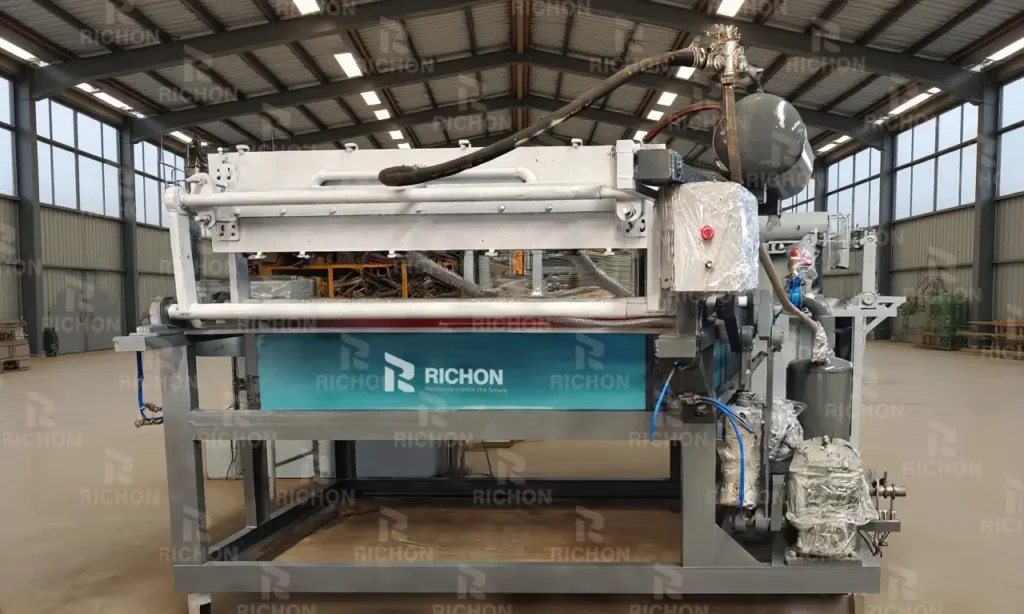
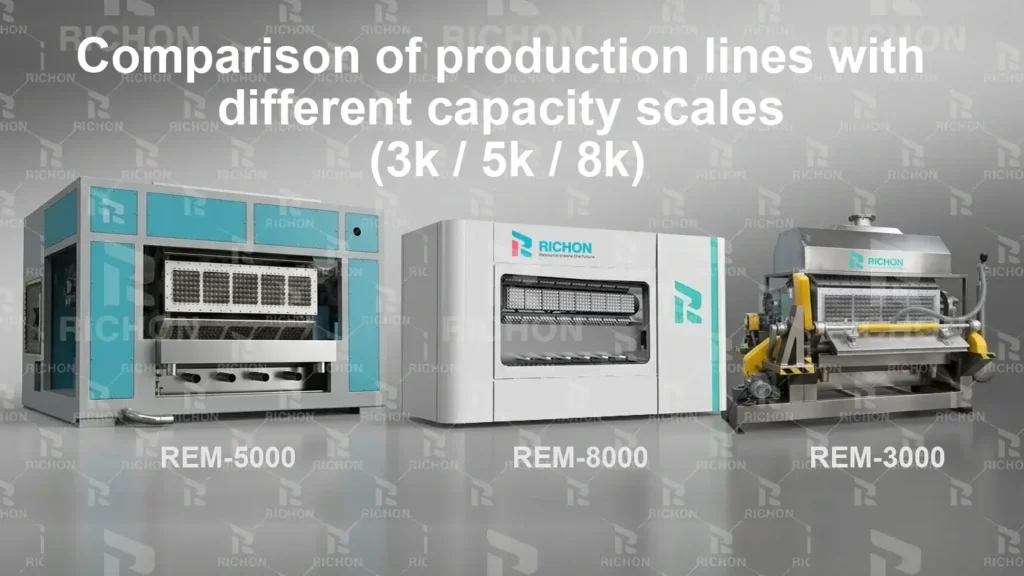
This guide covers demand, operating time, budget, drying, molds, utilities and expansion. For the current configuration entries, use the Richon capacity solutions comparison. Keep the planning calculation separate from the model-selection table.
Use capacity ranges as a starting point, not a verdict
Hourly output is useful for comparing the scale of proposals. It is not enough to choose a factory. Ask whether the stated figure refers to forming cycles, wet trays or finished trays, and which tray size, mold arrangement and operating conditions it assumes.
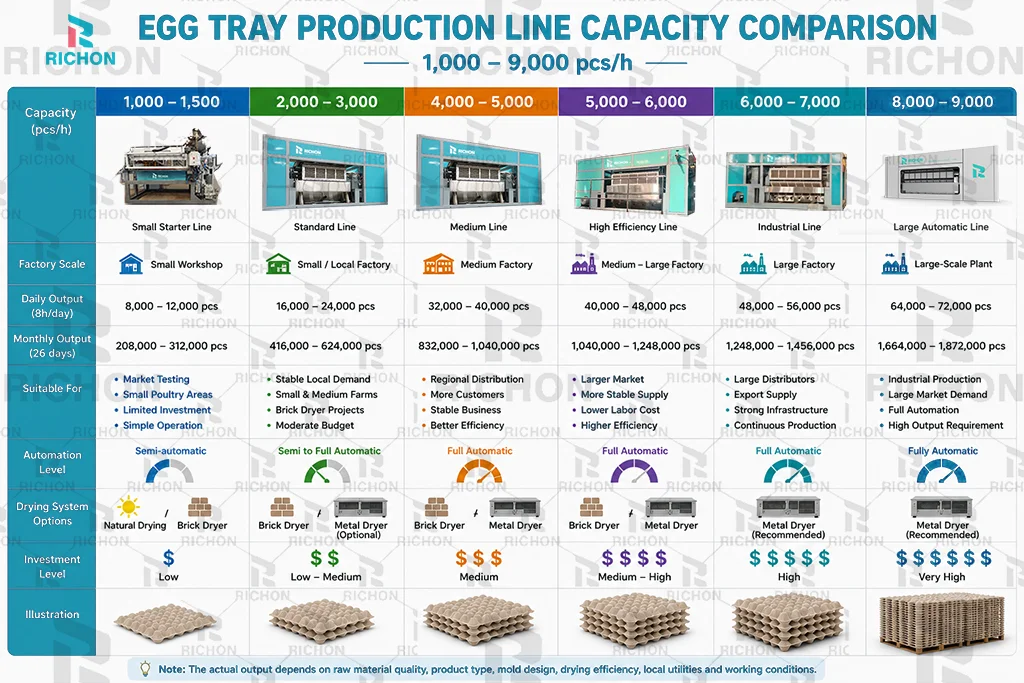
| Planning band | Question to settle before selection |
|---|---|
| 1,000–2,000 trays/h | Can the planned shifts cover orders without depending on uninterrupted running every day? |
| Around 3,000 trays/h | Can drying, tray handling and packing sustain the required finished output? |
| 4,000–5,000 trays/h | Is demand sufficiently established, and are utilities and material supply ready for the proposed schedule? |
| 6,000–8,000 trays/h | Can the whole site support sustained throughput, storage and dispatch rather than forming speed alone? |
| Above 8,000 trays/h | Has the larger system been checked against demand, service access, redundancy requirements and expansion space? |
These are planning bands, not guaranteed outputs or fixed recommendations for a particular country. Tray geometry, dry weight, moisture and the final equipment arrangement still need to be agreed.
Step 1: Turn orders into required finished output
List customers, tray specifications, delivery dates and order quantities. Separate contracted or repeat orders from enquiries. Check whether demand is steady or concentrated into a few delivery days. A monthly total can hide a weekly dispatch peak.
Next, calculate the time actually available for production. An eight-hour shift is not necessarily eight hours of continuous output. Allow for preparation, cleaning, mold changes, planned maintenance and interruptions. Use records from an existing factory where available; for a new project, show these allowances as assumptions to be checked.
Required finished rate = trays needed ÷ net production hours
Illustrative example: an order of 24,000 acceptable trays needs 3,000 finished trays/h over eight net hours. If only six net hours are available, the requirement becomes 4,000 finished trays/h. These figures describe a schedule, not a machine test.
Allow for rejects separately. If the accepted share of output is known from comparable production, required gross throughput equals required finished throughput divided by that accepted share. Do not insert an assumed yield simply to make a proposed machine appear sufficient.
For mixed products, allocate time to each tray type and add changeover time. A line that meets one product’s hourly target may not meet the combined delivery plan. The egg tray business plan can help organize the commercial assumptions; the capacity calculation should show the production assumptions alongside them.
Step 2: Check the investment scope before increasing capacity
A forming-machine price is not a factory budget. Compare offers using the same equipment boundary: pulping, forming, vacuum and compressed-air systems, drying, molds, handling, stacking and controls. State which installation, commissioning and training services are included.
Keep local expenditure visible. Building works, foundations, fuel connections, electrical distribution, water arrangements, freight and import charges can sit outside an equipment offer. Raw-material stock, finished-goods stock and the cash needed between production and customer payment also affect what the project can afford.
When the budget is tight
Review the shift plan and equipment scope before cutting a necessary line section. A cheaper dryer that cannot process the required wet trays can leave the forming machine waiting. Reducing automation may also change the handling and staffing arrangement.
When considering a larger line
Cost the extra utilities, storage and working capital as well as the machine. Check whether additional output has a buyer. Leave an explicit allowance for unresolved local costs instead of treating them as zero.
Use the price and project-budget guide for the cost boundary. This capacity guide keeps the focus on whether the proposed spending supports the required output.
Step 3: Match drying capacity to the wet-tray load
Drying is often where a forming-rate comparison becomes misleading. The dryer receives wet trays and must remove enough water to meet the agreed finished condition. Its duty depends on incoming moisture, tray weight, feed rate, residence time, airflow and available heat—not just a trays-per-hour label.
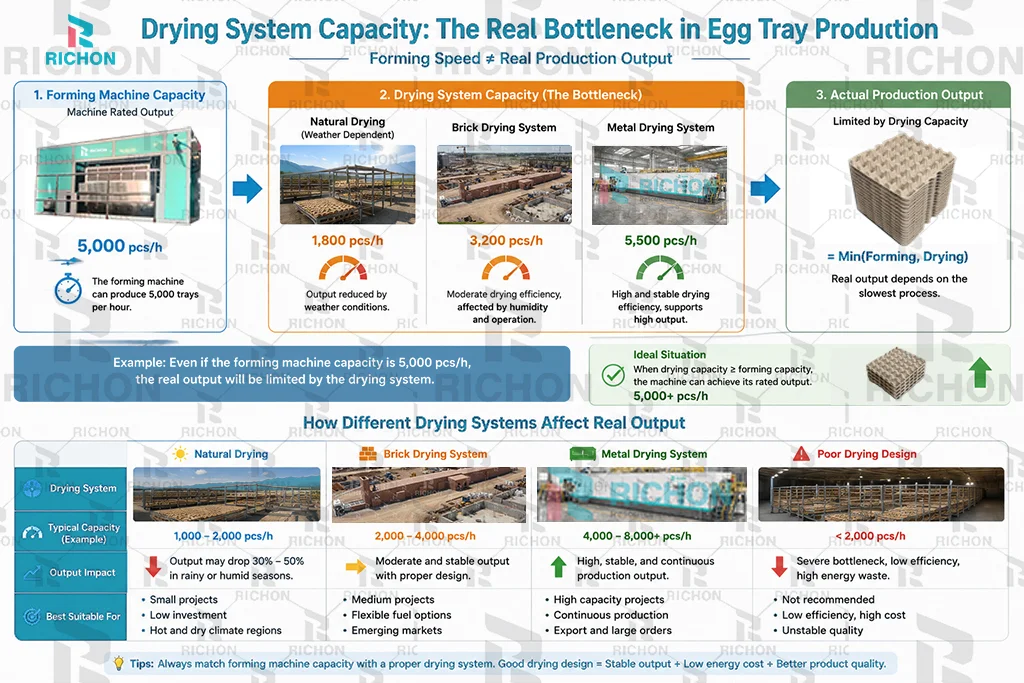
For example, if forming can sustain 5,000 wet trays/h but drying can process only 3,500 comparable trays/h, the line cannot sustain 5,000 finished trays/h. Wet-tray storage may cover a short interruption, but it does not remove a persistent capacity deficit. Also check transfer and stacking: the slowest section may change with the product or shift.
Natural drying
Assess usable drying area, handling time, local weather and protected storage. Base the schedule on conditions during the difficult production period, not only a dry-season trial. State what happens to orders when outdoor drying is interrupted.
Brick drying
Check the local construction scope, heat source, airflow distribution, tray transport and access for cleaning and repair. The proposed structure must be designed for the required load; the word “brick” does not establish its output or operating cost.
Metal drying
Check the supplied dryer sections, controls, insulation, conveyor arrangement and fuel or heating requirements. A continuous dryer can be configured for the production schedule, but consistent results still depend on correct loading, heat supply and operation.
For the construction and maintenance trade-offs, see brick versus metal drying. Use the drying-system comparison to review the broader routes without repeating that full comparison here.
Step 4: Verify the product and mold arrangement
Do not transfer a capacity figure from one tray to another without checking the product. Cavity arrangement, tray dimensions, target dry weight, wall thickness and drainage behavior can change the forming cycle and wet-tray load. The mold and machine must be considered together.
Check drainage passages, mesh condition and vacuum performance when reviewing forming consistency. Poor drainage can leave more water for the dryer to remove. Uneven forming or damaged mesh can create weak areas, dimensional problems and rejects even while the cycle counter shows the planned speed.
Specify the acceptance criteria before discussing output: product dimensions, dry condition, handling strength and stacking requirements. Then distinguish machine cycles, formed trays and accepted finished trays in production records. They are different measurements.
For an egg-tray and egg-carton mix, confirm which mold sets are included, the changeover procedure, required adjustment time and whether the same drying settings are appropriate. See mold technology and configuration for the detailed tooling checks.
Step 5: Check utilities and the complete factory layout
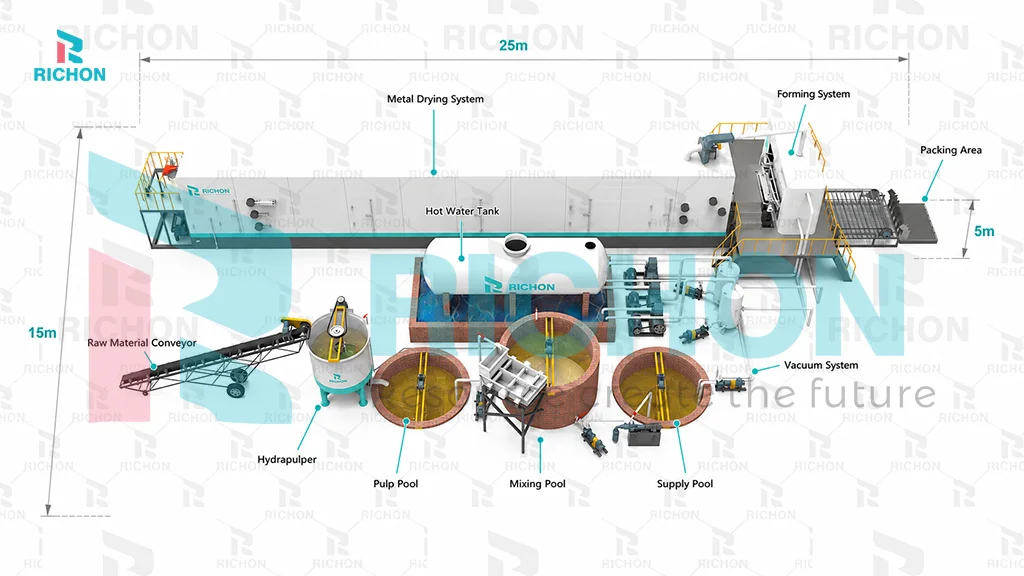
An equipment arrangement that fits inside a building may still be difficult to run. Leave room for loading paper, pulp preparation, wet-tray movement, packing, finished-goods storage and maintenance. Identify door positions, columns, clear height and routes used by vehicles and operators.
| Site item | Information needed for the capacity review |
|---|---|
| Electricity | Voltage, frequency, available supply, distribution scope and any interruptions affecting the intended schedule. |
| Water | Supply, storage, process-water circulation and arrangements for cleaning and drainage. |
| Heat and fuel | Available energy source, delivery reliability, connection requirements and the proposed dryer duty. |
| Space | Measured building dimensions, service access, storage and a reserved expansion route. |
| People and handling | Shift coverage, tray-transfer method, packing arrangement and maintenance responsibility. |
Installed electrical power is not the same as energy used per accepted tray. Likewise, a water tank size is not daily water consumption. Keep each quantity and its operating basis clear. Use the factory layout guide for a more detailed space review.
Select by the project’s constraints, not its label
New local producer
Confirm repeat orders, customer payment terms and the practical shift arrangement. Compare a smaller initial system with a larger proposal using the same demand forecast. Do not size the factory from enquiries alone.
Established local supplier
Use actual orders, rejects and downtime to identify the shortfall. Check whether another shift, better handling or a dryer improvement can meet it before replacing the forming machine.
Regional distributor or supplier
Include delivery peaks, stock between dispatches and transport arrangements. A higher hourly rate will not resolve insufficient packing or warehouse space.
Industrial expansion
Check how the new line shares pulping, utilities, labor and storage with existing equipment. Reserve space and service access without assuming that every section can accept the future load.
None of these project types has a universal capacity. Compare scenarios using net hours, accepted output and the bottleneck that each proposal leaves unresolved.
Check local operating conditions instead of regional averages
Two factories in the same country can need different capacities and drying arrangements. One may supply a single farm on repeat orders; another may dispatch to several distributors. Their power supply, fuel access, building and staffing can also differ.
Review the conditions at the actual site: seasonal drying constraints, supply interruptions, available paper grades, fuel delivery, maintenance support and customer delivery schedules. If a condition changes during the year, calculate its effect on the available operating hours or drying plan.
Country names should not replace that review. A regional customer case can show how one project was arranged, but its capacity, floor area or costs should not be copied into a new proposal without matching the relevant conditions.
Calculate monthly output before discussing returns
Multiplying an hourly rate by a shift and a calendar produces a theoretical total. It does not demonstrate delivered output, sales or profit. Keep that distinction visible when preparing the investment calculation.
3,000 trays/h × 8 h/day × 26 days = 624,000 trays/month
This arithmetic assumes the stated rate is sustained for every counted hour. Actual accepted output needs to account for lost time and rejects without counting the same allowance twice. Sales then depend on customer demand and dispatch, not only production.
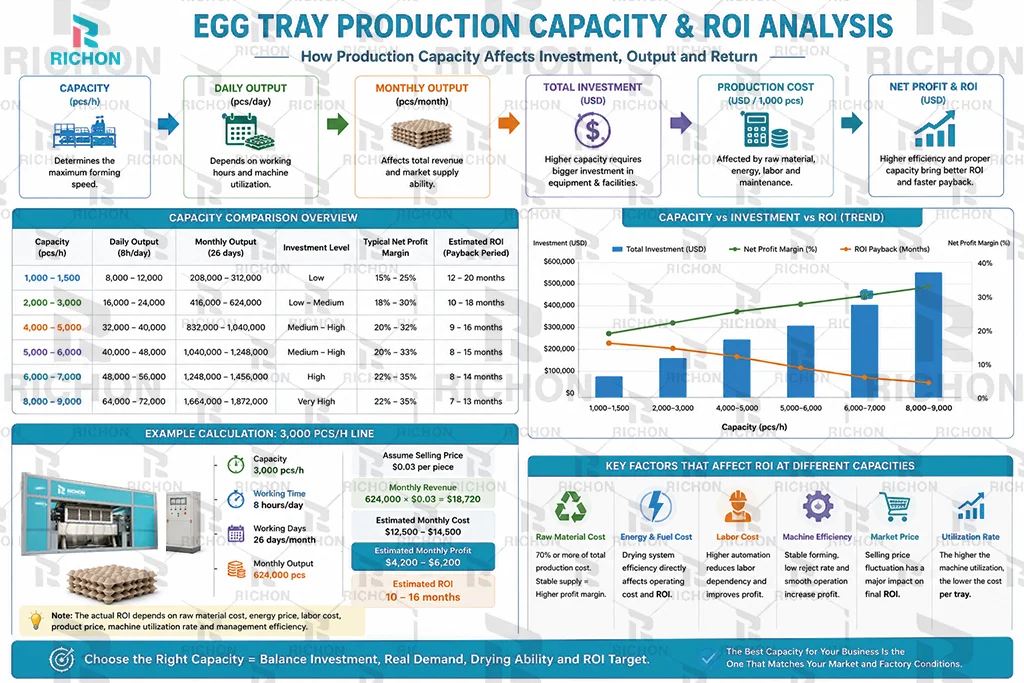
Build a project calculation from the actual tray selling price and agreed cost boundaries. Include paper, fuel, electricity, labor, packing, maintenance, local overheads and stock requirements. Show which inputs are measured, quoted or assumed. Review slower sales and interrupted production as separate scenarios.
A larger machine does not automatically shorten payback. Capacity only helps when the project can produce acceptable trays and sell them on the planned terms. See the profit-margin guide for the commercial calculation; this article does not promise a payback period.
Common capacity-selection mistakes—and the checks that prevent them
- Buying for an unconfirmed sales target. Separate repeat demand from the growth scenario. Check the cash and storage needed if sales develop more slowly.
- Comparing forming speed with finished output. Identify the basis of each quoted number and review drying, handling and acceptance conditions.
- Counting the whole shift as production time. Include cleaning, changeovers and maintenance. Check the delivery peak rather than relying only on a monthly average.
- Choosing on purchase price alone. Compare complete scopes and local costs. A missing line section can move expenditure outside the quotation without reducing the project’s real requirement.
- Leaving expansion until after installation. Check reserved floor space, utility headroom and access now. Identify the section likely to become the next bottleneck.
Keep the assumptions in one planning sheet. When an input changes, revise the affected calculation rather than adding a second, inconsistent output figure elsewhere in the proposal.
Leave a practical expansion path and a clear engineering brief
If expansion is expected, identify what can be enlarged, added or reused. A larger forming machine may require changes to pulp supply, vacuum equipment, drying, transfer, utilities and packing. Ask which parts of the present proposal can support the next stage and which would need replacement.
Before requesting a capacity recommendation, send a tray sample or drawing, target dry weight, order quantities and delivery pattern. Add the shift schedule, product mix, measured site dimensions and available utilities. Attach an existing layout or production record where one is available.
Mark unknown items clearly. The engineering review should return a proposed configuration, its operating assumptions, unresolved site items and the scope requiring a separate quotation. That is more useful than a capacity figure with no conditions attached.
Review the production-line equipment sections alongside the capacity solutions table. The final decision should connect a specific demand calculation to a specific configuration—not simply select the largest available machine.
Capacity planning questions
What is the best capacity for a new egg tray factory?
There is no universal starting capacity. Calculate confirmed demand, net production hours and accepted finished output, then check whether the site and budget support the proposed equipment.
Is an 8,000 trays/h line too large for a beginner?
Experience alone does not decide the answer. Review established orders, working capital, shift coverage, utilities, drying and handling. Do not justify the larger line using an unconfirmed sales forecast.
Does higher capacity mean higher profit?
No. Unsold stock, low utilization, rejects or an undersized dryer can prevent the expected benefit. Use the actual selling terms and cost assumptions rather than a promised payback period.
Which capacity suits an African project?
Use the actual customer’s demand and site conditions. Country or region alone does not establish a production requirement, dryer choice or suitable investment level.
Which capacity should an industrial project choose?
Set the required finished output and delivery schedule first. Then check the complete line, utility supply and expansion plan against those requirements. “Industrial” is not a single capacity specification.
Review your required output with Richon
Send your tray specification, order quantities, shift schedule, site dimensions and available utilities. Our engineers can review the equipment arrangement and identify the conditions that need checking before a quotation.
Discuss Your Capacity Requirements →