 English

Egg Tray Business Plan: Investment, Cost & Profit Analysis (2026)
Introduction
Starting an egg tray production business may seem simple:
👉 Buy a machine → start production → make profit
But in reality, success depends on one critical question:
👉 Is this business truly profitable and sustainable?
This business plan guide provides a complete breakdown of investment cost, operating expenses, profit margin, and ROI, helping you evaluate whether an egg tray project is worth investing in.
Is Egg Tray Business Still Profitable in 2026?
The demand for egg trays continues to grow globally due to:
- Expansion of poultry farming
- Increasing need for protective packaging
- Replacement of plastic with eco-friendly materials
👉 In many regions, molded pulp packaging is becoming the default solution due to environmental regulations.
👉 Conclusion:
❗Yes — but only if your cost structure and system design are optimized.
Typical Investment Required
The figures below are Richon’s 2026 indicative equipment ex-factory prices in US dollars, including molds. They exclude auxiliary equipment, freight, installation, taxes, factory buildings or premises, and startup working capital. They are not total factory-investment budgets.
Detailed model and configuration information is not published in these price bands. Request a project-specific written quotation privately, then budget the excluded equipment and local costs separately. The capacity groups in this article and the startup guide differ; do not treat their price bands as quotations for identical packages. See our cost and investment analysis for the budget checklist.
Concept illustration of investment planning; not a customer financial record. View full-size image
Small Scale (1000–2000 pcs/h)
- 2026 equipment ex-factory price (USD): $5,000 – $80,000
- Suitable for: beginners, small markets
Medium Scale (3000–5000 pcs/h)
- 2026 equipment ex-factory price (USD): $80,000 – $150,000
- Suitable for: growing businesses
Large Scale (6000–8000 pcs/h)
- 2026 equipment ex-factory price (USD): $150,000+
- Suitable for: industrial production & export
👉 Capacity selection: how-to-choose-the-right-egg-tray-production-line-capacity-1000-8000-pcs-h-guide
Cost Structure Breakdown
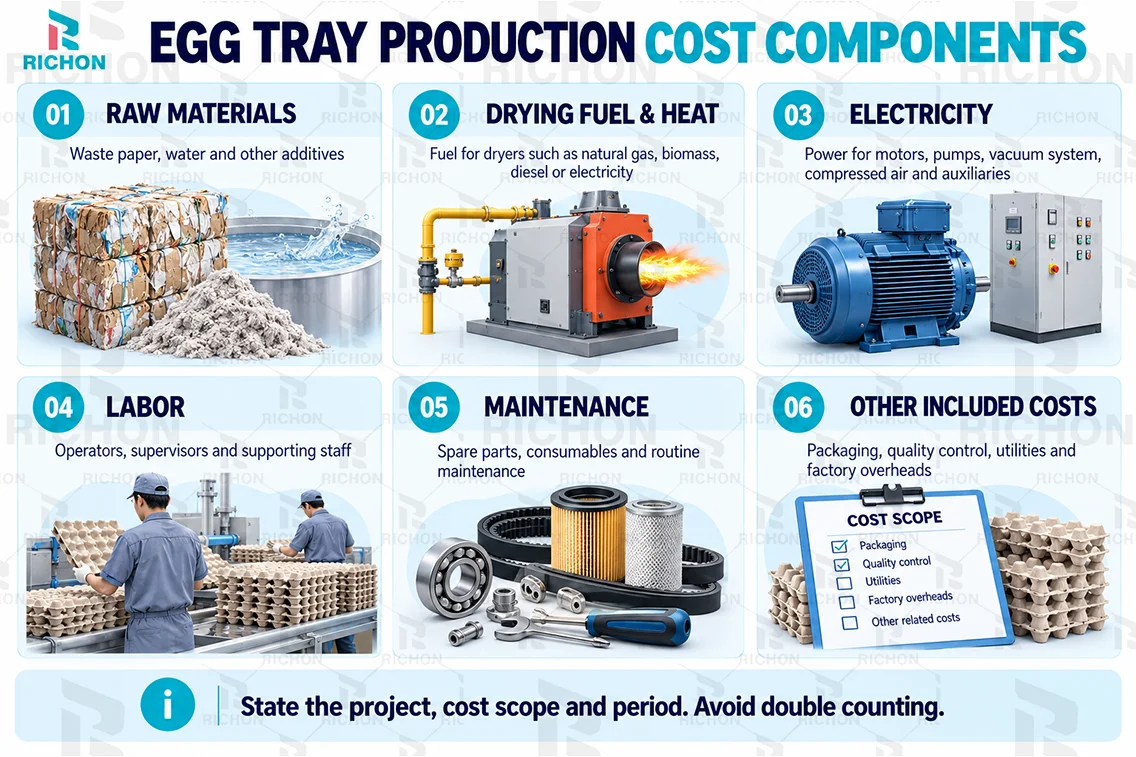
Cost categories, not cost shares. Allocate electric drying energy once within the stated cost scope. View full-size image
Production cost includes:
- Raw materials
- Drying energy
- Electricity
- Labor
- Maintenance
👉 Key insight:
Drying can be a major operating cost, but its share depends on the dryer, fuel, electricity tariff, tray specification and operating conditions. Compare electricity and drying fuel separately before combining them into total energy cost.
👉 Detailed breakdown: what-determines-the-real-production-cost-of-an-egg-tray-production-line
👉 Drying cost: egg-tray-drying-system-cost
👉 Electricity:how-much-electricity-does-an-egg-tray-machine-use
Revenue Model (How You Make Money)
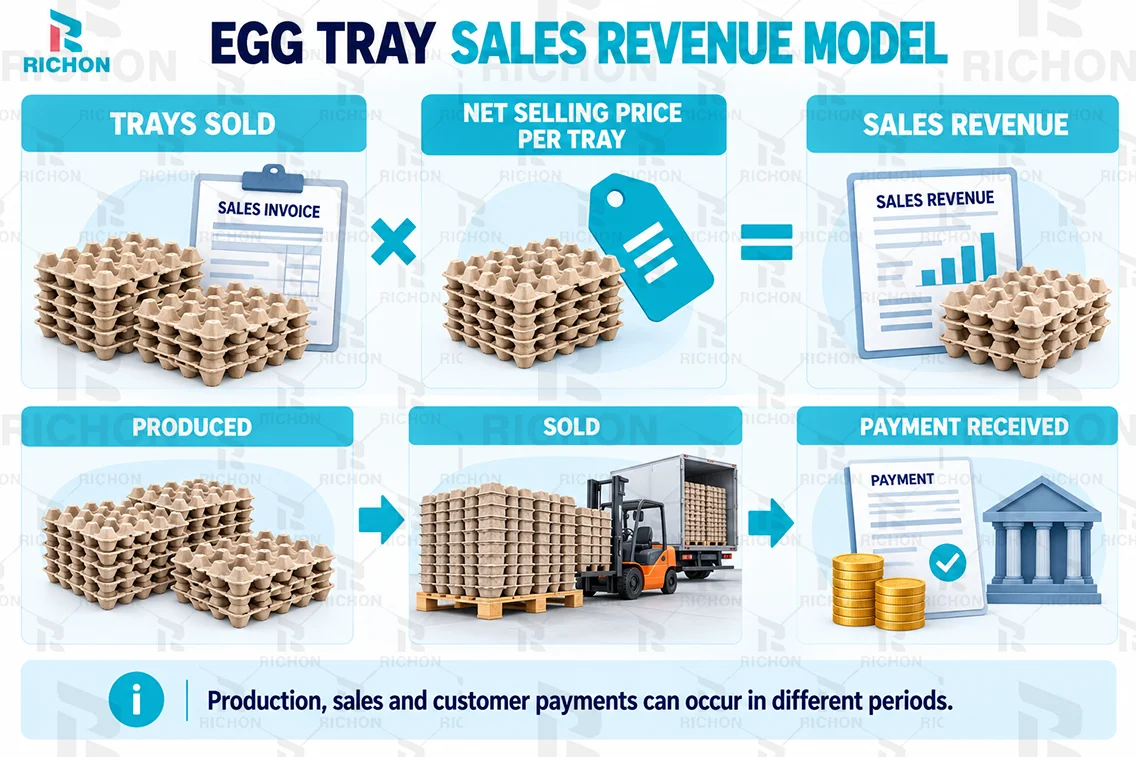
Method illustration. Production, sales revenue and cash receipts are different measures. View full-size image
Use a selling price supported by your own buyer quotations, contracts or sales records. Confirm the tray specification, delivery terms, currency and whether the price includes tax or freight. A price from another market or an earlier year is not a current selling-price assumption for your project.
Revenue for a period = trays actually sold × the agreed net selling price per tray. Track customer payments separately: production, sales and cash received can fall in different periods. Capacity is a planning constraint, not proof that every tray will be sold.
Profit Calculation (Core Model)
Profit formula:
Selling price minus the stated cost per tray gives a unit difference. Calculate net profit only after all applicable production costs and period expenses have been accounted for without double counting. Net profit margin = net profit ÷ net revenue × 100, using the same accounting period.
An illustrative net-margin planning target is 20–35%. This is a target for testing, not a measured customer result or a general industry average. Validate it using current local selling prices, sales quantities and complete costs, including applicable fuel or purchased heat, maintenance, depreciation, financing and taxes. A local model may show a lower margin or a loss.
Example (6000 pcs/hour)
For illustration only, assume a selling price of US$0.035 and a stated cost of US$0.020 per tray. The difference is US$0.015 per tray. For this planning example, the stated cost includes labor, raw materials, electricity and premises costs. These amounts are assumptions, not the customer’s selling-price or accounting records.
The inclusion of other applicable costs, including drying fuel or purchased heat, maintenance, depreciation, financing and taxes, has not been established. Add any costs not already included before describing the result as net profit. See our egg tray profit margin and ROI guide for the full calculation method.
ROI & Payback Period
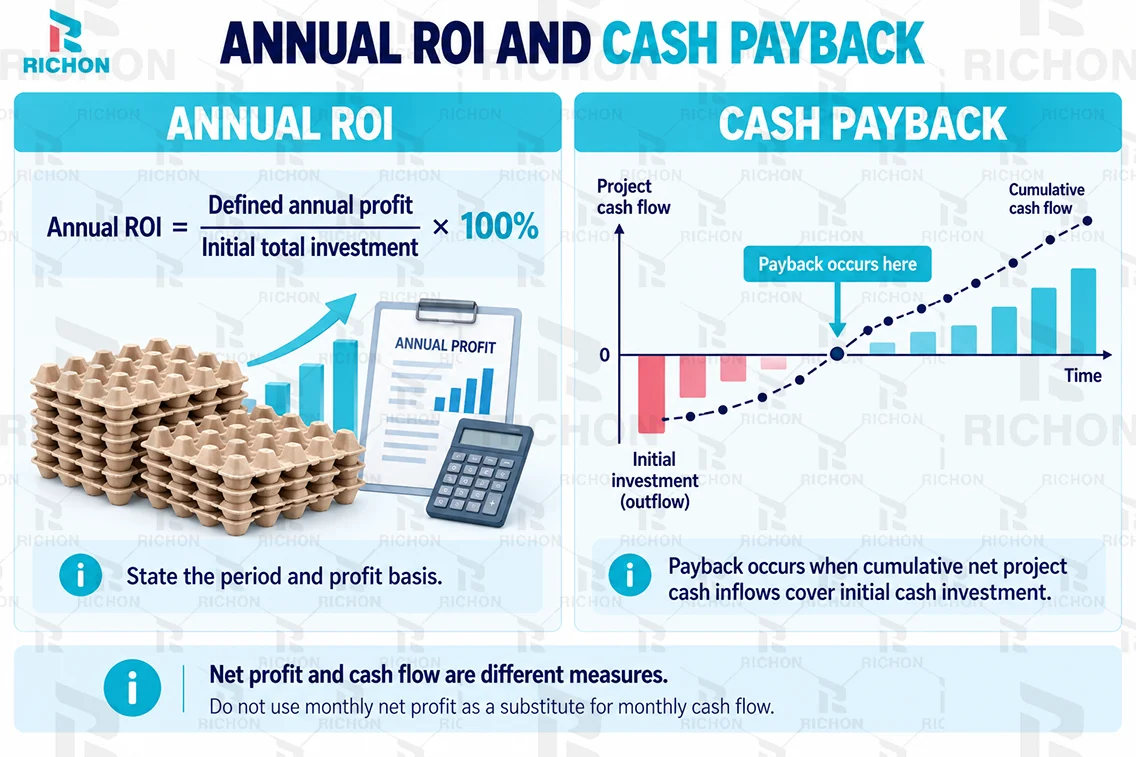
Method illustration only. The cash-flow diagram is conceptual, without a forecast or promised payback date. View full-size image
Example ROI:
Annual ROI and cash payback answer different questions. For simple annual ROI, divide the defined annual profit by the original total cash invested and state the accounting period and tax basis. See our ROI calculation guide.
For cash payback, compare the complete initial cash investment with cumulative net project cash flow. Include startup losses, working capital, customer payment timing and changing operating conditions. Monthly accounting profit is not automatically monthly net project cash flow.
This business plan uses 6–12 months only as an ideal cash-payback planning target to test. Evaluate whether the project can maintain stable production and sales, positive net cash flow and sufficiently favorable local selling prices and input costs after all relevant expenses are included. This target is not an observed customer average, a result verified for the 2018 reference, or a guaranteed recovery period. The initial equipment ex-factory price and the US$54,000 partial-cost illustration cannot establish it.
Use current country- or region-specific raw-material prices, electricity and fuel or steam prices, labor, premises costs, taxes, sales and the complete investment scope. A calculated recovery period can be longer, and a project without sufficient positive cash flow may not pay back. Contact Richon to share your project inputs by email or in an online meeting and prepare a specific calculation.
Key Factors That Affect Profitability
1. Raw material cost
→ affects base cost
2. Energy price
→ drying dominates
3. Capacity utilization
→ low utilization = low profit
4. Automation level
→ impacts labor & stability
👉 Related guides:
Risk Analysis
Common risks include:
- Raw material price fluctuation
- Energy cost increase
- Equipment quality issues
- Market price instability
👉 Avoid common mistakes: egg-tray-business-mistakes
Real Business Example (6000 pcs/h Factory)

Setup:
Richon’s anonymized historical reference is a 2018 REM6-8 production-line project in the 6,000–7,000 pcs/h class. Richon confirms that this is also the project used for the electrical operating reference in our electricity consumption guide. Customer identity and location are omitted. The production and electricity reference does not establish customer selling prices or actual net profit.
Financials:
The following is an approved planning illustration, not the customer’s financial result or a reconstruction of the measured operating day. Assume 6,000 trays per hour, 20 production hours per day, 30 days per month and that every planned tray is accepted and sold. The resulting sales quantity would be 3,600,000 trays. At an assumed selling price of US$0.035 per tray, revenue would be US$126,000. An assumed cost of US$0.020 per tray gives US$72,000 in stated costs and a remaining difference of US$54,000.
The stated cost includes labor, raw materials, electricity and premises costs. Whether all other applicable expenses, including drying fuel or purchased heat, maintenance, depreciation, financing and taxes, are included has not been established. Deduct any remaining costs without double counting. US$54,000 is a scenario difference, not verified customer net profit.
The 20-hour financial scenario is separate from the 24-hour electricity measurement period. Actual saleable output, sales quantities, selling prices, complete expenses and payment timing must replace the assumptions for a project-specific evaluation. Contact Richon to review your local prices and investment scope by email or in an online meeting.
Is This Business Right for You?
Suitable for:
- Poultry industry investors
- Recycling businesses
- Packaging manufacturers
Not suitable if:
- No raw material access
- High energy cost region
- No stable market
Next Step: How to Start
Starting a successful egg tray business requires:
- Correct capacity selection
- Proper drying system
- Stable raw materials
- Reliable equipment supplier
👉 Explore full solutions: egg-tray-production-line
👉 Or contact our engineers for a project evaluation.
Final Conclusion
Egg tray production is not just about buying a machine.
👉 It is about building a cost-efficient, stable, and scalable system.
The most important metric is not machine price, but:
Evaluate the cost per saleable tray, sustained net profit and project cash flow together. Confirm the full investment scope before comparing annual ROI or cash payback.
Need a Capacity Recommendation for Your Market?
Share your target output, local humidity/energy conditions, and tray type. Our engineers will suggest a suitable 3,000–8,000 pcs/h configuration and drying solution.
- Factory layout & utilities checklist
- Drying bottleneck evaluation
- Cost & ROI estimation reference
