 English
Egg Tray Production Line Installation & Commissioning Guide: Site Preparation, Utilities & Trial Run
Installing an egg tray production line is not only about placing machines inside a factory. A successful project depends on factory preparation, utility connection, drying system arrangement, machine alignment, operator training, and commissioning control.
Many production problems appear after installation because the factory was not fully prepared before the equipment arrived. For example, insufficient electrical capacity, poor drainage, incorrect drying layout, unstable water supply, or lack of operator training can all delay production and increase cost.
This guide explains the key steps of egg tray production line installation and commissioning, helping investors understand what should be prepared before machine arrival, how the equipment is installed, how trial production is tested, and what acceptance standards should be checked before stable operation.
1. Why Installation and Commissioning Matter
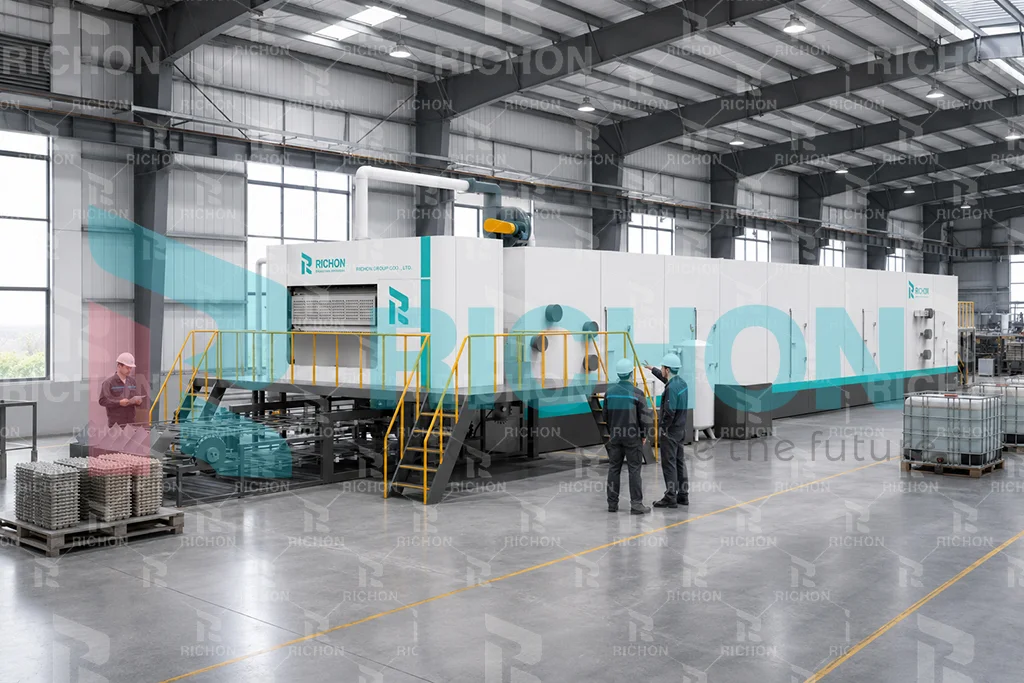
A good egg tray production line does not depend only on machine quality. Even a well-designed machine can perform poorly if the installation is not correct.
Installation and commissioning affect:
- Production stability
- Final tray quality
- Drying efficiency
- Energy consumption
- Operator safety
- Maintenance cost
- Time required to reach stable production
For egg tray factories, commissioning is especially important because the production process includes pulp preparation, vacuum forming, wet tray transfer, drying, stacking, and packing. If one section is unstable, the whole line may fail to reach the expected output.
A proper commissioning process helps confirm whether the full system can run continuously, not just whether each individual machine can start.
For investors still evaluating the full production process, you can first review the egg tray production process guide.
2. Factory Preparation Before Machine Arrival
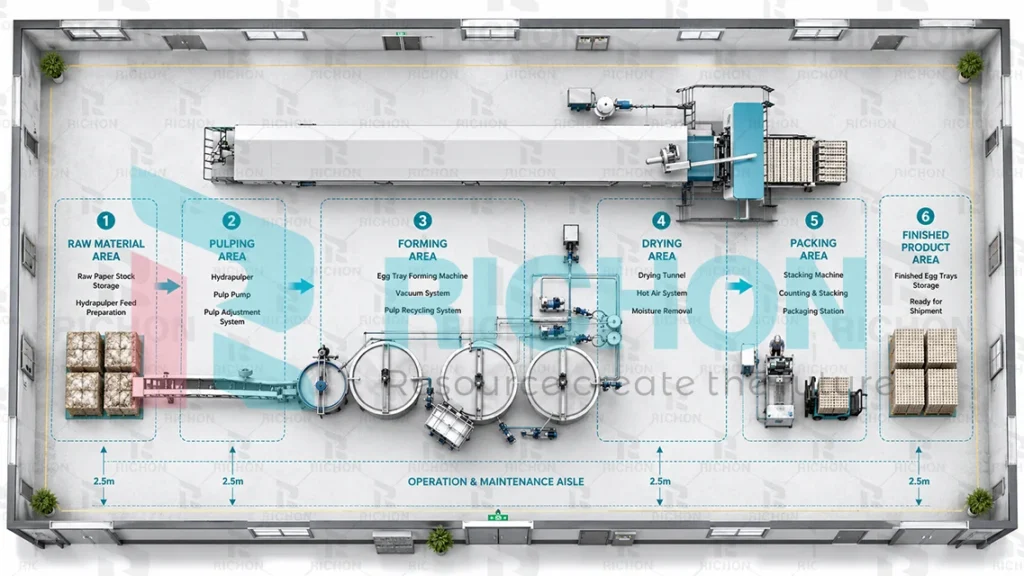
Factory preparation should begin before the production line is delivered. Waiting until the equipment arrives usually causes delays.
The factory should prepare enough space for:
- Raw material storage
- Pulping system
- Forming machine
- Vacuum and pipeline area
- Drying system
- Packing area
- Finished product storage
- Maintenance access
The production flow should be arranged in a clear direction:
Raw Material Area → Pulping Area → Forming Area → Drying Area → Packing Area → Finished Product AreaThis layout reduces unnecessary material handling and helps workers operate more efficiently.
Key factory preparation points
The floor should be strong enough to support machine weight and daily operation. The pulping section needs proper drainage because water and pulp slurry are involved. The drying area should have enough ventilation and safety distance. The packing area should be close to the dryer exit to reduce handling distance.
If the factory uses an existing workshop, equipment layout should be checked carefully before installation. Some buildings may have limited width, insufficient height, poor drainage, or inconvenient material movement.
For more details about factory space planning, read the egg tray factory layout guide.
U1 — Site Readiness Gate Before Equipment Arrival
Equipment should not be dispatched into an unprepared site. Before arrival, the buyer, local contractor and Richon project team should confirm that access, foundations, drainage, utilities and maintenance space match the approved layout and final equipment configuration.
This readiness gate supplements the egg tray production line overview. Use the approved factory layout guide as an early planning reference, then verify the project-specific layout before shipment.
| Readiness Item | Ready Evidence | Responsible Party |
|---|---|---|
| Site access and lifting route | Photos and marked route showing that delivery vehicles, lifting equipment and packaged machinery can reach the installation area | Buyer and local contractor |
| Foundation and floor | Approved foundation or floor drawing, completed-work photos and site verification record | Buyer and civil contractor |
| Drainage | Drain route, collection point and completed-work photos matched to the approved layout | Buyer and local contractor |
| Working and maintenance clearance | Marked equipment footprint and clear access around service points | Buyer and Richon project team |
| Raw-material storage and packing area | Identified storage, finished-product and packing zones on the site layout | Buyer |
| Electrical supply and grounding | Electrical readiness record, distribution point identification and grounding verification by qualified local personnel | Buyer and electrical contractor |
| Dryer fuel and exhaust, when applicable | Fuel connection, exhaust route and ventilation readiness record matched to the selected dryer | Buyer and local contractor |
| Local safety and compliance | Required permits, fire-safety provisions and local compliance records available before installation | Buyer and local responsible parties |
Do not release equipment for site delivery until open readiness items have an owner, corrective action and agreed verification method.
3. Utility Requirements: Water, Electricity, Air and Fuel
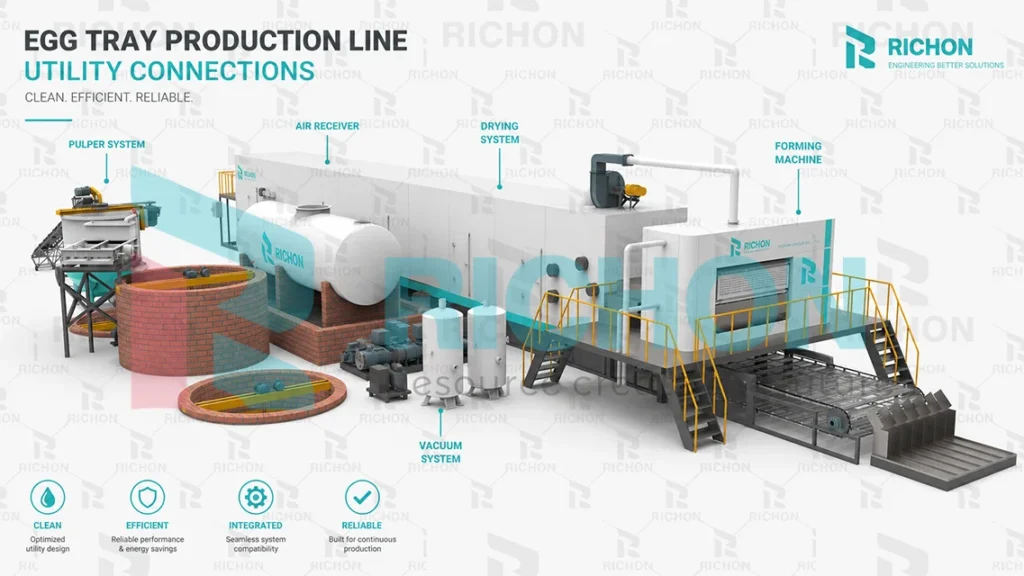
Before installation, the factory must confirm all basic utilities. These utilities directly affect commissioning speed and production stability.
Water Supply
Water is required for pulping, pulp dilution, slurry circulation, and cleaning. The water system should be stable, and the factory should consider water recycling from the beginning.
Poor water preparation may cause:
- Unstable pulp consistency
- Dirty circulation water
- Blocked pipelines
- Higher operating cost
- Poor tray quality
The factory should prepare water supply, water return, drainage, and recycling areas before installation.
For water planning, see the egg tray water consumption guide
Electrical Power
Electrical power is required for pulping equipment, pumps, forming machine, vacuum system, conveyors, control cabinet, and some drying system components.
Before installation, the factory should confirm:
- Transformer capacity
- Cable routing
- Control cabinet location
- Grounding system
- Safety protection
- Power distribution area
Electrical preparation should not be treated as a small detail. Insufficient power capacity may cause machine instability, motor overload, or delayed commissioning.
For more information, refer to the egg tray machine electricity consumption guide.
Air and Vacuum System
Vacuum is essential for forming wet trays. If the vacuum system is not stable, the trays may become weak, uneven, or difficult to release from the mold.
During installation, engineers should check:
- Vacuum pump position
- Pipeline connection
- Sealing condition
- Drainage from vacuum system
- Vacuum stability during forming
A small leak in the vacuum pipeline can reduce forming quality and increase production instability.
Fuel for Drying System
The drying system needs a suitable heat source. Depending on the project, the heat source may be gas, diesel, coal, biomass, or another locally available fuel.
Before installation, the factory should confirm:
- Fuel type
- Fuel supply stability
- Burner or furnace position
- Exhaust system
- Ventilation
- Fire safety space
Drying is one of the most important operating cost factors in egg tray production. For fuel planning, read the egg tray drying system cost analysis.
U2 — Utility Readiness Matrix
Utility planning should be based on the selected equipment and approved project documents. The general power consumption guide and water consumption guide can support early discussions, but they do not replace the final project requirements.
| Utility or System | Buyer Must Confirm | Ready-State Evidence | Final Requirement Source |
|---|---|---|---|
| Process water supply | Connection point, supply availability, storage or circulation arrangement, and access for inspection | Marked connection, photos and local readiness record | final configuration |
| Drainage and water return | Flow path, collection or reuse arrangement, clean-out access and discharge responsibility | Approved route, completed-work photos and inspection record | approved utility drawing |
| Three-phase power and grounding | Available supply, distribution point, cable route, protection arrangement and qualified grounding verification | Electrical readiness form, labelled distribution point and grounding record | local engineering requirement |
| Compressed or instrument air, when applicable | Connection point, treatment arrangement and isolation access | Labelled connection and readiness inspection record | final configuration |
| Vacuum piping | Routing, supports, connection points, inspection access and protection from damage | Installed-route photos and line-identification record | approved layout |
| Drying fuel, when applicable | Fuel type, connection route, isolation, storage or supply responsibility and local safety approval | Connection photos, local inspection record and responsible-party sign-off | burner/dryer specification |
| Exhaust and ventilation | Exhaust route, outlet location, ventilation provisions and local environmental or fire-safety requirements | Installed-route photos and local compliance record | local engineering requirement |
Any mismatch between site utilities and the final project documents must be resolved before energization or loaded testing.
4. Main Installation Steps
A complete egg tray production line usually includes pulping, forming, drying, and packing sections. Installation should follow the production flow instead of placing machines randomly.
Step 1: Install the Pulping System
The pulping system should be installed near the raw material area. This reduces manual handling of waste paper and improves daily operation efficiency.
Key installation points include:
- Pulper position
- Water inlet and outlet
- Pulp pipeline direction
- Pump installation
- Agitator connection
- Platform and safety access
The pulping system should allow operators to feed raw material conveniently and clean the system when needed.
Step 2: Position the Forming Machine
The forming machine is the core equipment of the production line. Its position affects wet tray transfer, pipeline layout, and drying system connection.
During installation, engineers should check:
- Machine levelness
- Foundation stability
- Mold alignment
- Vacuum connection
- Pulp supply direction
- Maintenance space
The forming machine should not be too far from the drying system. If the wet tray transfer distance is too long, trays may deform or lose shape before drying.
Step 3: Connect Pipelines and Vacuum System
Pipeline connection is a key installation step. Poor pipeline layout may cause pressure loss, pulp blockage, water leakage, or cleaning difficulty.
Important points include:
- Pulp pipeline slope
- Valve position
- Cleaning access
- Vacuum pipeline sealing
- Water return system
- Drainage direction
The goal is to make pulp flow stable and maintenance easy.
Step 4: Install the Drying System
The drying system must be arranged according to factory space, capacity, fuel condition, and product transfer method.
Drying system installation should consider:
- Dryer entrance and exit
- Hot air direction
- Fuel supply position
- Exhaust path
- Conveyor connection
- Maintenance access
- Safety clearance
Drying should not be designed after the forming machine is installed. It should be planned together with the full factory layout.
For system selection, see the brick dryer vs metal dryer comparison.
Step 5: Set Up Packing and Finished Product Area
After drying, trays should be collected, stacked, inspected, and packed. The packing area should be arranged near the dryer exit.
This area should allow:
- Tray cooling
- Quality inspection
- Stacking
- Counting
- Temporary storage
- Loading and transport
If trays are stacked too early while still hot or slightly wet, they may deform or stick together.
For product quality troubleshooting, refer to the egg tray quality problems guide.
5. Brick Dryer Installation Notes
Brick drying systems are widely used in small and medium egg tray projects, especially where investors want lower initial investment and flexible fuel options.
For a brick dryer project, installation and construction should focus on airflow, heat distribution, and tray transfer.
Key points include:
- Brick tunnel direction
- Heat source position
- Hot air circulation
- Exhaust opening
- Moisture discharge
- Wet tray transfer connection
- Space for maintenance and cleaning
A brick dryer is not only a civil construction structure. Its drying effect depends heavily on airflow design. If airflow is uneven, some trays may become over-dried while others remain wet.
For a practical small-to-medium project example, see the 3000 pcs/h Africa brick dryer project.
6. Metal Dryer Installation Notes
A metal drying system is more suitable for higher automation, continuous production, and projects requiring more stable drying control.
During metal dryer installation, engineers should check:
- Dryer foundation
- Conveyor alignment
- Burner connection
- Hot air circulation system
- Exhaust system
- Temperature control system
- Safety protection
- Access for maintenance
The conveyor should run smoothly without deviation. The burner and hot air circulation system should be tested before wet trays enter the dryer.
A metal dryer may improve automation, but only when installation, alignment, fuel supply, and control systems are properly prepared.
7. Commissioning Process: From Empty Run to Trial Production
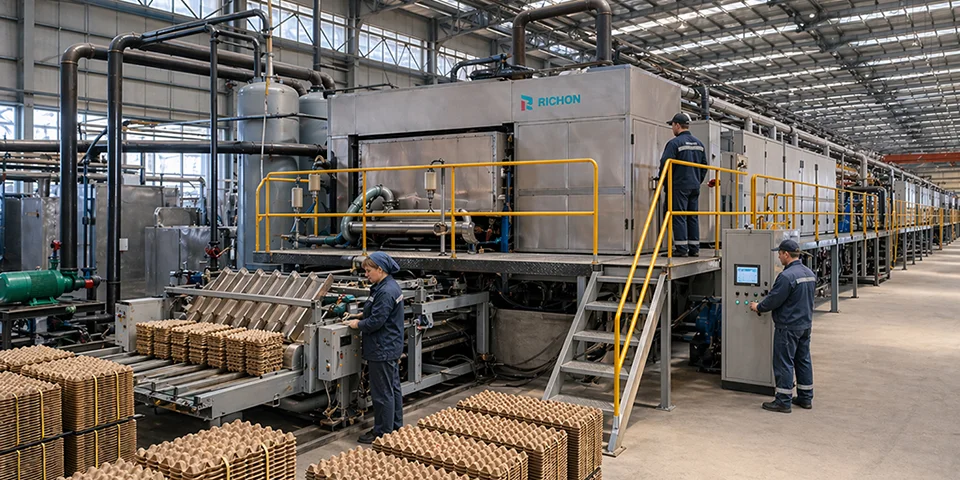
Commissioning should follow a step-by-step process. The goal is not only to start the machine, but to confirm stable continuous production.
Step 1: Empty Machine Test
Before adding pulp, the equipment should run without load.
Engineers check:
- Motor rotation direction
- Chain and transmission movement
- Pump operation
- Conveyor movement
- Control cabinet function
- Emergency stop
- Abnormal noise or vibration
This step helps identify mechanical or electrical issues before production begins.
Step 2: Water Circulation Test
The water system should be tested before pulp preparation.
Check:
- Water supply
- Water return
- Pipeline leakage
- Pump flow
- Tank circulation
- Drainage condition
A stable water system helps keep pulp consistency stable during trial production.
Step 3: Pulping Test
After water circulation is confirmed, operators can start pulping.
During this step, check:
- Waste paper feeding
- Pulping time
- Pulp uniformity
- Impurity removal
- Pulp tank mixing
- Slurry flow condition
Poor pulp preparation can cause weak trays, rough surfaces, uneven thickness, and forming instability.
Step 4: Forming Test
The forming test checks whether wet trays can be shaped correctly.
Important inspection points include:
- Wet tray shape
- Thickness distribution
- Mold drainage
- Vacuum stability
- Demolding condition
- Edge strength
- Tray weight consistency
If the wet tray is already unstable, drying cannot fully solve the problem. Commissioning should first confirm wet tray quality before adjusting drying conditions.
Step 5: Drying Test
The drying test checks whether wet trays can be dried without cracking, deformation, or sticking.
Check:
- Drying temperature
- Airflow distribution
- Drying time
- Tray moisture
- Tray shape after drying
- Color and surface condition
- Stacking performance
Higher temperature does not always mean better drying. If airflow is poor, high temperature may cause cracking while some areas remain damp.
Step 6: Continuous Trial Run
After each section works normally, the line should enter continuous trial production.
During continuous running, check:
- Output stability
- Machine vibration
- Pulp supply stability
- Wet tray consistency
- Dryer performance
- Finished product quality
- Operator response
- Reject rate
The purpose of trial production is to confirm that the line can run as a complete system, not just as separate machines.
U3 — Commissioning Stage Gates
Commissioning should move forward only when the evidence for the current gate is complete and its blockers are closed. Open items should be recorded with an owner, corrective action and retest status.
Gate 1: Pre-Start Inspection
Check installation condition, guards, fasteners, lubrication points, electrical terminations, grounding, piping, valves, rotation risks and emergency-stop access before any start command. Record an inspection sheet, supporting photos and the names of responsible personnel. Missing guards, incomplete electrical work, uncontrolled leaks, blocked access or unresolved safety items are blockers and must be corrected before the next gate.
Gate 2: Empty and Utility Run
Run the relevant equipment without production material and verify direction, abnormal noise or vibration, interlocks, emergency stops, water circulation, vacuum response and applicable dryer or conveying functions. Record observations, alarms, adjustments and retest results. Incorrect rotation, failed interlocks, unstable utility supply, leaks or abnormal mechanical behavior are blockers and require correction and repeat verification.
Gate 3: Loaded Continuous Trial
Introduce prepared pulp and evaluate forming, wet-tray release, transfer, drying when applicable, finished-tray handling and coordinated line operation under the approved project conditions. Record material context, operating observations, interruptions, corrective actions and retest evidence. Repeated release failure, uncontrolled stoppages, unsafe intervention, unresolved tray defects or incomplete records block acceptance and handover.
After commissioning, use the maintenance cost and planning guide to organize routine checks, consumables and service responsibilities around the final equipment configuration.
8. Trial Production Acceptance Checklist
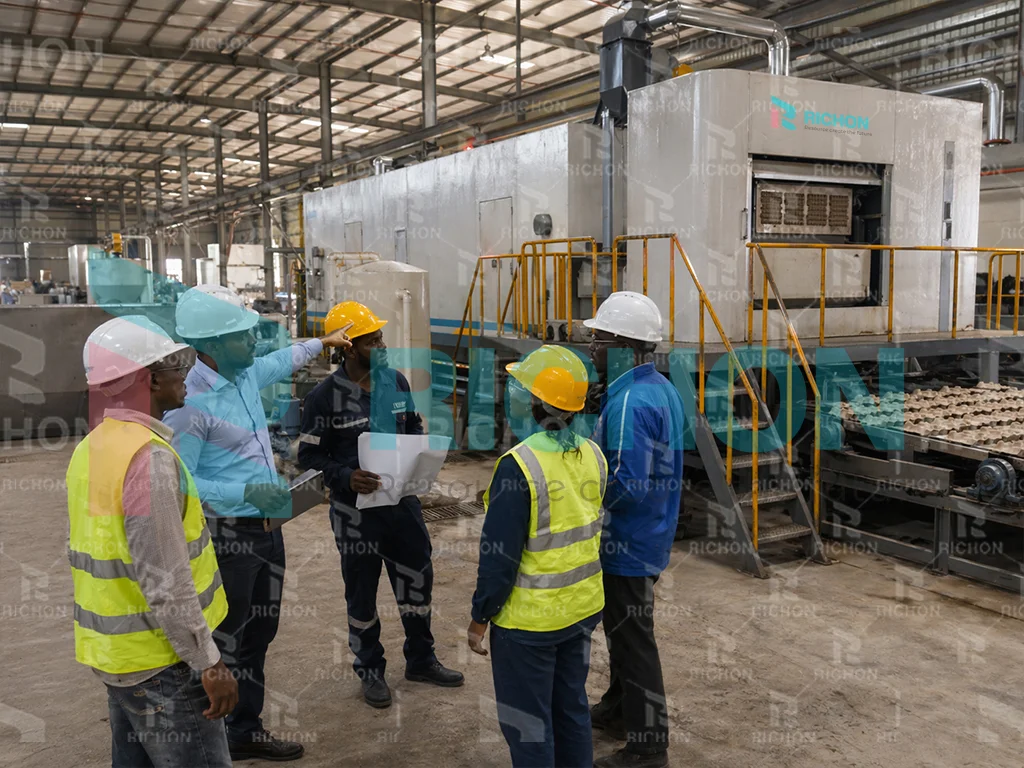
Use one traceable checklist during trial production acceptance. Each result should point to a dated record, photo, video, measurement sheet or signed handover item rather than an unsupported summary statement.
| Stage | Check Item | Evidence to Record | Acceptance Basis | Result | Responsible Party |
|---|---|---|---|---|---|
| Mechanical and safety | Guards, fasteners, lubrication, access, abnormal noise, vibration and visible leaks | Inspection sheet, photos, open-item log and retest record | Approved drawings, manuals and project safety requirements | Pass / Open item / Retest | Richon project team, buyer and local contractor |
| Electrical, interlock and emergency stop | Terminations, grounding, motor direction, protections, interlocks and emergency-stop response | Electrical inspection record, functional-test record and corrective-action evidence | Approved electrical documents and local engineering requirement | Pass / Open item / Retest | Qualified electrical personnel and Richon project team |
| Water, pulp and vacuum systems | Connections, circulation, drainage, pulp delivery, vacuum response and leakage condition | Utility-run record, photos, observations and retest evidence | Final configuration and approved utility drawing | Pass / Open item / Retest | Richon project team and buyer’s operators |
| Wet-tray forming and release | Pulp distribution, forming consistency, mould release and transfer condition | Identified trial samples, operating notes, photos or video and adjustment record | Final technical agreement and signed trial criteria | Pass / Open item / Retest | Richon project team and buyer’s operators |
| Dryer operation, when applicable | Transfer through dryer, heating-system response, ventilation, exhaust and safe operating condition | Dryer run record, alarm log, photos and corrective-action evidence | Burner or dryer specification and approved operating documents | Pass / Open item / Retest | Richon project team, buyer and local responsible parties |
| Finished-tray inspection | Appearance, completeness, handling condition and project-defined quality checks | Batch or sample identity, inspection sheet, photos and recorded observations | Project-specific signed acceptance criteria | Pass / Open item / Retest | Buyer and Richon project team |
| Continuous-run events | Starts, stops, alarms, interventions, material changes and corrective actions during the agreed trial | Event log, operating record and retest evidence | Signed commissioning procedure and final technical agreement | Pass / Open item / Retest | Richon project team and buyer’s operators |
| Operator training | Start-up, shutdown, safe intervention, routine inspection, cleaning and basic fault response | Attendance record, training checklist and operator demonstration record | Agreed training scope and equipment manuals | Complete / Open item / Retest | Richon trainer and buyer’s designated operators |
| Maintenance and spares handover | Maintenance points, service intervals, tools, supplied spares and document handover | Signed handover list, document register and open-item record | Contract supply scope and approved equipment documents | Complete / Open item | Richon project team and buyer |
Quantitative acceptance values must come from the final technical agreement, approved equipment configuration and signed commissioning record. This guide does not replace the project-specific acceptance document.
For project-specific installation documents, commissioning scope or evidence requirements, contact the Richon project team before shipment planning is finalized.
9. Common Commissioning Problems and Solutions
During commissioning, some problems may appear repeatedly. These problems should be solved systematically.
Problem 1: Pulp Does Not Flow Smoothly
Possible causes:
- Pipeline blockage
- Pulp concentration too high
- Pump issue
- Poor tank mixing
Solution:
Check pipeline layout, clean blockages, adjust pulp concentration, and confirm pump operation.
Problem 2: Wet Trays Are Too Soft
Possible causes:
- Pulp concentration too low
- Weak fiber quality
- Vacuum not strong enough
- Poor mold drainage
Solution:
Adjust pulp consistency, check raw material quality, inspect vacuum system, and clean mold drainage holes.
Problem 3: Wet Trays Do Not Release Well from the Mold
Possible causes:
- Mold surface problem
- Air blowing issue
- Excessive moisture
- Incorrect timing
Solution:
Check mold condition, adjust demolding action, inspect air system, and optimize forming cycle.
Problem 4: Dryer Temperature Is Unstable
Possible causes:
- Fuel supply instability
- Burner or furnace issue
- Poor airflow
- Exhaust imbalance
Solution:
Check fuel supply, heat source connection, airflow path, and exhaust system.
Problem 5: Finished Trays Deform After Drying
Possible causes:
- Uneven drying
- Wet tray thickness variation
- Stacking too early
- Poor cooling
Solution:
Balance drying airflow, improve forming consistency, allow cooling before stacking, and reduce excessive stacking pressure.
Problem 6: Output Cannot Reach Target
Possible causes:
- Pulp supply instability
- Slow forming cycle
- Drying bottleneck
- Operator unfamiliarity
- Poor tray transfer
Solution:
Check each section separately and identify the bottleneck. In many cases, output is limited by drying capacity or unstable pulp supply rather than the forming machine alone.
10. Operator Training After Installation
Operator training is part of commissioning. Without proper training, even a well-installed production line may fail to run efficiently.
Operators should understand:
- Raw material feeding
- Pulping control
- Pulp consistency adjustment
- Forming machine operation
- Mold cleaning
- Dryer temperature control
- Finished tray inspection
- Daily maintenance
- Emergency stop procedure
- Basic troubleshooting
Training should be practical, not only theoretical. Operators need to know what normal production looks like and how to respond when abnormal conditions appear.
For long-term operation planning, read the egg tray machine maintenance cost guide.
11. How Long Does Installation and Commissioning Take?
The installation and commissioning period depends on project scale, factory readiness, drying system type, utility preparation, and local construction conditions.
A small line may be installed faster if the workshop, water, power, and drying area are ready before the equipment arrives.
A brick dryer project may require more time because civil construction and drying tunnel preparation are involved.
A metal dryer project may require careful alignment, burner connection, exhaust preparation, and control system testing.
In most projects, delays are not caused only by the equipment. They are often caused by incomplete factory preparation, missing utilities, unfinished civil work, or lack of local coordination.
The best approach is to confirm a preparation checklist before shipment and keep installation requirements clear before the equipment arrives.
12. Final Recommendations Before Starting Production
Before starting commercial production, the factory should confirm the following:
- Factory layout is ready
- Water and electricity are stable
- Drying fuel is available
- Pipelines are connected correctly
- Forming machine is aligned
- Vacuum system is stable
- Dryer airflow is balanced
- Operators are trained
- Finished trays meet basic quality requirements
- Maintenance tools and spare parts are prepared
A successful egg tray production project should not rush into full production before the system is stable.
The correct goal of commissioning is:
Stable operation → Stable product quality → Stable output → Stable cost controlFor complete equipment planning, explore our egg tray production line solutions or contact Richon engineers for project support.
FAQ
How should I prepare my factory before installing an egg tray production line?
You should prepare the workshop layout, floor, drainage, water supply, electrical power, drying area, raw material storage, packing area, and maintenance space before the equipment arrives.
What utilities are required for egg tray production line installation?
The main utilities include water, electricity, vacuum system connection, drainage, and drying fuel. The exact requirements depend on the production capacity and drying system type.
Why is commissioning important after installation?
Commissioning confirms whether the pulping, forming, drying, and packing sections can work together continuously. It helps reduce downtime, quality problems, and production delays.
What are common problems during egg tray machine commissioning?
Common problems include unstable pulp flow, weak wet trays, poor demolding, uneven drying, tray deformation, and output not reaching the expected level.
Should operators be trained during installation?
Yes. Operator training is essential. Workers should learn pulping control, forming operation, dryer adjustment, daily inspection, emergency stop, and basic troubleshooting.
Need a Capacity Recommendation for Your Market?
Share your target output, local humidity/energy conditions, and tray type. Our engineers will suggest a suitable 3,000–8,000 pcs/h configuration and drying solution.
- Factory layout & utilities checklist
- Drying bottleneck evaluation
- Cost & ROI estimation reference
