


Molded Pulp Packaging Applications for Industrial Products
Molded pulp packaging can be engineered into custom trays, inserts, end caps and protective structures according to the size, weight, geometry and protection requirements of the product being packed. The packaging design then influences mold layout, forming conditions and equipment configuration.
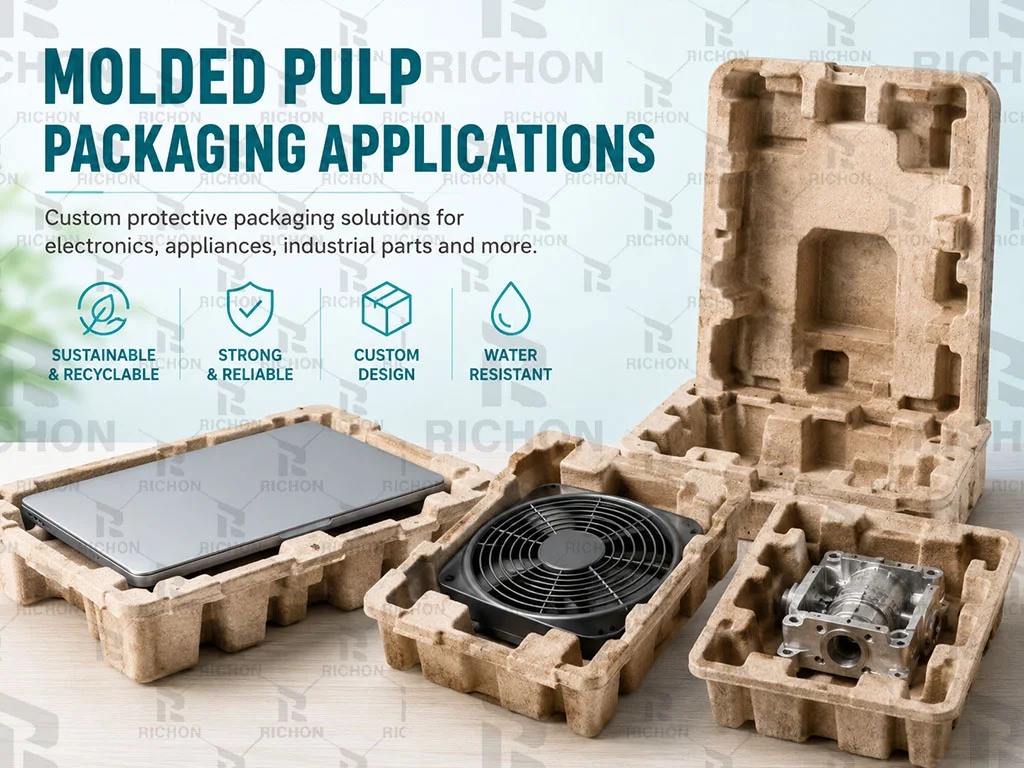
Molded fiber structures are designed around the actual product geometry and protection requirements , rather than one standard tray shape.
Product requirements determine packaging geometry, while packaging geometry influences the mold and forming configuration.
What Is Molded Pulp Protective Packaging?
Molded pulp protective packaging is a fiber-based packaging structure formed from prepared pulp using a product-specific mold. It can be designed to position, separate, support and protect products during handling, storage and transportation. Unlike a fixed standard tray, industrial molded pulp packaging is usually developed around the geometry and protection requirements of the product being packed.
The Packaging Shape Is Defined by the Product
Industrial molded pulp packaging is not one standardized product format. A tray, insert or end cap may have different cavity depths, support points, ribs, clearances and positioning structures depending on the product it is designed to protect.
This means the development process usually begins with the customer’s product dimensions, weight, geometry and packaging requirements before the mold and forming configuration are selected.
During the industrial pulp molding process , prepared fibers are deposited onto the mold through vacuum forming, dewatered, transferred and dried into the required packaging shape.
Molded Pulp Packaging Is Product-Specific
Two products from the same industry may require completely different packaging structures. For this reason, packaging design should be evaluated from the actual product rather than selected only by industry category.
What Types of Industrial Molded Pulp Packaging Can Be Produced?
Industrial molded pulp packaging can be developed into different structures according to the product geometry, positioning requirements and protection needs . The final packaging form is determined by the application and mold design rather than by one fixed tray format.
Common industrial molded pulp packaging structures include protective trays, molded fiber inserts, end caps, component trays, multi-part supports and fully customized protective packaging . Richon can develop the corresponding mold configuration according to the customer’s actual product and required packaging layout.
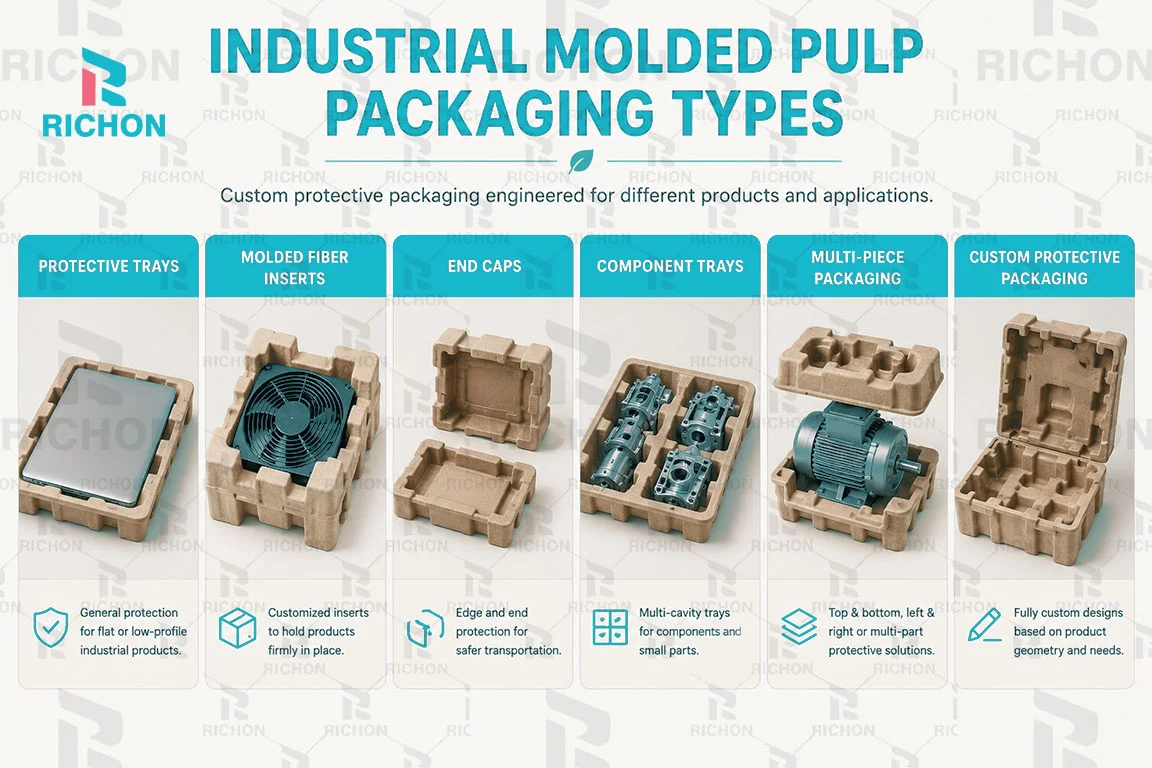
Packaging geometry is developed around the customer’s actual product , not selected from one universal tray format.
Tray size, support points and single- or multi-cavity layouts can be customized according to placement requirements.
Protective Trays
Molded trays can position, separate and support industrial products during handling, storage and transportation.
Molded Fiber Inserts
Inserts fit inside an outer package and can locate the product while separating selected components or surfaces.
End Caps
Product-specific end supports can protect and locate selected ends, edges or corners inside the outer package.
Component Trays
Customized cavities can organize automotive parts, industrial components, accessories or electronic products.
Multi-Part Protective Packaging
A product can use separate top, bottom, left, right or other molded support sections according to its packaging structure.
Custom Molded Fiber Packaging
Non-standard protective packaging can be developed from product dimensions, samples, drawings, CAD data or packaging concepts.
The packaging category is only the starting point. Product size, shape, quantity, support points and required protection ultimately determine the tray structure and corresponding custom mold solution.
Molded Pulp Packaging for Electronics and Electrical Products
Molded fiber packaging can be evaluated for suitable electronic and electrical products where the package needs to provide positioning, separation and structured support inside an outer carton or transport package.
For electronics and electrical products, the packaging structure should be designed around the actual product geometry, weight distribution, contact points and required clearance . A molded pulp insert can then be developed with cavities, ribs or support areas that help locate the product and separate sensitive components from surrounding surfaces.
Product Contact Points
Packaging geometry should identify where the molded fiber structure can safely support or locate the product without interfering with sensitive components.
Clearance & Separation
Cavities and spacing can be designed to separate the product from accessories, outer carton walls or neighboring components.
Weight Distribution
Heavier areas of a product may require different support geometry from lighter sections, influencing the structure of the molded pulp insert.
Packaging Orientation
The way a product is positioned inside the carton affects cavity direction, locating features, support areas and the overall molded packaging layout.
Packaging Design Starts with the Actual Product
Electronics from the same product category can have very different dimensions, projections and support requirements. Therefore, molded pulp packaging should be developed from the real product or accurate product data rather than selected from a generic industry template.
Molded Fiber Packaging for Appliances and Equipment
Customized molded fiber packaging can be developed around appliances and other industrial products using top, bottom, left, right or product-specific support structures . The packaging arrangement is selected according to the actual product geometry and protection requirements.
Industrial molded pulp packaging does not need to use one complete tray around the entire product. Richon can develop separate molded fiber supports around selected areas of the product , such as a top tray and bottom tray or a left support and right support. The mold solution is customized according to the customer’s product, packaging structure and required support points.
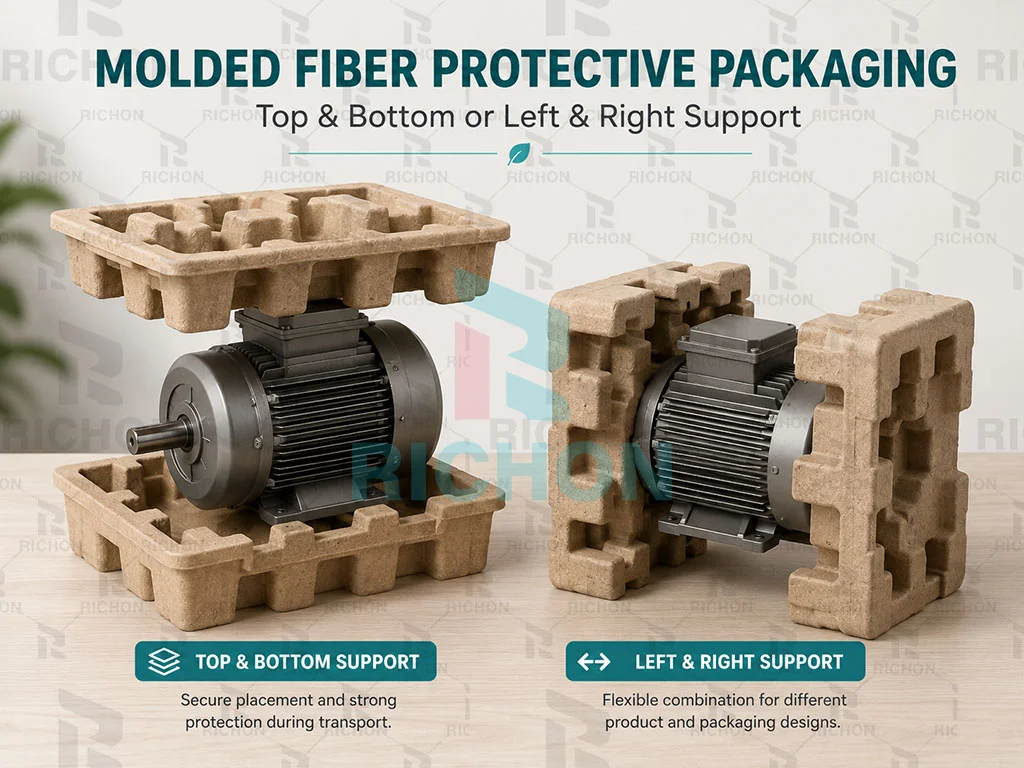
Suitable when the package requires support from the upper and lower areas of the product.
Suitable when the product requires opposing side or end supports inside the outer package.
Support Point Design
Molded fiber structures can be positioned around selected product areas where locating or protective support is required.
Product Geometry
Corners, protrusions, curved surfaces and different dimensions influence the shape of each molded packaging section.
Outer Carton Layout
Molded pulp supports should work with the outer carton to locate the product in the required position and available packaging space.
Custom Mold Solution
Each support piece can use a product-specific mold developed from customer dimensions, drawings, samples or packaging concepts.
Examples of Products That Can Use Customized Protective Packaging
Richon does not limit industrial packaging to one standard tray format. The packaging and corresponding mold solution can be developed around the customer’s actual product and required support arrangement .
Molded Pulp Trays for Industrial Components and Parts
Protective molded pulp trays can be customized around the specific parts, components and quantities that the customer needs to place in each tray . The mold cavity layout is developed according to the actual items rather than a fixed standard arrangement.
Richon can develop molded fiber protective trays according to the customer’s required products and placement layout. A tray may contain one large cavity or multiple customized cavities for the same or different parts. Cavity geometry, spacing and tray structure are determined from the actual components that need to be positioned, separated and protected.
Part Dimensions
The length, width, height and local geometry of each component determine the basic shape and size of its locating cavity.
Quantity per Tray
Customers can define how many products or parts need to be arranged in one tray, which then influences the cavity layout.
Position & Spacing
Cavity positions and spacing can be customized to keep parts organized and separated according to the required handling or packing arrangement.
Support Geometry
The molded fiber structure can include customized locating, support and separation areas around each part according to its shape and packaging requirements.
One Tray Can Hold Multiple Customized Parts
A molded pulp component tray can be designed with multiple cavities when several products need to be placed together. The cavity quantity and arrangement are not fixed. They are developed according to the customer’s product dimensions, required quantity, tray layout and packaging concept.
The customer defines what products need to be placed and how they should be arranged . Richon can then develop the molded pulp protective tray and corresponding mold solution around those requirements.
How Do Molded Pulp Inserts and End Caps Protect Industrial Products?
Molded pulp inserts and end supports can be designed around selected product surfaces, edges, ends and positioning points . Instead of using one universal packaging shape, the protective structure can be divided into different molded sections according to the customer’s product.
Molded pulp inserts and end caps protect industrial products mainly by helping position, separate, support and isolate selected areas of the product inside the outer package. Richon can customize the number, position and geometry of these molded fiber supports according to the customer’s actual product and packaging arrangement.
Positioning
Custom cavities and support points help locate the product in the required position inside the carton or outer packaging.
Separation
Molded fiber structures can create spacing between products, components, accessories or selected product surfaces.
Local Support
Support can be concentrated around selected areas according to product geometry, weight distribution and packaging layout.
End & Edge Protection
Molded end supports can be developed around corners, ends or other selected areas that require additional positioning or protective structure.
Protective Packaging Does Not Need to Be One Single Piece
For many industrial products, the packaging solution can use several separate molded pulp pieces instead of one complete tray. Richon can customize the mold arrangement according to the shape of the product and the areas that need to be supported .
For example, one product may use upper and lower supports, while another product may use left and right end supports. More complex products can use other customized combinations when required by the packaging design.
The objective is not to force every product into one standard packaging format, but to develop the molded fiber structure around the customer’s actual product.
Support Points Should Follow the Product, Not a Standard Template
The molded packaging layout is determined after reviewing the product dimensions, geometry, contact areas, required position and outer packaging arrangement . These requirements are then translated into the corresponding molded pulp mold structure.
Engineering note: the final protection performance depends on the complete package, including the molded fiber structure, product geometry, outer carton, support locations and transport conditions. Packaging configuration should therefore be evaluated as a complete system rather than by molded pulp material alone.
When Can Molded Pulp Replace Foam or Plastic Inserts?
Molded pulp can replace some foam or plastic protective inserts when the required product support, geometry, surface conditions and environmental resistance can be achieved with a properly engineered molded fiber structure.
Molded pulp is not automatically the best replacement for every foam or plastic insert. Suitability should be evaluated from the product geometry, weight, required protection, surface sensitivity, moisture exposure, dimensional requirements and packaging workflow . When these requirements can be met with molded fiber, the packaging structure can be customized around the customer’s product and required support points.
Product Geometry
Product dimensions, corners, protrusions and support areas determine whether an effective molded fiber structure can be developed.
Protection Requirement
The complete package should be evaluated according to the required positioning, separation, support and transport protection.
Surface & Tolerance
Products with sensitive surfaces or demanding dimensional requirements may need additional evaluation of packaging geometry and finishing requirements.
Moisture Exposure
Storage, shipping and environmental conditions should be reviewed so that the required level of water or moisture resistance can be considered during material preparation.
Molded Pulp vs Foam or Plastic Protective Inserts
| Design Factor | Molded Pulp | Foam / Plastic Insert |
|---|---|---|
| Custom Geometry | Product-specific molded structures can be developed through customized tooling. | Geometry depends on the selected foam or plastic process and corresponding tooling or fabrication method. |
| Positioning & Separation | Cavities, ribs and support areas can be designed around the customer’s required product layout. | Can also provide customized positioning depending on the selected material and manufacturing method. |
| Moisture Resistance | Water and moisture resistance can be adjusted through suitable additives according to the customer’s required resistance level. | Performance depends on the selected polymer or foam material. |
| Surface Requirements | Surface quality depends on fiber, mold, forming and optional finishing configuration. | Surface characteristics depend on material and manufacturing process. |
| Packaging Format | Can use trays, inserts, end caps, top/bottom supports, left/right supports or custom multi-part structures. | Can also use different packaging formats depending on product and manufacturing method. |
| Material Selection | Fiber and additives are selected according to product, forming and packaging performance requirements. | Material selection depends on required foam or plastic characteristics and project conditions. |
Molded Pulp Water Resistance Can Be Configured by Project
Standard fiber packaging and moisture-resistant packaging do not necessarily use the same pulp formulation. According to the customer’s required water-resistance level, different types of water-resistant additives can be introduced during pulp preparation . The material formulation should therefore be confirmed together with the product application and environmental conditions.
Molded Pulp May Be Suitable When:
- Product geometry can be supported by a molded fiber structure.
- Custom trays, inserts or end supports can provide the required positioning and separation.
- Surface and dimensional requirements are compatible with the selected forming and finishing process.
- Required moisture resistance can be matched through the material formulation and packaging design.
- The complete outer packaging system is designed together with the molded pulp protection.
More Evaluation May Be Needed When:
- The product has highly sensitive finished surfaces.
- Packaging requires very demanding dimensional tolerances.
- The package will face significant or prolonged moisture exposure.
- Unusual product geometry makes forming, release or support difficult.
- Transport protection requirements have not yet been defined for the complete package.
Selection principle: the decision should not be based only on whether molded pulp, foam or plastic is “better.” The correct packaging material depends on the customer’s product, protection target, environmental exposure, packaging workflow and required finished-product characteristics.
How Does Packaging Design Affect Mold and Machine Selection?
For customized industrial molded pulp packaging, machine selection starts with the product and packaging design . Product dimensions, support structure and cavity arrangement determine the mold configuration, which then affects forming conditions and production capacity.
A customized molded pulp project should normally be engineered in the following order: customer product → protective packaging geometry → mold dimensions and cavity layout → forming cycle → machine configuration → production capacity . Because each industrial packaging product can be different, the machine should not be selected only from a fixed pieces-per-hour specification.
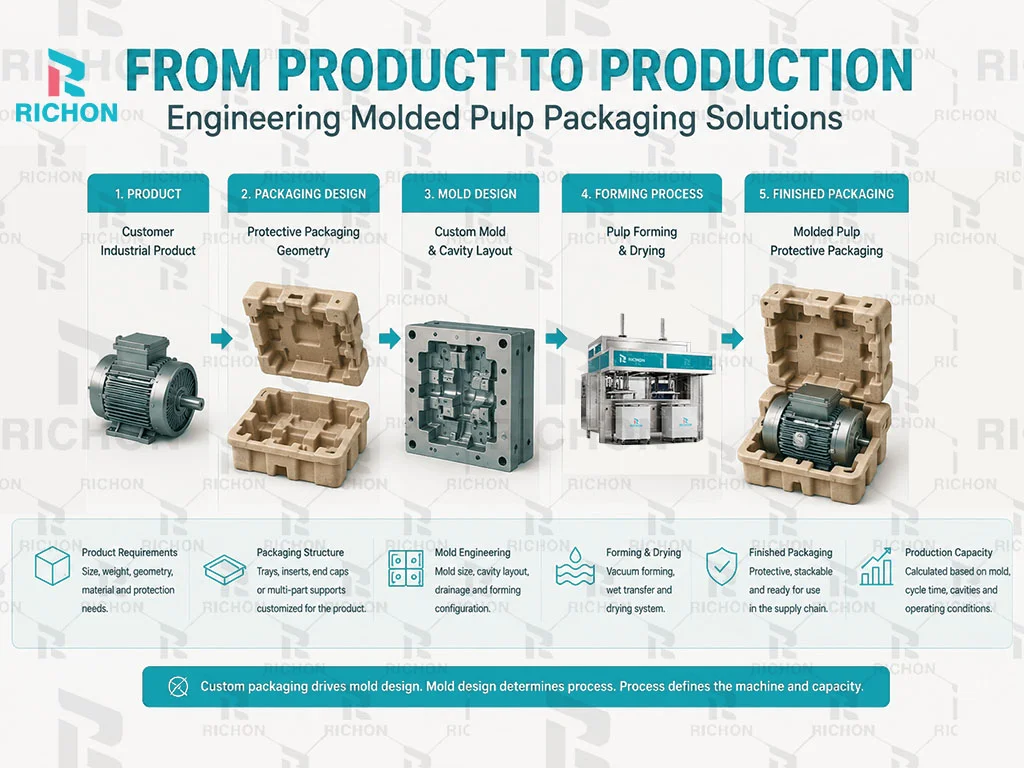
Product → Packaging → Mold → Machine is the core configuration sequence for a customized industrial pulp molding project.
Production capacity is calculated after product geometry, mold cavities and forming cycle are confirmed.
Product Dimensions
The size and geometry of the packed product establish the basic dimensions and support requirements of the molded fiber packaging.
Packaging Geometry
Trays, inserts, end caps or multi-part supports are developed around the customer’s required positioning and protective layout.
Mold Size
The finished packaging dimensions determine the required mold area and influence the compatible forming-machine configuration.
Cavity Layout
One mold may contain one or multiple product cavities depending on packaging dimensions, required arrangement and available mold area.
Forming Conditions
Product size, depth, weight and geometry influence forming, dewatering and wet-product transfer requirements.
Machine Configuration
After the mold and forming requirements are confirmed, the reciprocating forming equipment can be matched to the actual packaging project.
Why Industrial Pulp Molding Capacity Cannot Use One Fixed pcs/h Value
Customized protective packaging can vary significantly in dimensions, weight, mold cavity quantity and required forming cycle . A small multi-cavity component tray and a large appliance support can therefore produce very different pieces per hour. Capacity should be calculated after the actual product and mold arrangement are confirmed.
Richon engineering principle: for customized industrial molded pulp packaging, the customer’s finished product is the starting point. Packaging design, mold engineering, forming equipment and expected production capacity should be developed as one connected system.
Molded Pulp Packaging Applications FAQ
These questions summarize how customized molded fiber packaging can be developed for industrial products and how the finished packaging influences mold and equipment configuration.
What products can use molded pulp protective packaging?
Molded pulp protective packaging can be customized for a wide range of industrial products, including products such as laptop computers, electric fans, automotive parts, industrial components and other customized products . The actual packaging structure is developed according to the dimensions, shape, weight, placement and protection requirements of the customer’s product.
Can molded pulp packaging be customized for different product shapes?
Yes. The packaging mold can be customized according to the customer’s product sample, dimensions, drawing, CAD information or packaging concept. Different cavity shapes, support positions and packaging sections can be developed around the actual product rather than using one fixed standard tray.
Can one product use separate top and bottom or left and right molded pulp supports?
Yes. Customized protective packaging can use a top tray and bottom tray, left support and right support, or another product-specific combination . The number and location of the molded fiber sections are selected according to the customer’s packaging layout and required product support points.
Can one molded pulp tray hold multiple parts or components?
Yes. A protective tray can be designed with multiple customized cavities according to the quantity, dimensions and required arrangement of the products being placed in the tray. The cavity quantity is not fixed; it is determined from the actual component layout and mold design.
Can molded pulp packaging have water or moisture resistance?
Water and moisture resistance can be adjusted according to the customer’s required resistance level by selecting suitable water-resistant additives during pulp preparation . The required performance should be confirmed for the specific product and operating environment. Water resistance should not automatically be interpreted as complete waterproofing.
Can molded pulp replace foam or plastic protective inserts?
It can replace some foam or plastic packaging applications when the required product positioning, support, surface requirements, environmental resistance and transport protection can be achieved through the molded fiber structure. Suitability should be evaluated from the complete packaging system rather than from material type alone.
How does packaging design affect production capacity?
Packaging dimensions, product weight, mold cavity quantity, structural complexity and forming cycle all influence production output. This means customized industrial molded pulp packaging does not have one universal pieces-per-hour capacity. Production capacity should be calculated after the actual packaging and mold configuration are confirmed.
What machine is used to produce customized industrial molded pulp packaging?
Customized industrial protective packaging can be produced with a reciprocating industrial pulp molding machine configured around the customer’s product, mold dimensions, forming requirements, target production and downstream drying system.
Have a Product That Needs Custom Molded Fiber Packaging?
Send Richon your product dimensions, drawing, sample, CAD/3D information or existing packaging concept . We can evaluate the protective packaging structure, mold layout, cavity arrangement, forming equipment and expected production configuration around your actual product.