 English
Industrial Pulp Molding Machine Cost & Investment Guide
The cost of an industrial pulp molding machine depends on the product being manufactured and the complete production configuration. Custom tooling, required output, vacuum, drying, finishing and factory conditions can all change the final project investment.
There is no universal fixed industrial pulp molding machine price . Richon calculates project cost after the customer’s molded fiber product, tooling configuration, required production, drying method and total production-line scope are confirmed.
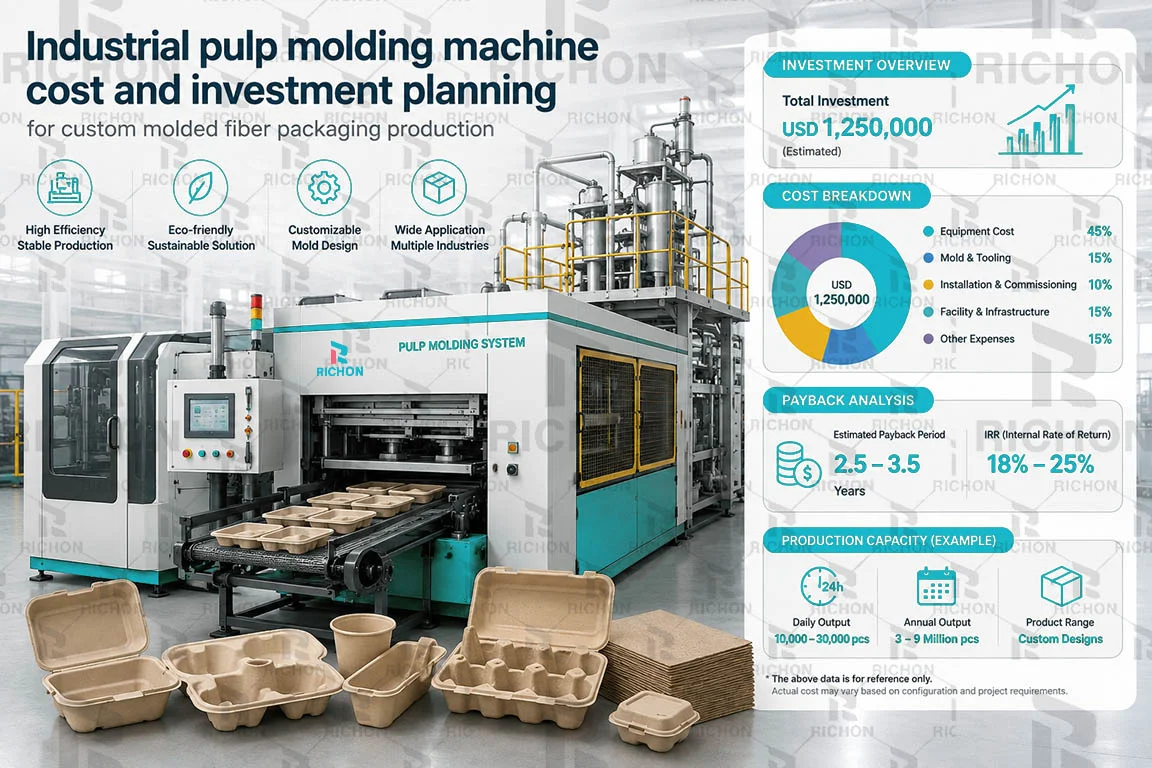
Product dimensions, weight and geometry influence tooling, forming area and the required production configuration.
Tooling scope depends on product structure, cavities, forming, transfer, hot pressing and optional finishing.
Target output affects mold layout, forming configuration, vacuum demand and the required drying solution.
Workshop space, electricity, drying energy and site conditions influence the complete project investment.
How Much Does an Industrial Pulp Molding Machine Cost?
Industrial molded fiber packaging is normally produced around a customer-specific product and tooling configuration. For this reason, an industrial pulp molding machine price cannot be determined accurately from the machine name alone.
There Is No Universal Fixed Price for Every Industrial Pulp Molding Project
The final cost depends on the customer’s molded fiber product, product dimensions, custom tooling, required output, forming-machine configuration, vacuum and dewatering requirements, drying method, finishing processes and total production-line scope. A meaningful quotation should therefore be calculated after the product and project requirements are defined.
Forming Equipment Cost
A machine-only quotation may refer mainly to the reciprocating forming equipment and its associated machine configuration. It does not automatically represent the total investment required to manufacture the finished molded fiber product.
Complete Production Configuration
A complete project can require pulp preparation, forming, product-specific tooling, vacuum and water handling, drying, finishing, electrical systems and factory-related preparation. This is the more useful basis for evaluating real industrial pulp molding investment.
What Can Be Included in Industrial Pulp Molding Project Cost?
The exact quotation scope varies by project. Before comparing prices, confirm which equipment, tooling and process systems are actually included.
Equipment required to prepare and supply pulp to the forming process.
Reciprocating forming equipment configured around the actual product.
Product-specific molds required by forming, transfer and finishing.
Vacuum generation and related dewatering or water-separation scope.
Selected according to wet-product output, quality and project conditions.
Hot pressing, shaping or trimming when required by the finished product.
Electrical and control scope matched to the final line configuration.
Factory layout, utilities and other site-specific preparation.
The Product Determines the Machine Configuration
Two customers can both request an industrial pulp molding machine while requiring completely different product sizes, mold layouts, production targets and finishing processes. The equipment configuration must therefore follow the product, rather than forcing every product into one fixed machine price.
What Determines Industrial Pulp Molding Machine Price?
Industrial pulp molding equipment is configured around the customer’s actual protective packaging product. Product size, tooling, required output and downstream processing determine the machine configuration before they determine the price.
Product Specification Comes Before Machine Quotation
The same reciprocating forming platform can require different molds, forming conditions, vacuum capacity, drying and finishing arrangements for different industrial packaging products. A reliable quotation should therefore begin with the customer’s product rather than with a generic equipment price.
Length, width, depth, wall structure and protective features influence the required forming area and tooling design.
Pricing impact: machine and mold configurationCavity quantity, mold dimensions, drainage, transfer and finishing requirements determine the tooling scope for the product.
Pricing impact: product-specific tooling investmentOutput must be calculated from the actual product, mold cavities, forming cycle and realistic operating conditions.
Pricing impact: production configuration and line scaleThe machine must be matched to product dimensions, mold arrangement, forming requirements and the required production target.
Pricing impact: equipment configurationProduct geometry, drainage and production conditions influence the vacuum and water-removal requirements of the forming process.
Pricing impact: vacuum and process-system scopeWet-product output, retained moisture, quality requirements, factory space and local conditions determine the drying solution.
Pricing impact: CAPEX and long-term energy costProduct transfer, handling and the degree of production integration required by the project can change the overall equipment scope.
Pricing impact: total line complexityHot pressing, shaping and trimming may be added when the finished product requires higher surface, dimensional or edge quality.
Pricing impact: additional tooling and finishing equipmentWhat Should Be Confirmed Before Pricing?
A preliminary quotation becomes much more useful when Richon can understand the customer’s product geometry, packaging function, production target, quality requirement and factory conditions . The required machine and tooling can then be calculated around real project data.
How Does Custom Mold & Tooling Affect Project Cost?
Industrial molded fiber packaging normally requires product-specific tooling. Mold cost depends on the actual packaging geometry, number of tooling stages, cavity layout, material selection and required finished-product quality.
There Is No Universal Fixed Price for Industrial Pulp Molding Tooling
Tooling must be calculated from the customer’s actual product. A project can require a forming mold, transfer mold and hot pressing mold , with an additional trimming mold when higher edge or dimensional finishing is required. Product dimensions, structural complexity, cavity quantity, mold material and the total number of product designs all influence the final tooling investment.
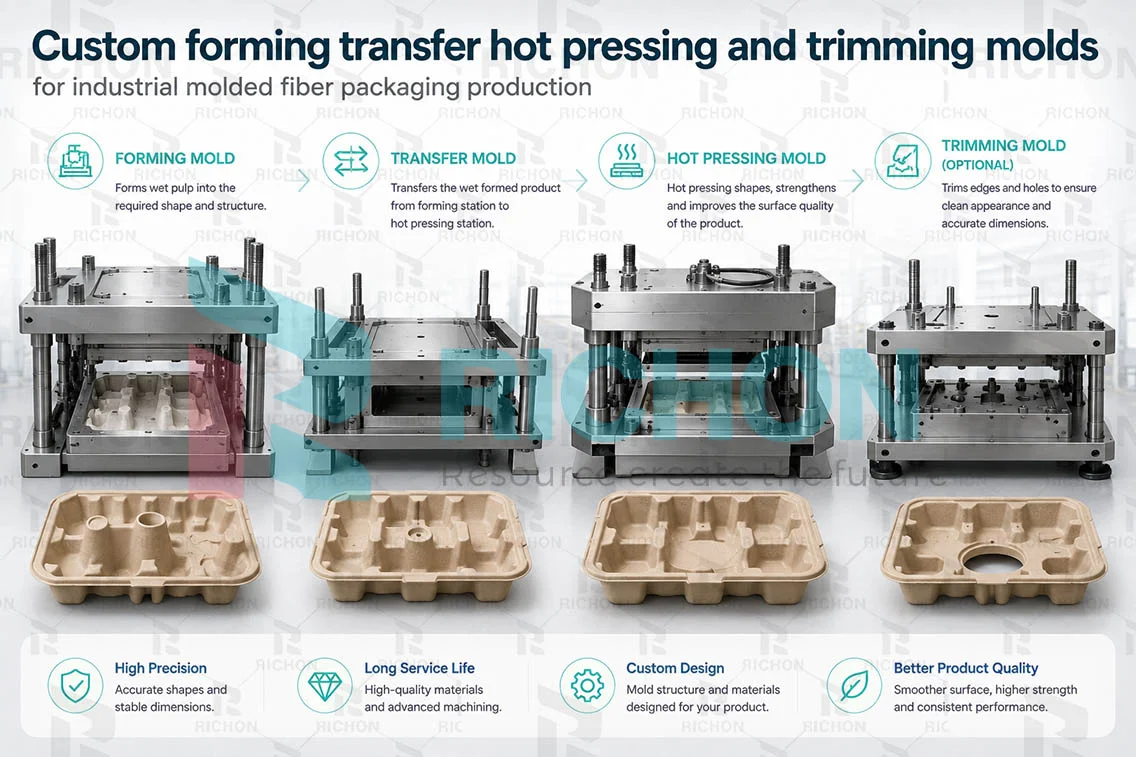
One Molded Fiber Product Can Require Several Different Molds
The tooling system should be evaluated as a production sequence, not simply as one generic “mold.” Each stage performs a different function in forming, transferring, shaping or finishing the customer’s molded fiber product.
Creates the wet molded fiber geometry during vacuum forming and initial dewatering.
Supports wet-product transfer from the forming stage to the following production process.
Used for shaping and improving the finished product’s surface and dimensional consistency when required.
Can be added when the product requires more controlled edges or additional dimensional finishing.
What Determines Industrial Pulp Molding Mold Cost?
Mold price should be calculated from actual tooling complexity rather than from one generic price per set.
Larger products can require larger tooling surfaces and a different mold structure.
The number and arrangement of cavities influence mold layout and manufacturing complexity.
Deep structures, supports, ribs and complex protective features can increase tooling complexity.
Forming and dewatering requirements influence mold drainage and process-surface design.
Wet-product handling and transfer geometry must match the selected forming and downstream process.
Hot pressing and trimming requirements add additional tooling beyond the forming and transfer stages.
Material selection is determined according to project and customer requirements.
Multiple packaging components or different product models can require additional tooling sets.
Mold Material Is Selected According to Project Requirements
Aluminum is commonly used for industrial pulp molding tooling. Steel or copper can also be selected or customized according to the customer’s product, tooling application and technical requirements. Material should therefore be confirmed as part of the tooling specification rather than treated as one fixed standard for every project.
Common tooling material for industrial pulp molding projects.
Can be selected according to the customer’s tooling and technical requirements.
Can be customized when required by the actual tooling application.
How Does Multi-Part Packaging Affect Tooling Cost?
Industrial protective packaging can contain more than one molded component, so the definition of “one product” should be confirmed before mold quantity and project cost are calculated.
A single molded tray can be evaluated around one product geometry and the tooling stages required to manufacture it.
A top and bottom packaging structure is generally evaluated as two molded products because the two components normally have different geometries and tooling requirements.
If product height, structure and available mold layout allow a suitable combined output arrangement, the project can be evaluated accordingly after the actual product is reviewed.
What Is Included in a Complete Industrial Pulp Molding Production Line Investment?
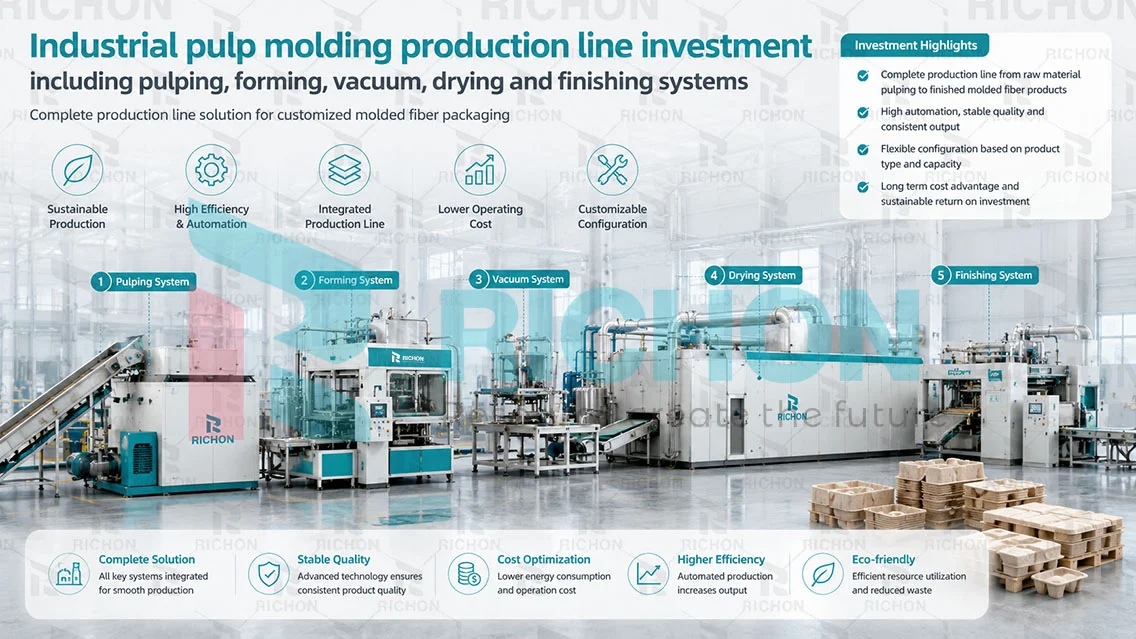
Buying the forming machine is only one part of an industrial molded fiber project. The complete investment should be evaluated around the full production configuration required to convert fiber raw material into the customer’s finished packaging product .
Complete Line Investment Is More Than the Forming Machine Price
Depending on the customer’s product and project requirements, total investment can include pulp preparation, reciprocating forming equipment, product-specific tooling, vacuum and water handling, drying, hot pressing or trimming, electrical systems and factory-related preparation . The exact equipment and service scope must be confirmed before two project quotations are compared.
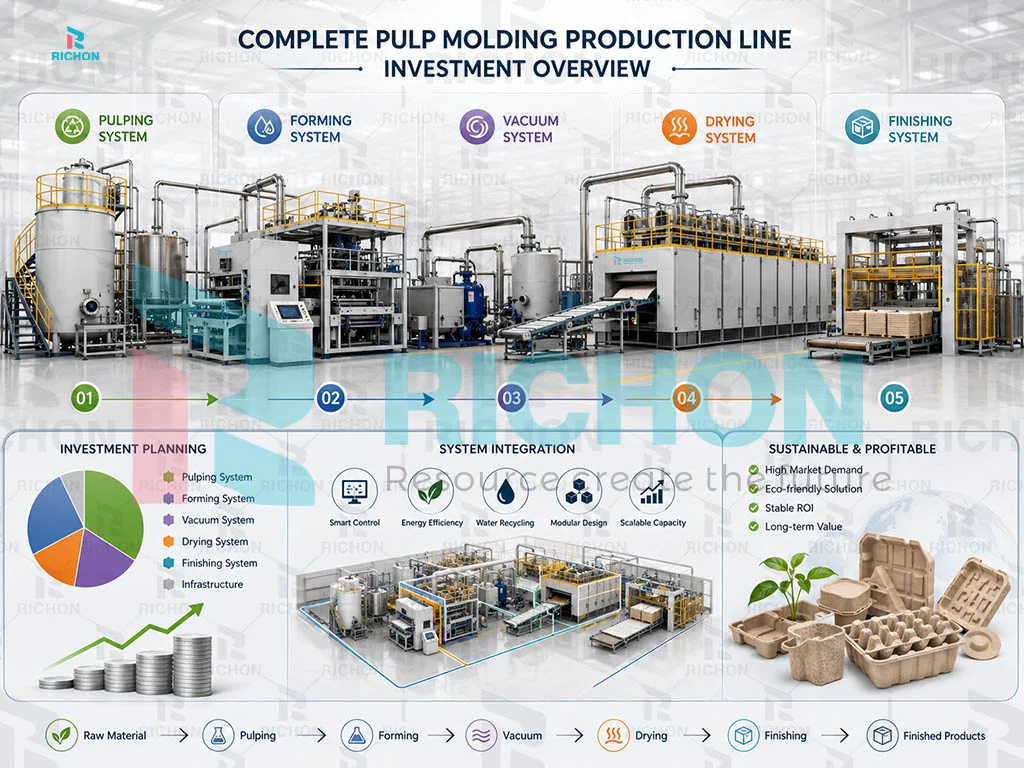
Build the Production Line Around the Finished Product
The equipment list should follow the customer’s actual product, required production and quality requirements. This prevents a low machine-only quotation from being mistaken for the complete capital requirement of the project.
Main Capital Investment Components
Not every project needs exactly the same configuration. These are the main production and project scopes that should be checked when building a complete industrial pulp molding budget.
Equipment and process scope required to prepare fiber and supply pulp to the forming section.
Main forming equipment configured according to product size, mold arrangement and required production.
Forming, transfer, hot pressing and optional trimming tooling according to the actual product.
Vacuum generation, dewatering support and related process water-handling requirements.
Drying configuration selected around wet-product output, product requirements and project conditions.
Additional shaping or trimming processes when required by the customer’s finished-product specification.
Electrical and production-control systems matched to the final equipment configuration.
Layout, utilities and other site-related preparation that may sit inside or outside the equipment quotation.
Forming Equipment Purchase
This view focuses on the main forming machine and may exclude important systems required to convert raw fiber into an acceptable finished product. It should not automatically be treated as total project CAPEX.
Complete Production Investment
This view evaluates the forming machine together with tooling, process systems, drying, finishing and site requirements needed to achieve the customer’s required finished-product output.
Confirm What Is Included—and What Is Separate
Equipment suppliers can define project scope differently. A useful quotation should clearly state whether items outside the core machine package are included, optional or the customer’s responsibility . This is especially important when estimating the real amount of capital required before production can start.
What Determines Industrial Pulp Molding Operating Cost?
Operating cost is determined by the actual molded fiber product and local production conditions—not by machine purchase price alone. Product weight, raw material, electricity, drying, labor, maintenance and production efficiency all affect the ongoing cost of manufacturing.
There Is No Universal Operating Cost per Hour or per Product
Industrial pulp molding operating cost depends on the customer’s actual product weight, mold cavities, cycle time, operating hours, fiber price, electricity tariff, drying method, local energy price, labor and maintenance conditions. These variables must be calculated using the same product and production basis before a meaningful OPEX figure can be produced.
This formula describes recurring production expenses. Tooling and machine investment belong to the capital-investment side of the project and can be allocated separately when calculating a fully loaded cost per finished product.
Main Industrial Pulp Molding Operating Cost Components
The relative importance of each item changes with product design, local utility prices and the selected production configuration.
Fiber consumption is strongly influenced by the weight and specification of the finished molded product.
Calculation input: product weight + fiber priceElectricity is used by forming, vacuum, pulping, pumps, controls and other electrical equipment in the configured line.
Calculation input: actual operating load + electricity tariffDrying cost depends on how much moisture must be removed, operating hours and the selected drying method.
Calculation input: drying load + local energy priceWater use and additive cost depend on the pulp recipe, process management and finished-product requirements.
Calculation input: actual process consumptionLabor cost depends on production organization, operating hours, material handling and the level of production integration.
Calculation input: labor arrangement + local wage levelRoutine maintenance, wear items and tooling-related service should be included in long-term production economics.
Calculation input: actual maintenance plan and operating conditionsStandard production-line configuration reference for conventional industrial molded fiber production requirements. Customized configurations can differ.
Installed Power Is Not the Same as Actual Electricity Consumption
The 54–77 kW figure describes the power range of a standard production-line configuration. It should not be read as “54–77 kWh consumed every hour.” Actual electricity use changes with equipment loading, operating sequence, vacuum demand, optional processes and real production conditions.
Raw Material Choice Changes Production Economics
Industrial molded fiber products can be made from recycled paper, OCC/cardboard, virgin pulp or mixed fiber . The appropriate material depends on the product and performance requirement. OPEX should therefore use the customer’s actual fiber specification and local purchasing cost rather than one universal raw-material price.
Drying Method Changes Long-Term Energy Cost
Drying energy should be evaluated against the required output, product quality and local project conditions. Different drying methods can produce very different capital and operating-cost structures.
Hot Pressing Adds a Product-Specific Finishing Cost
When hot pressing is required, production economics should include the press operating cycle and heating requirement. The following values are common engineering references, not fixed settings for every molded product.
Actual pressing time and process conditions must be calculated according to the customer’s product and finished-quality requirements.
What Data Is Needed to Calculate Operating Cost?
A realistic OPEX estimate should use customer-specific production and local cost data instead of generic global averages.
How Do You Calculate the Cost per Molded Pulp Product?
Cost per piece should be calculated from the real production cost and acceptable finished output . A reliable unit-cost model uses the customer’s actual product, production conditions and local raw-material, energy and labor prices.
Divide Total Production Cost by Acceptable Finished Output
The basic calculation is: Cost per Piece = Total Production Cost ÷ Acceptable Finished Output . Total recurring production cost can include fiber, electricity, drying energy, water and additives, labor and maintenance. If a fully loaded unit cost is required, allocated tooling cost can be added separately according to the project’s accounting basis.
Use Finished Output, Not Theoretical Machine Output
The denominator should represent the number of products that are actually acceptable for production use during the same accounting period as the costs being measured.
Cost period and output period must match. For example, hourly cost should be divided by acceptable hourly output, while monthly cost should be divided by acceptable monthly output.
Operating Cost per Piece
This calculation focuses on the recurring expenses required to manufacture the product during normal production.
Fully Loaded Cost per Piece
When a more complete project-cost model is required, the business can allocate tooling investment over the planned production volume or accounting period.
Which Costs Should Be Included?
The exact cost structure varies by project, but these are the main items normally considered when building a molded fiber product unit-cost model.
Calculated from finished-product weight, fiber specification and the customer’s actual raw-material price.
Based on actual operating electricity use and the local industrial electricity tariff.
Determined from the selected drying method, moisture-removal requirement and local energy price.
Uses actual project consumption and the pulp recipe required by the finished-product specification.
Includes the actual production labor arrangement and recurring maintenance cost for the selected line configuration.
Used when tooling investment is allocated across a planned production quantity or accounting period for fully loaded costing.
Unit Cost Depends on Product-Specific Capacity
Industrial pulp molding machines do not have one universal pieces-per-hour value for every packaging product. Mold cavities, cycle time and realistic operating efficiency must be evaluated for the actual product.
First Define What “One Product” Means
Product counting affects capacity, mold quantity and cost-per-piece calculations. Multi-part industrial protective packaging should therefore be defined before the economics are modeled.
One independently molded tray is normally counted as one finished molded product in the production calculation.
A top and bottom packaging set is generally evaluated as two molded products because each component normally has its own product geometry and tooling requirement.
If product height, structure and mold layout allow a suitable combined output arrangement, the project can be calculated accordingly after engineering review.
What Data Is Needed for a Cost-per-Piece Calculation?
A useful model combines actual product data, production output and local operating prices rather than relying on generic industry averages.
How Should You Compare Industrial Pulp Molding Machine Quotations?
Two industrial pulp molding quotations can show very different prices while describing apparently similar equipment. The correct comparison starts by checking whether both proposals use the same product, production basis, tooling scope and project boundary .
Compare Technical Scope Before Comparing the Final Price
A valid quotation comparison requires the same molded fiber product, the same realistic production target and the same included equipment scope. Confirm mold cavities, cycle basis, tooling, vacuum, drying, finishing, electrical scope and project responsibilities before deciding which quotation represents the lower total investment.
Start With the Technical Basis, Not the Bottom-Line Price
Industrial molded fiber equipment is customized around the customer’s actual product. Two apparently similar quotations may therefore be based on different assumptions.
Before comparing price, ask: “Can both proposed systems manufacture the same finished product at the same realistic output and quality requirement?”
Confirm dimensions, structure, product weight if known and finished-quality requirements.
Check cavities, cycle time and operating-efficiency basis used to calculate output.
Confirm forming, transfer, hot pressing and optional trimming tooling where applicable.
Confirm what process systems are included around forming and dewatering.
Compare drying type, required throughput and whether the drying system is included.
Check whether hot pressing, shaping or trimming is needed and included.
Compare electrical and control requirements using the same production-line boundary.
Confirm supplier and customer responsibilities for site, logistics and implementation items.
Example Quotation Scope Comparison
The table below does not represent specific suppliers. It shows how a buyer can identify whether two quotations provide enough technical detail to be compared on the same basis.
| Comparison Item | Scope Not Clearly Defined | Scope Clearly Defined | Buyer Should Confirm |
|---|---|---|---|
| Product Basis | Generic product description | Customer-specific product data | Same dimensions, structure and quality? |
| Capacity | Headline pcs/h only | Cavities + cycle + operating basis | How was production calculated? |
| Forming Machine | Machine model only | Configuration matched to product | Same forming basis and scope? |
| Forming Mold | “Mold” not defined | Forming tooling scope defined | Quantity, cavities and material? |
| Transfer Mold | Not specified | Included / requirement defined | How is the wet product transferred? |
| Hot Pressing Mold | Not specified | Requirement clearly defined | Is hot pressing required? |
| Trimming | Not mentioned | Optional requirement stated | What edge quality is required? |
| Vacuum System | General statement only | Process scope defined | What equipment is included? |
| Drying | Dryer not specified | Drying configuration defined | Type, throughput and energy scope? |
| Electrical Scope | One power number only | Equipment boundary explained | Which systems are included? |
| Installation / Site | Responsibility not stated | Supplier / customer boundary stated | What additional CAPEX remains? |
Never Compare Two Output Numbers Without Checking Their Basis
Industrial pulp molding capacity is product-specific. A larger quoted pcs/h number is not automatically a higher-performing solution if the proposals use different product dimensions, cavity quantities, cycle times or operating assumptions.
Questions to Raise When a Quotation Is Not Fully Defined
These points do not automatically indicate a poor proposal. They simply mean more technical clarification may be needed before the commercial comparison is complete.
Ask which product dimensions, cavities and cycle assumptions support the quoted output.
Confirm whether forming, transfer, hot pressing and trimming requirements are covered.
Confirm whether drying equipment, throughput basis and related project requirements are included.
Clarify which site, logistics, utility and implementation costs remain outside the quotation.
What Information Does Richon Need for an Industrial Pulp Molding Cost Estimate?
A useful industrial pulp molding quotation begins with the customer’s actual packaging product. The product defines the tooling, production capacity, forming configuration, drying requirement and project scope. Detailed operating-cost data can be added later as the project develops.
Start With the Product Drawing, Dimensions and Required Production
You do not need to know every technical parameter before contacting Richon. The most useful starting information is the product drawing, sample or clear photo, main dimensions, packaging structure and target production . Product weight, operating hours, raw-material prices, electricity, drying energy and factory conditions can then be added when a more detailed investment or operating-cost model is required.
Four Basic Inputs Are Enough to Begin the Engineering Discussion
Early-stage customers should not delay an inquiry because every technical or factory detail is not yet available. The first goal is simply to define what product must be produced and how much is required.
CAD data, dimensioned drawing, physical sample or clear reference images can all help start the product review.
Length, width, height and important cavities or protective structures should be provided when available.
Single tray, insert, end cap, top-and-bottom packaging or another custom protective arrangement.
Required hourly, daily or planned annual production target provides the basis for capacity evaluation.
What Additional Information Improves the Cost Estimate?
More detailed data helps move the project from a preliminary equipment discussion toward a full investment, OPEX and cost-per-product analysis.
Used to define tooling, cavity arrangement, forming requirements and finished-quality needs.
Used to evaluate mold cavities, forming output, drying demand and the scale of the production line.
These values are especially useful when calculating OPEX, cost per piece and project economics.
Site information helps determine whether the proposed line, drying method and utility requirements are practical.
How Much Information Do You Need Before Requesting a Quotation?
The answer depends on whether you need an initial equipment discussion, a technical configuration or a full project-economics model.
Enough to begin evaluating whether the molded packaging product is suitable and what additional information is required.
Supports preliminary mold, forming, drying and production-line configuration analysis.
Supports deeper CAPEX, OPEX and cost-per-product evaluation using customer-specific assumptions.
How Product Information Becomes a Project Cost Estimate
The cost estimate follows the engineering process. Product requirements are translated into tooling, capacity, production-line and site requirements before the project budget is finalized.
Send Richon Your Product Drawing, Sample or Dimensions
Provide the molded packaging product information you already have together with the required production target. Richon can then evaluate the tooling, reciprocating forming machine, drying and finishing requirements needed for the project.
Industrial Pulp Molding Machine Cost FAQ
These answers summarize the main questions buyers ask when budgeting a customized industrial molded fiber packaging project. Final machine configuration and project cost should always be based on the actual product and production requirements.
01 How much does an industrial pulp molding machine cost?
There is no universal fixed price for every industrial pulp molding machine . The quotation depends on the actual molded fiber product, product dimensions, tooling, required production capacity, forming configuration, vacuum system, drying method, finishing requirements and total project scope.
A useful cost estimate should therefore begin with the customer’s product information rather than one generic machine-price range.
02 Why can industrial pulp molding machine quotations differ so much?
Quotations may be based on different assumptions about the finished product, mold cavities, production capacity, tooling scope, vacuum, drying, finishing, electrical systems and project responsibilities.
Before comparing prices, confirm that both quotations are based on the same product, the same capacity calculation and the same included project scope .
03 Does 54–77 kW mean the production line consumes 54–77 kWh every hour?
No. 54–77 kW is a typical standard production-line configuration power range for conventional industrial molded fiber production requirements. It is not a fixed hourly electricity-consumption figure.
Actual electricity use varies with equipment loading, operating sequence, vacuum demand, optional finishing processes and real production conditions. Customized line configurations can also have a different installed-power requirement.
04 What molds are normally required for industrial molded fiber packaging?
A typical industrial molded fiber product can require a forming mold, transfer mold and hot pressing mold . A trimming mold can also be added when the finished product requires more controlled edges or additional dimensional finishing.
The exact tooling quantity depends on the customer’s product structure, cavity layout, finishing requirements and the number of different packaging components.
05 What materials can be used for industrial pulp molding molds?
Aluminum is commonly used for industrial pulp molding tooling. Steel and copper can also be customized according to the customer’s product, tooling application and technical requirements.
Material selection should be confirmed as part of the product-specific tooling design rather than treated as one universal material standard for every project.
06 Which drying system is best for industrial molded fiber packaging?
There is no single best drying system for every project. Air or natural drying can be considered when production volume, climate, available space and drying time allow it.
Brick drying is technically possible, but Richon generally does not treat it as the preferred solution for customized industrial packaging projects where more stable production and industrial quality requirements are important.
Higher-volume or more integrated projects can use metal drying. The final choice should balance required output, product quality, factory conditions, initial investment and long-term energy cost . See the pulp molding drying system comparison .
07 How is industrial pulp molding production capacity calculated?
Capacity is product-specific and should be calculated from the actual mold and production cycle:
Pieces / Hour = Mold Cavities × 3600 ÷ Cycle Time (seconds) × Operating Efficiency
Product dimensions, mold cavities, cycle time and realistic operating efficiency must all be defined before a meaningful pieces-per-hour figure can be confirmed.
08 What information does Richon need to prepare a project cost estimate?
The best starting information is the customer’s product drawing, sample or clear photo, main dimensions, packaging structure and target production .
For deeper CAPEX, OPEX and cost-per-product calculations, additional information such as product weight, operating hours, raw-material price, electricity cost, drying-energy conditions, labor cost and factory conditions can be added later.
Customers do not need to know every technical parameter before starting the discussion.
Get an Industrial Pulp Molding Cost Estimate Based on Your Actual Product
Send Richon your molded fiber packaging drawing, sample, dimensions or product information together with the required production target. We can then evaluate the tooling, reciprocating forming machine, drying, finishing and project configuration required for your application.