

Why Are Egg Trays Taking Too Long to Dry?
Wet trays are waiting beside the forming machine. Some need longer in the dryer, while others leave with damp areas. Increasing the temperature seems an obvious response, but it may leave the underlying restriction unchanged.
Slow drying can begin before trays enter the dryer. Extra water in the wet tray, uneven wall thickness, restricted airflow, unsuitable loading or a mismatch between forming and drying can all affect the result.
Start by identifying what has changed: the product entering the dryer, the drying conditions, or the rate at which trays move through the line. The practical goal is stable output of trays that meet the agreed requirements for cooling, stacking and packing.
This guide focuses on drying time and production bottlenecks. If the main problem is cracking, deformation or sticking, use the egg tray quality troubleshooting guide for the defect-specific diagnosis and existing retest record.

1. Confirm That Drying Is the Production Bottleneck
A growing queue of wet trays shows that two stages are out of balance. It does not, by itself, prove that the dryer is too small. The forming rate may have increased, the wet trays may carry more water, or unloading and stacking may be interrupting an otherwise adequate drying process.
Compare the same tray design over a defined production window. Note the quantity delivered to drying, the quantity leaving in an acceptable condition, and where trays wait. Here, accepted output means trays that pass the agreed drying and product-quality checks. Separate normal running from startup, changeovers and stoppages.
| What you observe | What to check first |
|---|---|
| Most trays take longer than before | Changes in wet-tray condition, loading, heat supply, airflow and weather where relevant |
| The same positions remain damp | Local thickness, support contact, blocked airflow and temperature distribution |
| Drying becomes slower after loading is increased | Water load per hour, spacing, airflow obstruction and residence time |
| Trays leave dry enough, but wet trays keep accumulating | Actual drying throughput, forming input and discharge interruptions |
| Problems appear mainly after stacking | Cooling and packing conditions; follow the quality troubleshooting guide |
A complete egg tray production line should be evaluated across forming, wet-tray transfer, drying and finished-tray handling. Forming-machine speed alone does not establish the number of saleable trays the factory can produce.
2. Check the Water Load Before Changing Dryer Settings
The drying section receives both fiber and water. For the same product and required outlet condition, more water entering with each tray means more water must be removed.
Required water removal per hour = water to be removed per tray × actual trays entering per hour.
This relationship helps organize the diagnosis; it is not a dryer-sizing calculation. Dryer selection also depends on heat transfer, airflow, product geometry and operating conditions.
Compare wet-tray weight with a reliable dry-solids reference using a consistent sampling method. A heavier wet tray may contain more fiber, more water, or both. Wet weight alone cannot identify the cause. State whether moisture results use a wet basis or dry basis, and do not compare the two as if they were the same measurement. If no suitable measurement is available, label the finding as an observation.
Review changes in tray weight, wall-thickness pattern, raw material, pulp consistency during forming, vacuum performance and mold drainage. A blocked mesh or restricted drainage path can change the condition delivered to drying. See the mold technology guide for mold-side checks.
Additional dewatering may reduce the downstream moisture load, but extending it can also slow the forming cycle. Use the egg tray production process guide to review that connection before treating longer dewatering as an automatic improvement.
3. Review Residence Time, Loading and Tray Spacing Together
Residence time is the time a tray spends in the effective drying process. For a continuous dryer, it is affected by the travel path and conveyor speed. For rack or batch operation, loading, holding and unloading also affect practical output.
Slowing a conveyor can give each tray more drying time while reducing the number passing through per hour. Increasing loading can move more trays into the dryer while obstructing the air needed to dry them. Check both the outlet condition and accepted output before deciding that either change helped.
Look for trays touching or overlapping, tight spacing, blocked openings, support surfaces that shield damp areas, and interrupted movement. Record whether the problem follows a loading position or occurs across the batch.
If drying performance changed after a new tray design, heavier product or denser loading was introduced, compare those conditions with the previously stable setup. Do not apply one loading pattern to every product. Use the permitted arrangements and settings for the installed equipment.
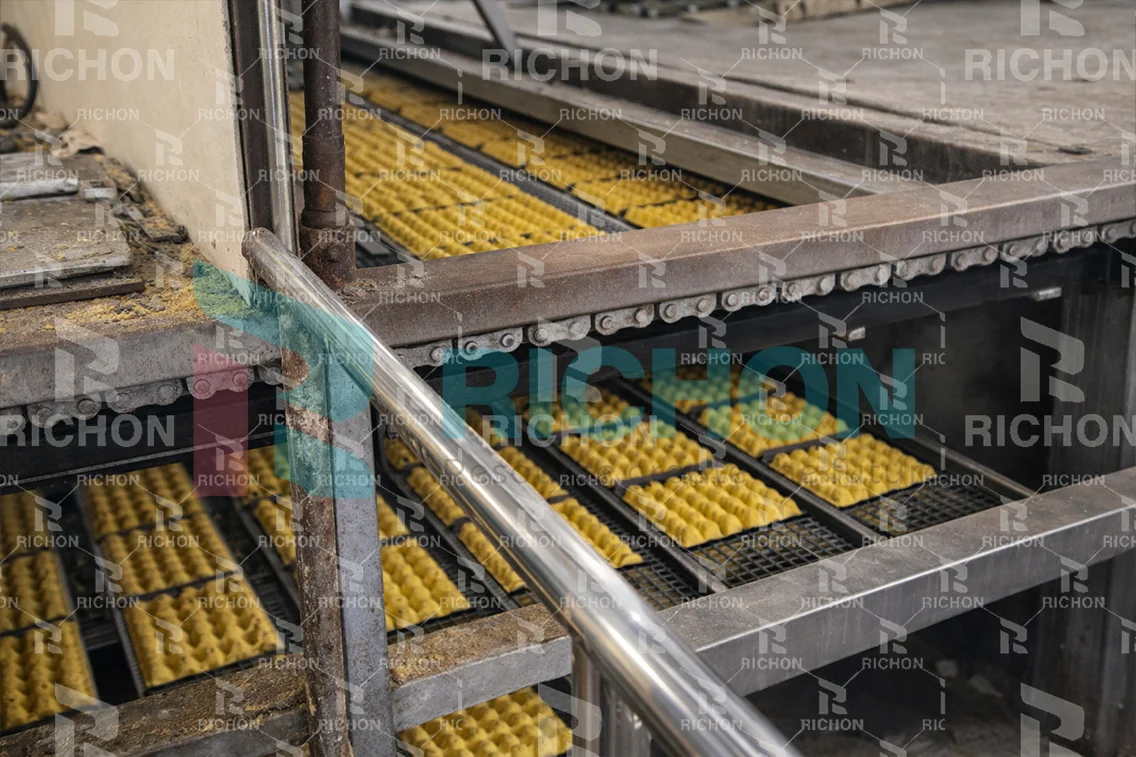
4. Check Heat Delivery, Air Distribution and Moisture Removal
For heated drying, energy supports evaporation and airflow carries moisture away from the product. A temperature reading at one sensor does not establish that every tray receives suitable drying conditions.
Where the equipment provides suitable access and measurement points, review three areas:
- Heat delivery: Has heat supply become unstable? Are the relevant zones reaching and maintaining the commissioned operating condition?
- Air distribution: Does dampness repeatedly follow one side, level or loading position? Check for obstructed paths, leakage and air bypassing the trays.
- Moisture exhaust and replacement air: Can the system remove moisture while maintaining its intended air balance? Review exhaust, recirculation and replacement-air operation together.
More recirculation is not always better: it may retain heat while also retaining moisture. More exhaust can remove moisture while increasing heat loss or disturbing the intended balance. Neither change should be treated as a universal fix.
Use the installed dryer design and approved operating procedure for adjustments. Inspection involving guards, hot surfaces, electrical equipment or moving conveyors requires the site's safe isolation procedure. Do not bypass protective controls to test a drying idea.
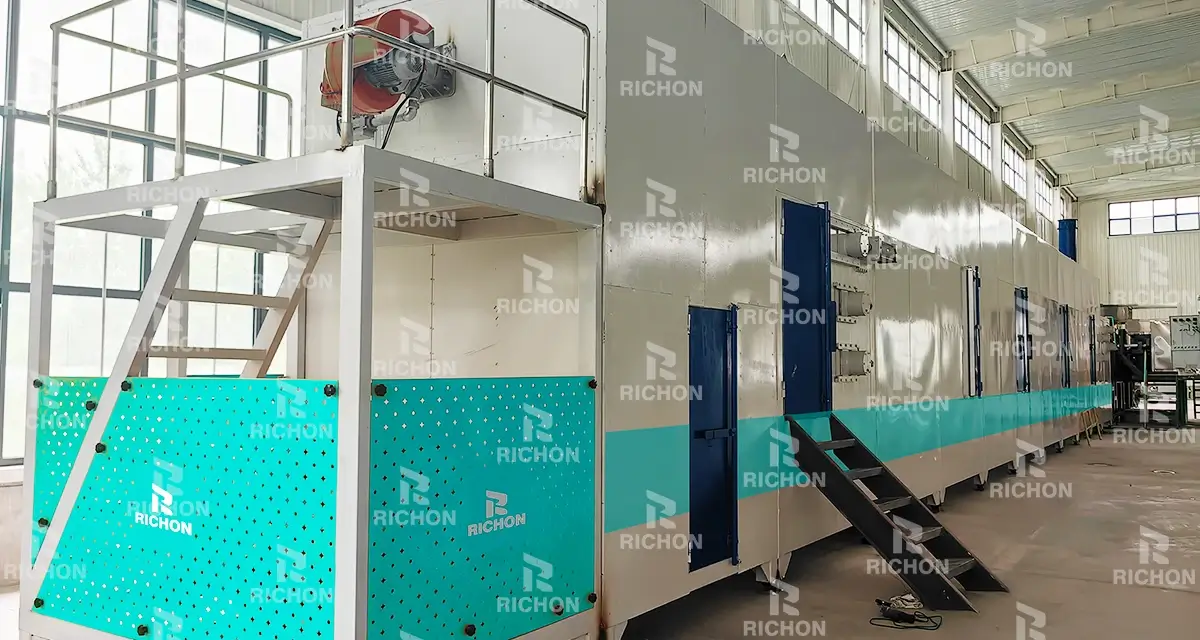
5. Adjust the Checks to the Drying Method
The same symptom can require different checks in different factories.
| Drying method | Checks relevant to slow drying |
|---|---|
| Natural drying | Weather and humidity, exposure, rack spacing, airflow access, available area and changes during the drying period |
| Brick drying | Heat-source stability, circulation and exhaust paths, leakage, loading arrangement and transfer or discharge delays |
| Metal drying | Conveyor movement, fans, air paths, doors and seals, available zones and sensors, and their operating condition |
Check only features present in the actual installation. A dryer does not necessarily have independent temperature zones or adjustable recirculation simply because it has a metal enclosure.
For selecting between methods, use the drying system comparison. If the choice has narrowed to two heated systems, the brick dryer vs metal dryer comparison explains the construction and operating tradeoffs. An operating problem should be diagnosed before concluding that a different dryer structure is required.
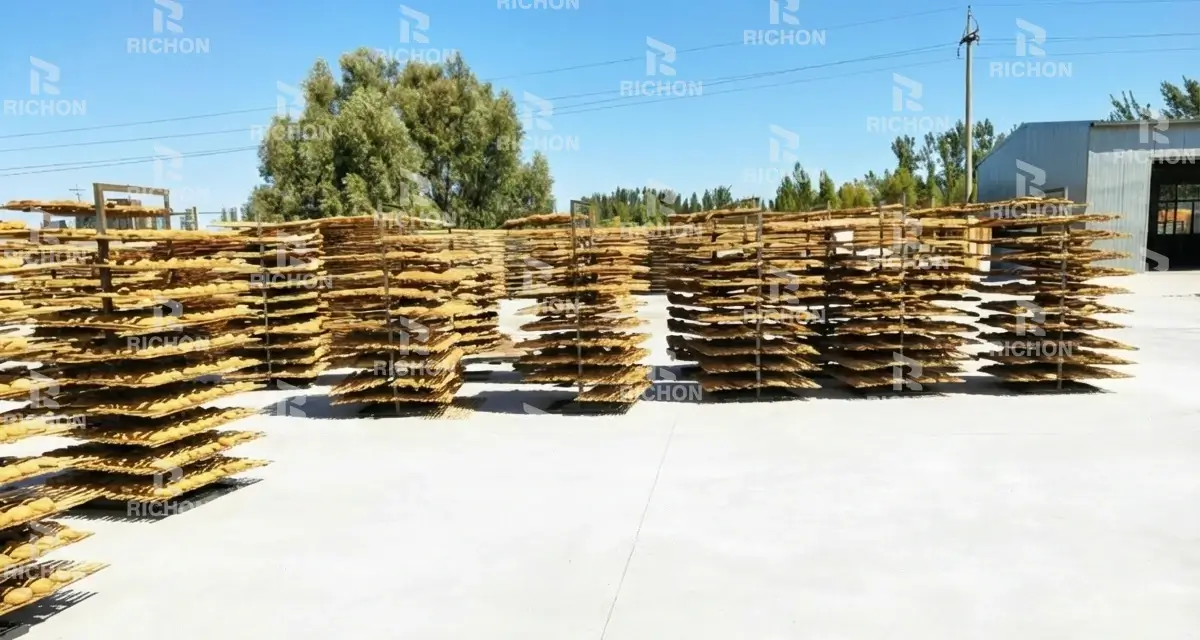
6. Judge the Change by Accepted Output and Energy Use
A shorter drying time is useful only if the trays still meet the agreed outlet and downstream requirements. Lower hourly fuel use is not necessarily an improvement if accepted output falls further.
Use a comparable tray specification and operating window. Record accepted tray quantity, rejects or trays requiring further drying, waiting time, operating hours and the available energy readings. Count each tray once when it is accepted; a second drying pass must not become a second accepted tray. Keep startup and shutdown consumption identifiable. Account for trays already inside the dryer at the start and remaining inside at the end so that delayed output does not distort the comparison. If opening and closing quantities differ materially, extend the window or repeat the comparison under comparable steady operating conditions.
For a defined, comparable measurement boundary:
Electricity per 1,000 accepted trays = measured electricity use ÷ accepted tray quantity × 1,000.
Record each fuel separately in its measured unit. Do not add electricity, gas volume and fuel mass without an appropriate conversion basis. State whether the meter covers the dryer, its auxiliaries or the whole line. If tray specification or product weight changes, a per-tray result alone may be misleading.
Make one controlled change at a time and use the existing retest method in the quality troubleshooting guide. Review the result after the system has stabilized, including cooling and stacking. No fixed energy saving can be inferred from a change in temperature, speed or airflow alone. For cost assumptions, refer to the drying system cost guide.
7. Common Questions About Slow Egg Tray Drying
Why are trays still damp when the dryer temperature looks normal?
The reading may not represent the conditions around all trays. Extra incoming water, uneven thickness, obstructed airflow, high moisture in circulating air or insufficient residence time may still limit drying. Compare the damp positions and wet-tray condition before raising the setpoint.
Should I slow the conveyor until every tray is dry?
That may help establish whether residence time contributes to the problem, within the approved operating range. It may also reduce hourly output. Check wet-tray loading and airflow, then compare accepted output and product condition rather than conveyor speed alone.
Will adding a fan solve the problem?
Not necessarily. Fan selection and air-path resistance must match the dryer. A stronger fan cannot automatically correct blocked loading, uneven distribution or an unsuitable exhaust balance. Review the existing system before adding equipment.
When should the drying capacity be reviewed?
Seek an engineering review when the confirmed product and required input rate cannot be handled consistently within the approved operating conditions, or when repeated checks do not isolate the restriction. Include wet-tray condition, actual input and accepted output, drying method, where dampness appears, and any recent product or loading change.
What information should I send to Richon?
Share the tray type, target and actual output, drying method, problem pattern, recent changes and any available operating observations. These details help distinguish a process issue from a system-matching question. Exact operating settings and any equipment changes must follow the final configuration and site conditions.
Contact Richon engineers to discuss the forming-to-drying match for your project.
Review Your Forming-to-Drying Match
Share the tray type, drying method, actual output and recent operating changes to discuss the conditions affecting your line.
- Tray type and drying method
- Actual input and accepted output
- Recent changes and damp positions
Discuss Your Drying Conditions
Operating settings depend on the final configuration and site conditions.
Contact Richon Engineers →